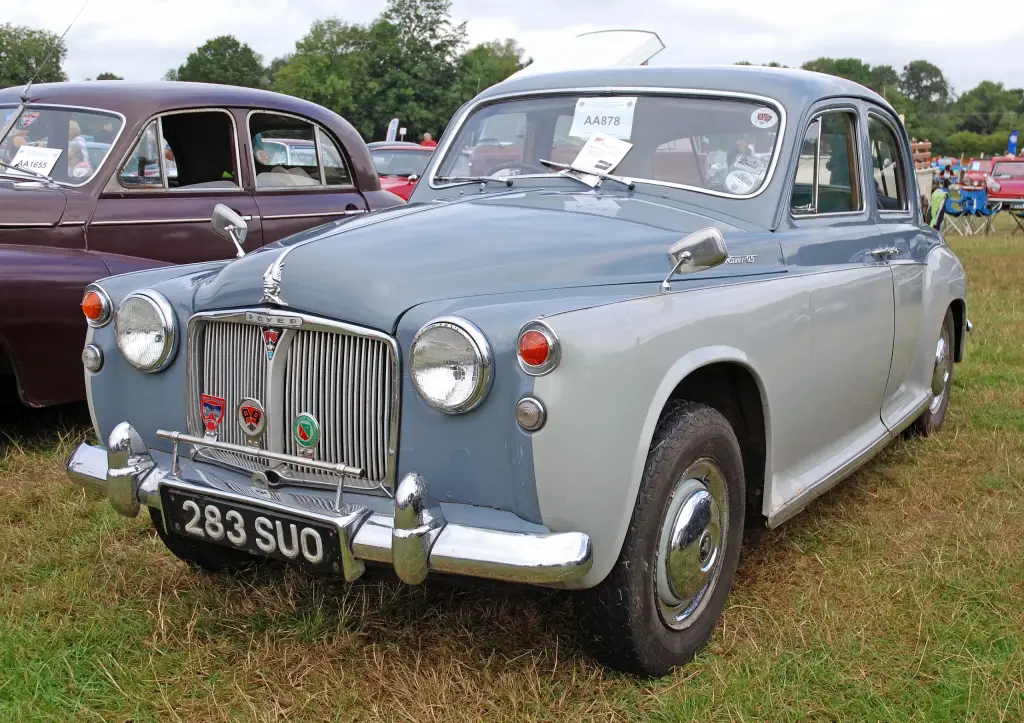
The Rover P4 series was a group of mid-size luxury saloons produced by the Rover Company from 1949 until 1964. The P4 name was factory terminology and was not used day to day by owners, who knew their cars as the Rover 75, 60, 90 or by other model names.
Rover P4 at a glance
| Production | 1949–1964 |
|---|---|
| Designer | Gordon Bashford |
| First model | Rover 75, announced 23 September 1949 |
| Range from 1953 | Rover 60 with a 2-litre four, Rover 75 with a 2.1-litre six, Rover 90 with a 2.6-litre six |
| Gearbox | four-speed manual, column change at first, floor change from September 1953 |
| Freewheel | fitted to cars without overdrive until mid-1959 |
| Chassis | separate chassis, independent front suspension on coil springs, live rear axle |
| Brakes | hydro-mechanical at first, fully hydraulic from 1950, Girling front discs from October 1959 |
| Bodies | Pressed Steel shells with Birmabright alloy doors, boot lid and bonnet, steel on the final 95 and 110 |
| Rover 75 test (1949) | 83.5 mph, 0–60 mph in 21.6 s, 27.8 mpg, £1,106 |
| Replaced by | Rover 2000 in 1964 |
Based on one source: the English Wikipedia article on the Rover P4, which covers the series and its models.
History of the Rover P4
The Rover 75 of 1949
The new Rover 75 was announced by managing director Spencer Wilks on 23 September 1949 and first displayed at the opening day of the Earls Court Motor Show on 28 September, then the only Rover in production. It had modern styling in stark contrast with the outdated P3 it replaced: gone were the traditional radiator, separate headlamps and external running boards, replaced by a chromium grille, recessed headlamps and a streamlined body the full width of the chassis, with a steering column-mounted gear lever. The styling was derived from the then controversial 1947 Studebakers, and Rover executives bought two of them and fitted one body to a prototype P4 chassis to create a development mule known as the Roverbaker. Another distinctive feature was the centrally mounted light in the grille, where most makers provided a pair; the Cyclops eye did not catch on and was dropped in the new grille announced on 23 October 1952. Power came from a more powerful version of the previous model’s 2,103 cc straight-six, now with chromium-plated cylinder bores, an aluminium cylinder head with a built-in induction manifold and a pair of horizontal instead of downdraught carburettors. The Motor tested a car in 1949 and recorded 83.5 mph, 0–60 mph in 21.6 seconds, 27.8 miles per imperial gallon and a price of £1,106 including taxes, with a 37-foot turning circle.
Three engines from 1953
After four years of a one-model policy Rover returned to a range with three engine sizes. In September 1953 it announced the four-cylinder Rover 60 and the 2.6-litre Rover 90 to join the 75’s 2.1-litre six, aiming to cater for a wider field of motorists wanting a quality car with different running costs and performance. On the same day came modifications shared by all three, including a curved central gear change lever in response to dislike of the steering column change, whose shape still allowed three people on the front bench seat, and parking lights mounted on top of the front mudguards, with the disused apertures below used for reflectors and later traffic indicators. Earlier cars used a Rover engine from the 1948 Rover 75, with a four-speed manual gearbox on the column at first and on the floor from September 1953; synchromesh was on third and top at first and added to second in 1953. A freewheel clutch, a traditional Rover feature, was fitted to cars without overdrive until mid-1959. The cars had a separate chassis with independent front suspension on coil springs and a live rear axle on half-elliptical leaf springs. Brakes were hydro-mechanical at first and fully hydraulic from 1950, and Girling disc brakes replaced drums at the front from October 1959. Complete body shells were made by Pressed Steel with aluminium and magnesium alloy doors, boot lid and bonnets, which dented easily if the handle was not used; steel was substituted for the final 95 and 110 models. The P4 was one of the last British cars to use rear-hinged doors.
An Auntie Rover
The cars became part of British culture as the Auntie Rovers, and were driven by royalty including Grace Kelly and King Hussein of Jordan, whose first car was a 1952 Rover 75. The series was supplemented in September 1958 by the new Rover 3-litre P5, but it stayed in production until 1964, when it was replaced by the Rover 2000.
Design and features
- Studebaker-inspired styling: a full-width streamlined body that shocked Rover traditionalists in 1949.
- Cyclops eye: a single central grille light, dropped in 1952.
- Freewheel: a traditional Rover feature fitted to cars without overdrive until 1959.
- Alloy panels: Birmabright doors, bonnet and boot lid, replaced by steel on the final models.
Rover P4 versions
- Rover 75 (1949): the 2,103 cc six that started the series.
- Rover 60 (1953): the 2-litre four-cylinder model below the 75.
- Rover 90 (1953): the 2.6-litre six at the top of the range.
- Rover 95 and 110: the final models, with steel panels instead of alloy.
The P4 was replaced by the Rover P6 and sat below the larger Rover P5. More cars are in the Rover collection.
Sources
- Rover P4, English Wikipedia: the Rover 75, the 1953 range and the engineering