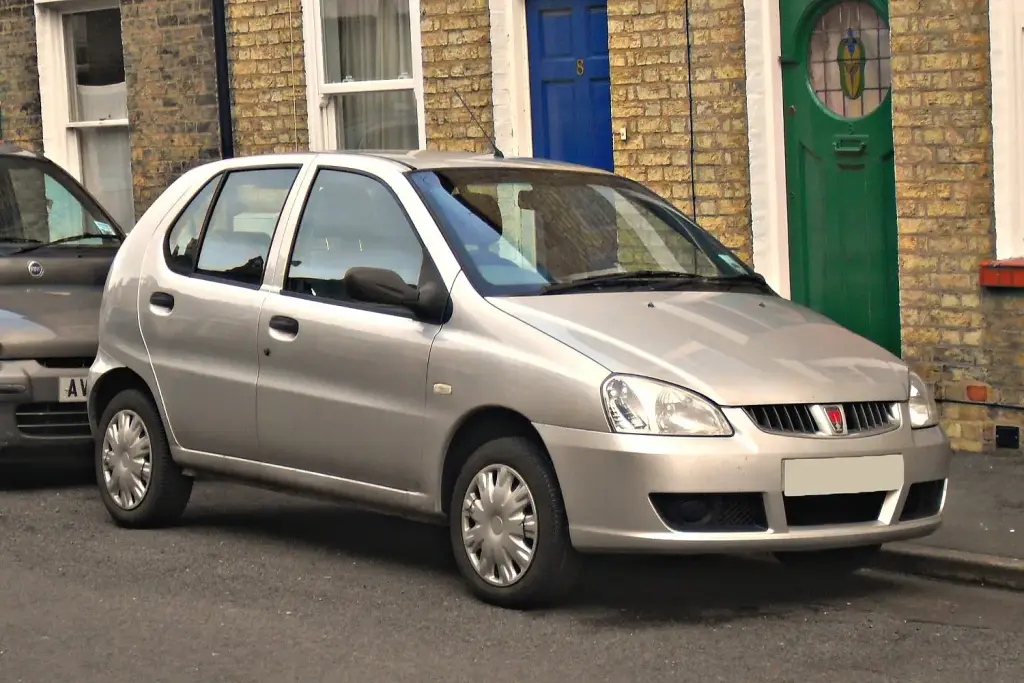
The Rover CityRover was a supermini marketed by MG Rover under the Rover marque between 2003 and 2005. Launched in the autumn of 2003, it was a rebadged version of the Indian Tata Indica, and production ended in April 2005 when MG Rover fell into administration.
Rover CityRover at a glance
| Production | 2003–2005 |
|---|---|
| Launched | autumn 2003 |
| Based on | Tata Indica, built by Tata Motors in Pune, India |
| Engine | 1,405 cc four-cylinder eight-valve, Peugeot-derived, 85 bhp |
| Torque | 88 lb·ft (119 N·m) |
| Acceleration | 0–60 mph in 11.9 seconds |
| Top speed | 100 mph (161 km/h) |
| British changes | new bumpers, Rover badge grille, 14-inch wheels and new suspension settings |
| Starting price | £6,495 |
| Price cut | £900 in December 2004 |
Based on one source: the English Wikipedia article on the Rover CityRover.
History of the Rover CityRover
A rebadged Indica
The CityRover was offered with only one engine: a Peugeot-derived 1,405 cc four-cylinder eight-valve unit producing 85 bhp (63 kW) and 88 lb·ft (119 N·m). It could accelerate to 60 mph in 11.9 seconds and reached a top speed of 100 mph. The car was manufactured by Tata Motors at its factory in Pune, India, and alterations for the British market included new bumpers, a Rover badge grille, 14-inch wheels and new suspension settings. Its performance was considered poor for a small car in contemporary road tests, and its lack of quality, poor road handling and high price were not well received.
Safety equipment
The high driving position and large glass area gave good all-round visibility, and the rear lamps were mounted high on the structure so other road users could see them more prominently. All doors had anti-intrusion bars with child locks on the rear doors, the steering column was collapsible, and a driver-side airbag was standard on all models, with a passenger airbag standard on the top trim and optional on the entry and mid-range trims. All seats had anti-submarine ramps and three-point seatbelts, with pretensioners and height-adjustable head restraints in front, and ABS was included on Style models.
Prices and criticism
MG Rover was reported to be paying Tata £3,000 for each car, and with a Rover corporate nose and revised suspension settings the buying public was not impressed by the £6,495 starting price. In May 2004 Rover refused to lend a CityRover to the motoring show Top Gear to test, so James May went undercover and test drove one at a dealer with a hidden camera, saying afterwards that it was the worst car he had driven on the programme. Sales were well short of MG Rover’s targets, so the CityRover was upgraded for the 2005 model year with more standard equipment, and in December 2004 prices were cut by £900, confirming that the earlier prices had not been competitive. According to the reviewer Parker’s, the CityRover was the worst-rated Rover car from MG Rover, with two stars out of five, and in October 2013 Top Gear Magazine placed it on its list of the thirteen worst cars of the last twenty years. Production ceased in April 2005 along with the rest of the MG Rover range.
Design and features
- Tata origins: built in Pune as a rebadged Indica, with Rover bumpers, grille and suspension.
- Single engine: a Peugeot-derived 1,405 cc eight-valve unit of 85 bhp.
- Safety kit: anti-intrusion bars, a collapsible steering column and a standard driver’s airbag.
- High seating: a raised driving position and large glass area for visibility.
Rover CityRover versions
- CityRover (2003–2005): the single model range, with ABS on Style trim.
- 2005 model year: an upgraded version with more standard equipment.
- December 2004 price cut: £900 off, after sales fell short of targets.
The CityRover was the smallest model in the Rover collection, below the Rover 25.
Sources
- Rover CityRover, English Wikipedia: engine, equipment, prices and criticism