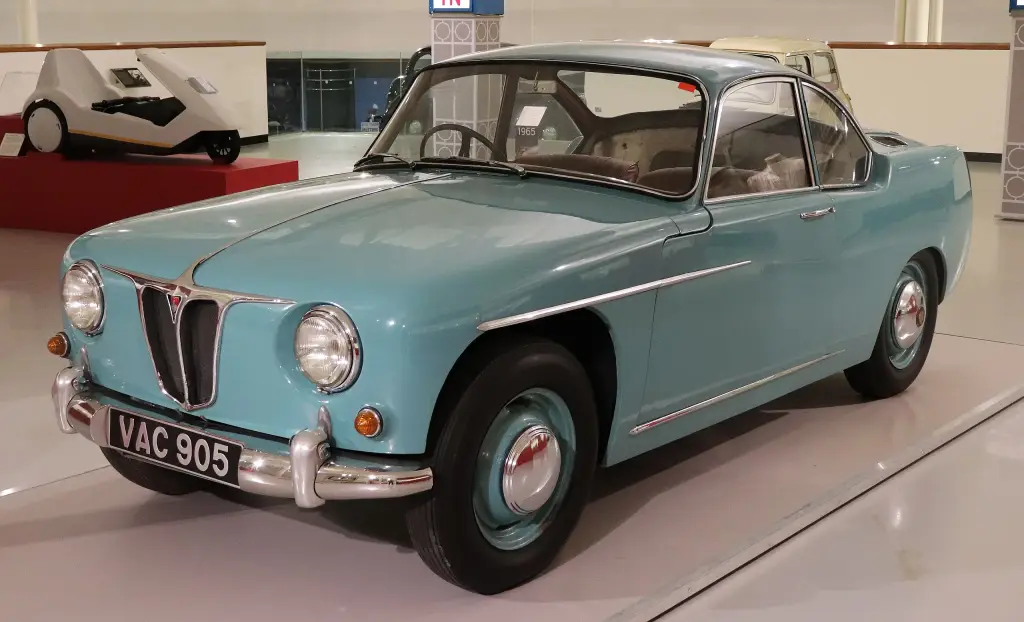
The Rover T3 is a gas turbine-powered coupé developed in the 1950s by the Rover Company and launched at the Earls Court Motor Show in November 1956. It was Rover’s third turbine car, designed by Charles Spencer King and Gordon Bashford, and it showcased Britain’s leading role in developing the technology.
Rover T3 at a glance
| Launched | Earls Court Motor Show, November 1956, stand 153 |
|---|---|
| Designers | Charles Spencer King and Gordon Bashford |
| Predecessor | Rover JET1, a two-seater convertible of 1949–1950 |
| Engine | modified Rover 2S/100 gas turbine, single combustion chamber |
| Compressor | single centrifugal compressor, up to 52,000 rpm |
| Output | 110 bhp, 100 mph (161 km/h) |
| Drive | four-wheel drive, De Dion tube rear suspension |
| Brakes | inboard Dunlop discs all round |
| Body | blue glass-fibre coupé |
| Controls | two pedals, one to accelerate and one to brake |
| Today | part of the BMIHT collection at the British Motor Museum, Gaydon |
Based on one source: the English Wikipedia article on the Rover T3, which also describes the T3 base unit development car.
History of the Rover T3
Rover’s third turbine car
Rover had begun developing gas turbine passenger vehicles after the Second World War, and its first attempt was the Rover JET1, a two-seater convertible of 1949 and 1950. The T3 was the third of the line, designed by Charles Spencer King and Gordon Bashford, and it was launched at the Earls Court Motor Show in November 1956 on stand 153, an occasion captured on film by British Pathé.
The turbine and the chassis
The modified Rover 2S/100 gas turbine has a single combustion chamber and a single centrifugal compressor rotating at up to 52,000 rpm, with a free turbine driving the output shaft separately from the compressor turbine. The T3 kept the two-pedal operation of the JET1 prototype, one pedal to accelerate and one to brake. The engine is rated at 110 bhp and is capable of 100 mph. The chassis incorporates four-wheel drive, De Dion tube rear suspension and inboard Dunlop disc brakes all round, and the fully developed car carries a blue glass-fibre coupé body.
The T3 base unit and survival
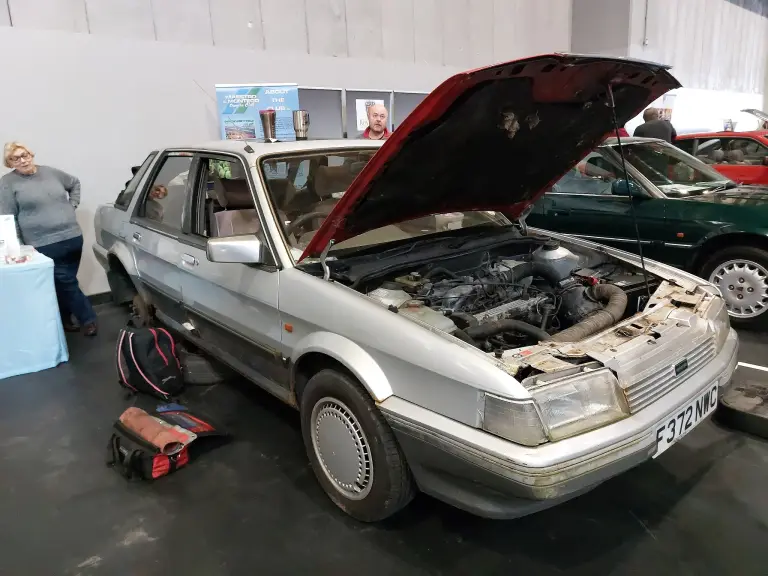
The Rover T3 base unit was a gas turbine-powered development mule built in the early 1950s as the engineering test car for the 1956 coupé. Mechanically almost identical to the finished car, it had a simple steel-panel body that allowed turbine units and other components to be changed easily, four-wheel drive, the same De Dion rear suspension and, perhaps surprisingly for a test mule, luxurious blue leather seats. It was stored for over fifty years after engineering work finished in the 1960s, and restoration began in 2018 by the same volunteers who worked on the Rover-BRM; the base unit was first demonstrated at the museum’s Gaydon Gathering in August 2022. The completed T3 became part of the BMIHT collection and has been on display at the British Motor Museum at Gaydon.
Design and features
- Gas turbine power: a 2S/100 engine with a single combustion chamber and a free power turbine.
- Four-wheel drive: unusual for a British coupé of the 1950s, with De Dion rear suspension.
- Two pedals: one to accelerate and one to brake, carried over from the JET1.
- Glass-fibre body: a blue coupé shape over a chassis with inboard Dunlop disc brakes.
Rover T3 versions
- Rover JET1 (1949–1950): the two-seater convertible that began the turbine programme.
- T3 base unit (early 1950s): the steel-bodied development mule, restored from 2018.
- Rover T3 coupé (1956): the blue glass-fibre show car at Earls Court.
The T3 was followed by the Rover P6, whose engine bay was shaped with a turbine in mind. More cars are in the Rover collection.
Video: 1956 Rover T3 Gas Turbine Coupe Prototype Up Close
Video by vintagevehicles on YouTube.
Sources
- Rover T3, English Wikipedia: the 1956 coupé, the turbine, the chassis and the base unit