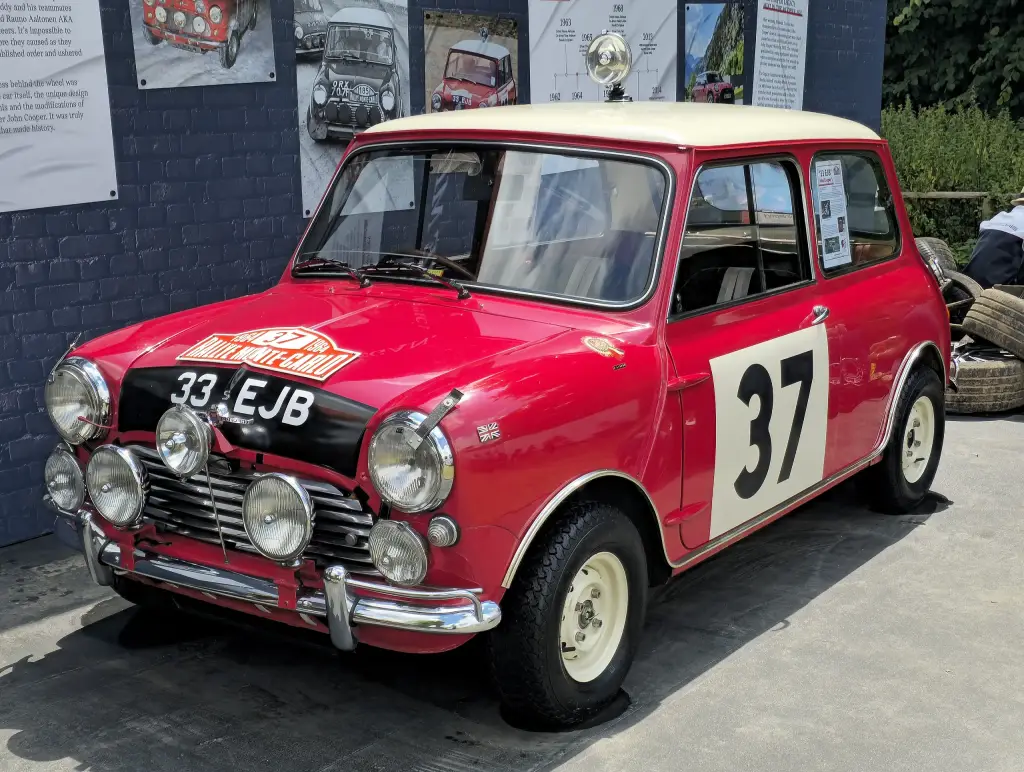
The Mini is a two-door, four-seat small car produced for four decades over a single generation. Designed by Sir Alec Issigonis, it was built by the British Motor Corporation and its successors British Leyland and the Rover Group, and in its final years it was a Rover model, made at Longbridge until October 2000.
Rover Mini at a glance
| Production | 1959–2000 |
|---|---|
| Designer | Sir Alec Issigonis |
| Layout | transverse engine, four-speed transmission in the sump, front-wheel drive |
| Names | Austin Seven and Morris Mini-Minor at first; Austin Mini from 1962; Mini as a marque from 1969 |
| Body styles | saloon, estate, convertible, van, pick-up and the Moke |
| Performance models | Mini Cooper and Cooper S |
| Rally wins | Monte Carlo Rally in 1964, 1965 and 1967 |
| Built at | Longbridge and Cowley, and under licence in many countries |
| Total built | about 5.38 million of all variations |
| End of production | Longbridge, October 2000 |
The Mini is described in the English Wikipedia article on the model as a whole; this page covers the car in its Rover Group years.
History of the Rover Mini
A car born of the Suez Crisis
The Mini came about because of a fuel shortage caused by the 1956 Suez Crisis, when petrol was rationed again in Britain, sales of large cars slumped and the market for German bubble cars boomed. Leonard Lord, head of BMC, reportedly detested these cars so much that he vowed to rid the streets of them and design a proper miniature car. He laid down basic requirements: the car should fit in a box measuring 10 by 4 by 4 feet, the passenger accommodation should occupy 6 feet of the 10-foot length, and the engine, for reasons of cost, should be an existing unit. Alec Issigonis, who had been working for Alvis, had been recruited back to BMC in 1955 to design a range of technically advanced family cars in the same spirit as his Morris Minor. Work on his largest project stopped and the smallest, XC9003, became the priority. With his team, Issigonis designed and built the original XC9003 prototype by July 1957; it was nicknamed the Orange Box because of its colour, Lord approved it for production on 19 July and the project became ADO15.
The layout that changed small cars
The ADO15 used a conventional BMC A-Series four-cylinder water-cooled engine, but mounted it transversely with the engine-oil-lubricated four-speed transmission in the sump and front-wheel drive. Drive went down to the transmission through a conventional clutch coupled to primary gears on the end of the crankshaft, which gave the characteristic transmission whine for which the Mini became famous. Almost all small front-wheel-drive cars since have used a similar configuration, although with the transmission separately enclosed rather than running in engine oil. The radiator was mounted at the left side so that the engine-mounted fan could be retained, with reversed pitch so that it blew air into the low-pressure area under the front wing; this saved length but fed the radiator with air heated by the engine and exposed the ignition system to rainwater through the grille. The space-saving layout allowed 80 per cent of the floorpan area to be used for passengers and luggage, and it influenced a generation of makers, from the Honda N360 and Nissan Cherry to the Fiat 127. In 1999 the Mini was voted the second most influential car of the 20th century, behind the Ford Model T and ahead of the Citroën DS and Volkswagen Beetle.
Names, versions and the Rover years
Initially the Mini was marketed as the Austin Seven and the Morris Mini-Minor; the Austin Seven became the Austin Mini in 1962 and Mini became a marque in its own right in 1969. The Mark I had three major UK updates, the Mark II, the Clubman and the Mark III, and within them came an estate, a pick-up, a van and the Moke buggy. The Mini Cooper and Cooper S won the Monte Carlo Rally in 1964, 1965 and 1967. The car was built at Longbridge and Cowley and under licence in Australia, Spain, Belgium, Italy, Chile, Malta, Portugal, South Africa, Uruguay, Venezuela and Yugoslavia. In 1980 British Leyland launched the Austin Metro as the Mini’s follow-up, but the Mini outlasted it and continued in production at Longbridge until October 2000, after BMW had taken ownership of the name. Retrospectively the car is known as the Classic Mini to distinguish it from the modern MINI produced since 2001.
Design and features
- Issigonis layout: transverse engine, transmission in the sump and front-wheel drive, copied across the industry.
- Space efficiency: 80 per cent of the floorpan given over to passengers and luggage.
- Rally pedigree: Cooper and Cooper S versions won the Monte Carlo Rally three times.
- Long life: one generation, four decades and about 5.38 million cars.
Rover Mini versions
- Austin Seven and Morris Mini-Minor (1959): the original names.
- Cooper and Cooper S: the performance models and rally winners.
- Clubman: the 1970s variant with a squarer front.
- Estate, van, pick-up and Moke: the other body styles.
- Classic Mini of the 1990s: the Rover Group car, still built at Longbridge until 2000.
The Mini was meant to be replaced by the Rover Metro, and its later stablemate was the Rover Streetwise. More cars are in the Rover collection.
Video: Classic Mini Production – Longbridge, UK
Video by TopGearrules on YouTube.
Sources
- Mini, English Wikipedia: origins, layout, names, versions and production