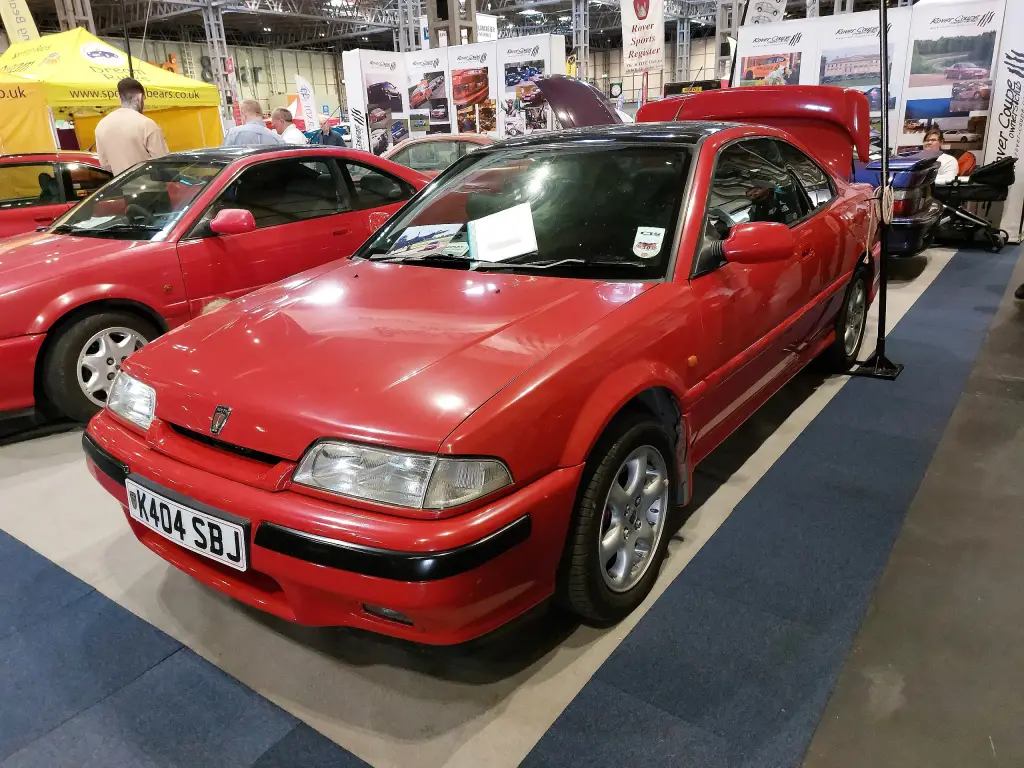
The Rover 200 Coupé was a two-door coupé based on the Rover 200 Mk II, with most of its body panels and bumpers unique to the model. It was launched on 6 October 1992 at the Paris Motor Show under the project code name Tomcat, and at its introduction the 220 Turbo Coupé was the most powerful and fastest production Rover ever built.
Rover 200 Coupé at a glance
| Production | 1992–1998 |
|---|---|
| Launched | 6 October 1992, Paris Motor Show |
| Project code | Tomcat |
| Bodies | two-door coupé, four seats |
| Roof | two glass panels in a central T-bar, removable and stowable in the boot |
| Engines | 1.6-litre Honda 111 PS; 2.0-litre T-series 136 PS; 2.0 turbo 200 PS |
| Transmission | five-speed manual; four-speed automatic only with the 1.6 |
| 216 Coupé | £14,495, 0–60 mph in 9.5 s, 120 mph |
| 220 Coupé | £16,670, 136 PS at 6,000 rpm, 127 mph, 0–60 mph in 8.2 s |
| 220 Turbo Coupé | 200 PS, 150 mph, 0–60 mph in 6.2 s |
| Renamed | Rover Coupé with new engines in 1996 |
Based on one source: the English Wikipedia article on the Rover 200 Coupé.
History of the Rover 200 Coupé
Launch in 1992
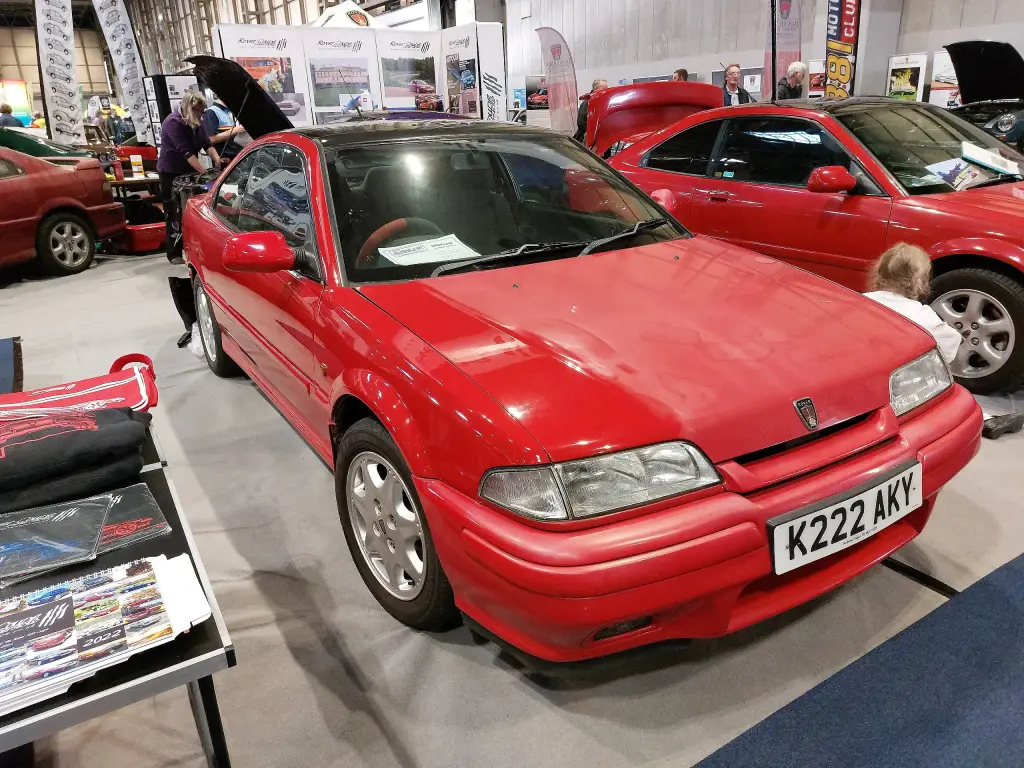
The Rover 200 Coupé was produced by Rover on the basis of the Rover 200 Mark II, but most of its body panels and bumpers were unique to the range. It was launched on 6 October 1992 at the Paris Motor Show and carried the project code name Tomcat while in development. Its lines came from a completely new monoside, new front and rear roof panels, new front and rear bumpers and a deep front spoiler extension with a large intake grille. The interior was designed for four people, with individually styled rear seats, burr walnut veneer and quality fabrics in the Rover tradition, with optional leather trim. Infra-red remote central locking was standard, and the car used the ultrasonic alarm developed for the Rover 800, giving both perimetric and volumetric protection.
The split glass roof
The coupé was equipped with a specially shaped split glass roof system with a central T-bar. The twin panels could be tilted or detached independently, and the bar itself could be removed and stowed in the boot in its own protective cover. The glass was a semi-reflective material coated with titanium, and its transmission of solar heat was limited to six per cent, which removed the need for a sun blind.
Engines and the Turbo flagship
At launch three engines gave the Coupé a broad appeal: a 1.6-litre Honda D-series unit of 111 PS, and two Rover 2.0-litre T-series engines, a naturally aspirated version of 136 PS and a turbocharged one of 200 PS. All versions had a manual gearbox as standard, with an automatic offered only with the 1.6. A specially developed version of the Torsen torque-sensing traction control system, previously used only on four-wheel-drive and some rear-wheel-drive cars such as the Maserati Biturbo, was standard on the 220 Turbo Coupé and optional for the first year on the naturally aspirated 220. Critics at the time reported that the handling was marred by the power being clumsily transmitted through the front wheels, so the dynamics fell short of its rivals. The 1.6-litre 216 Coupé cost £14,495, reached 60 mph in 9.5 seconds and 120 mph. The 220 Coupé cost £16,670 and used the 2.0-litre 16-valve T-series engine of 136 PS at 6,000 rpm, with a top speed of 127 mph and 0–60 mph in 8.2 seconds, adding rear disc brakes, anti-lock brakes, front fog lamps and leather seat borders over the 216. The 220 Coupé Turbo, flagship of the range, gave 200 PS at 6,000 rpm and 174 lb·ft, reaching 150 mph and 60 mph in 6.2 seconds. In 1994 the range gained a chrome grille to match the rest of the 200 series, along with cost-saving changes such as less leather, the loss of the ignition barrel light and no dash light dimming, and the alarm was updated. Ash Grey was the standard trim colour, with full leather available in Ash Grey or Sand Stone Beige. Over the 216 Coupé, the 220 added rear disc brakes, anti-lock brakes, front fog lamps and a boot-mounted body-coloured spoiler; a Torsen differential was an option that was deleted after the first year. The range was revised in 1996 with new engines and renamed Rover Coupé, and production ceased in 1998.
Design and features
- Split glass roof: two independently tilting or removable panels in a T-bar, with titanium-coated glass that let in only six per cent of solar heat.
- Unique bodywork: a new monoside, roof panels, bumpers and a deep front spoiler distinguished it from the 200 hatchback.
- Turbo flagship: the 220 Turbo Coupé was the fastest and most powerful production Rover at its launch.
- Rover 800 alarm: ultrasonic protection with both perimetric and volumetric sensing was standard.
Rover 200 Coupé versions
- 216 Coupé: the 1.6-litre Honda-engined model at £14,495, with an automatic option.
- 216 SE: a run-out model with a rear spoiler and front fog lamps, built to clear excess stock.
- 220 Coupé: the 2.0-litre T-series with 136 PS and rear disc brakes.
- 220 Turbo Coupé: 200 PS, 150 mph and Torsen traction control as standard.
- Rover Coupé (1996–1998): the revised range with new engines and the Rover name.
The Coupé was based on the Rover 200 hatchback, and its saloon sister was the Rover 400. More cars are in the Rover collection.
Sources
- Rover 200 Coupé, English Wikipedia: launch, glass roof, engines and prices