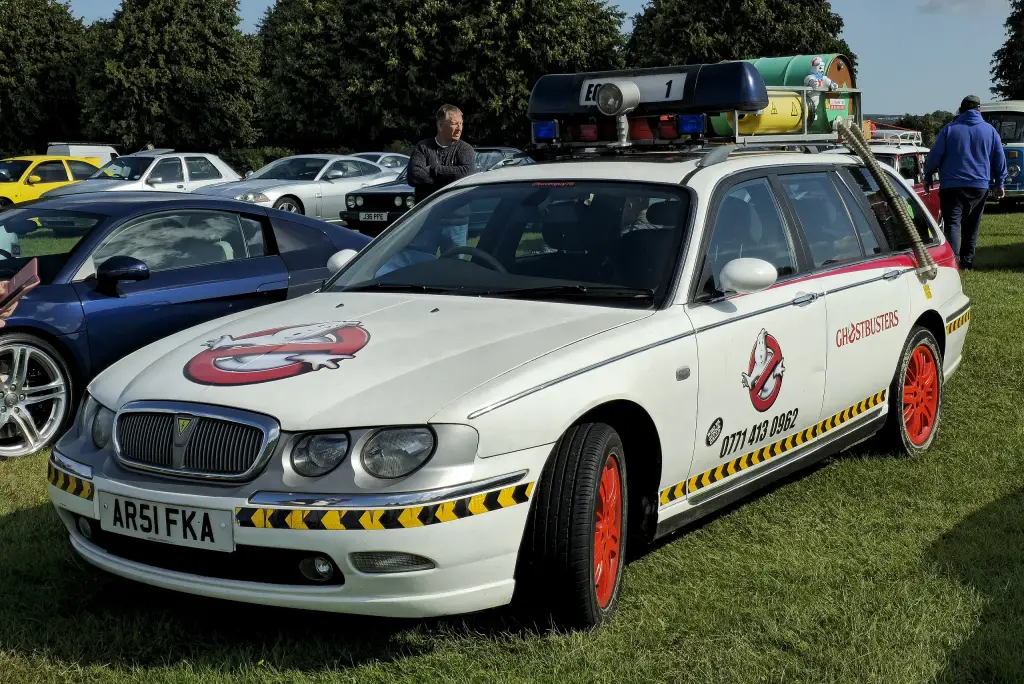
The Rover 75 was a large family and executive car manufactured from 1998 to 2005 by the Rover marque. It was built as a four-door saloon and a five-door estate, initially with front-wheel drive, later joined by a rear-wheel-drive V8 version and an extended-wheelbase model.
Rover 75 at a glance
| Production | 1998–2005 |
|---|---|
| Project code | R40 |
| Debut | Birmingham Motor Show, 20 October 1998; deliveries from February 1999 |
| Bodies | four-door saloon, five-door Tourer estate, extended wheelbase |
| Built at | Cowley until 2000, then Longbridge |
| Petrol engines | 1.8-litre K-series, 1.8 turbo, 2.0 and 2.5-litre KV6 |
| Diesel | 2.0-litre M47R common-rail, engineered by Rover and Steyr |
| Gearboxes | Getrag 283 five-speed manual or JATCO five-speed automatic |
| Suspension | MacPherson struts in front, BMW-derived Z-Axle at the rear |
| Estate | Tourer, designed by Ian Callum, from July 2001 |
| Sister model | MG ZT, launched in 2001 |
| End | 2005, when MG Rover entered receivership |
Based on one source: the English Wikipedia article on the Rover 75.
History of the Rover 75
Development under BMW
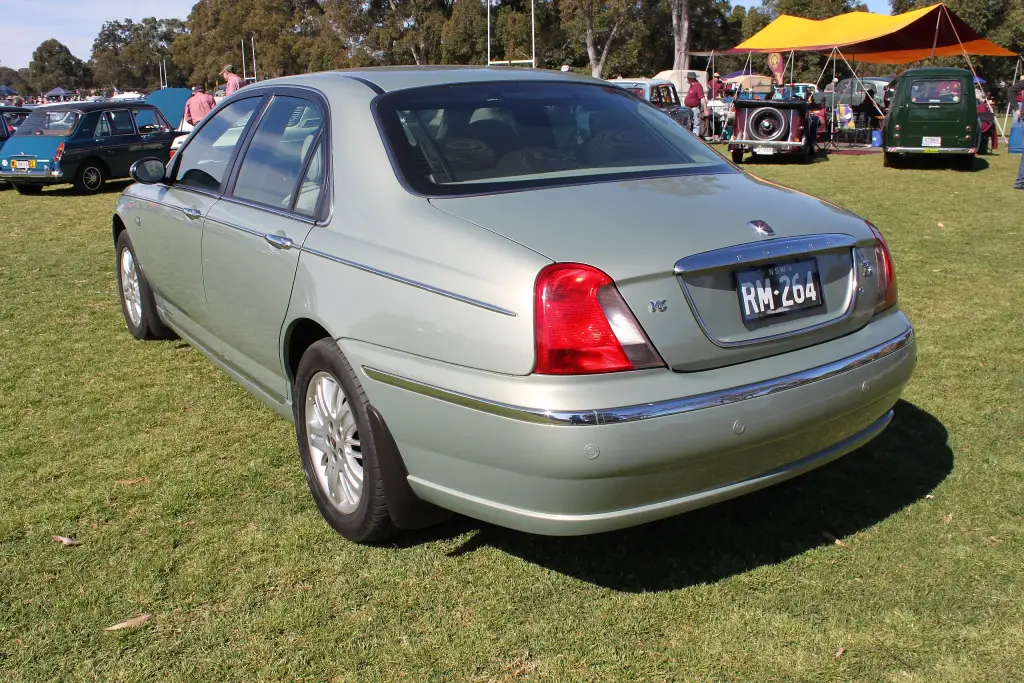
The Rover 75 began as one of three new designs for the company under the guidance of Richard Woolley: a large saloon codenamed Flagship, a smaller car codenamed Eric and the 75. Only the 75 progressed. The initial aim was to reskin the Rover 600, launched in April 1993, but after the BMW takeover in 1994 it was quickly decided that the platform would not be reused and would be replaced by an entirely new model for the late 1990s. Work on the new car, codenamed R40, continued with little operational interference from BMW; the styling received an enthusiastic response and both companies believed the classical look was the ideal direction for Rover. The design process included 3D virtual reality assembly simulations. The 75 debuted at the Birmingham Motor Show on 20 October 1998 and deliveries began in February 1999, after extensive testing by the motoring press.
Engines and chassis
The 75 had petrol and diesel engines from 1.8 to 2.5 litres. Petrol units were Rover’s four-cylinder K-series in 1.8-litre form and the quad-cam KV6 in short-stroke 2.0 or revised 2.5-litre versions; the 2.0-litre was later dropped when the 1.8-litre turbo arrived for emissions reasons. The diesel came through BMW Group channels: the four-cylinder M47R was engineered by Rover Group and Steyr for transverse mounting and differed from the M47D20 engines of the BMW 3 and 5 Series in its common-rail injection, turbocharger and temperature management. Transmissions were the Getrag 283 five-speed manual from the company’s new Bari plant or the JATCO five-speed automatic, one of the first transverse-engine applications of that gearbox. Four-wheel disc brakes were backed by a Bosch 5.7 four-channel ABS with electronic brake force distribution, and the parking brake was a cable-operated drum inside the rear discs. Suspension was by MacPherson struts in front with alloy lower L-arms, and at the rear by a version of BMW’s Z-Axle arrangement used on the 1988 Z1 sports car. The 75 won a series of international awards.
Cowley, Longbridge and the Tourer
Assembly originally took place at Cowley, but in 2000, after BMW sold the company to Phoenix Venture Holdings, production moved to Longbridge. In 2001 came the Rover 75 Tourer, developed alongside the saloon but never authorised for production by BMW, quickly followed by the MG ZT and ZT-T, more sporting interpretations with modified chassis settings and their own colour and trim. Between 2000 and 2003 the most significant change was the replacement of the 2.0-litre V6 by a low-pressure turbocharged 1.8-litre four, which helped company car drivers taxed on carbon dioxide emissions. A Monogram customisation programme let buyers order a wider range of paint finishes, interior trims and factory-fit options, and rather surprisingly the 75 was sold in Mexico, the first Rover in the Americas since the Sterling. From June 2002 a factory-approved dual-fuel petrol and LPG conversion was available in Britain on 1.8 and 2.5-litre models, developed by EcoGas Systems and Landi Renzo with MG Rover Powertrain and ordered through Rover dealers, with the three-year factory warranty retained. The Ian Callum-designed Tourer of July 2001 had an optional opening rear glass section and load space up to 1,480 mm wide and 2,060 mm long, with 400 to 680 litres behind the seats and 1,222 litres with them folded; self-levelling rear suspension and an integral load restraint system were optional.
Design and features
- BMW-era engineering: a new platform, the Z-Axle rear suspension from the BMW Z1 and a BMW-sourced diesel.
- Classical styling: the retro look that management and BMW both backed for Rover’s flagship.
- Tourer estate: Ian Callum’s 2001 estate with an optional opening rear glass.
- MG ZT: the sporting sister model with modified chassis settings.
Rover 75 versions
- 75 saloon (1998–2005): the original four-door, from the 1.8 K-series to the 2.5 KV6.
- 75 Tourer (2001–2005): the estate with 1,222 litres of load space.
- MG ZT and ZT-T (2001–2005): the sporting saloon and estate.
- V8 model: a later rear-wheel-drive version with a V8 engine.
- Extended wheelbase: a long-body version of the saloon.
The 75 replaced the Rover 600 and the Rover 800, and shared its V6 with the Rover 45. More cars are in the Rover collection.
Sources
- Rover 75, English Wikipedia: development, engines, the Tourer and the end of production