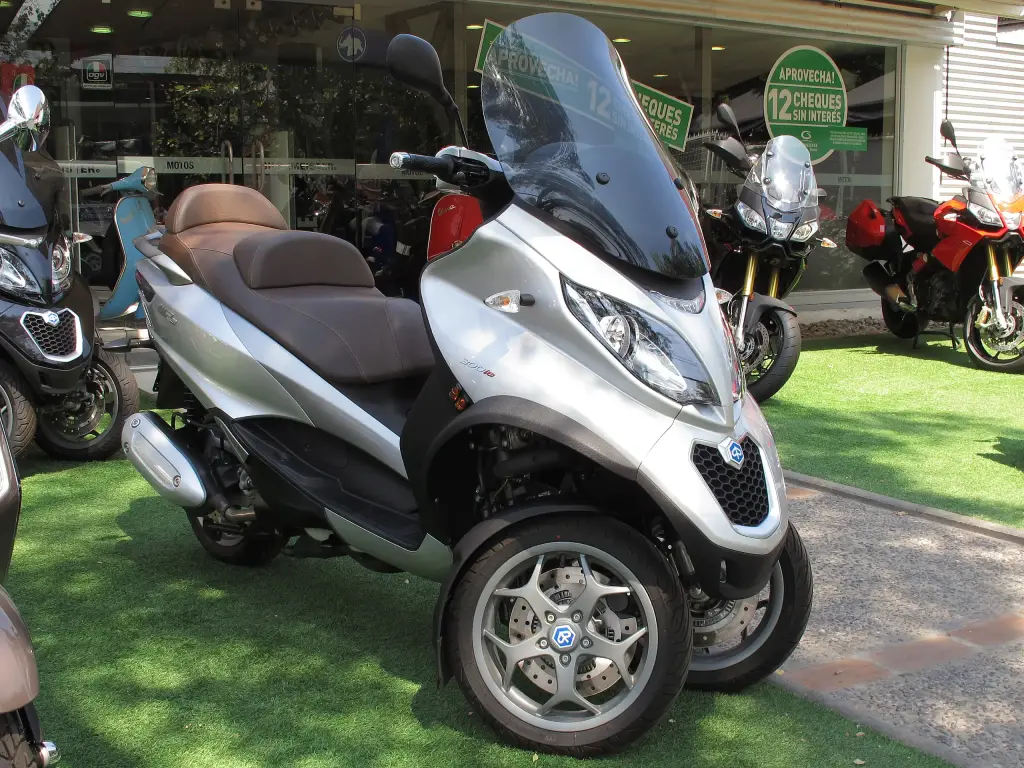
The Piaggio MP3 is a tilting three-wheeled scooter from the Italian manufacturer Piaggio, first marketed in 2006 and noted for its combination of two front wheels and a single rear wheel.
Piaggio MP3 at a glance
| First marketed | May 2006 |
|---|---|
| Layout | two front wheels, one rear wheel, tilting |
| Suspension | developed with Marabese Design; locks the front at a standstill |
| Suspension lock | manual below about 2,500 rpm, released automatically above |
| First engines | Leader 125 with 15 hp and Quasar 250 with 22.5 hp, Euro 3 |
| Later engines | Master 400 (2006), 500, 300, 350 HPE, 400 HPE, 530 HPE |
| Second generation | presented on 16 May 2014, with 13-inch front wheels |
| Third generation | June 2022, after 230,000 MP3s sold |
| Driving licence | LT versions are classified as tricycles and can be driven on a car licence |
The article is based on a single source, the English Wikipedia page on the MP3.
History of the Piaggio MP3
The MP3 was launched on the market in May 2006 in two displacements, using four-stroke engines already present on other models of the house: the Leader 125 cm3 and the Quasar 250 cm3, both liquid-cooled and Euro 3. The 125 delivers 15 hp at 9,250 rpm and the 250 delivers 22.5 hp at 8,250 rpm. In November 2006 the Master 400 cm3 version was officially presented with 34 hp, and it went on sale in the summer of 2007. In Europe the 500 cm3 version was marketed under the sporty Gilera brand as the Gilera Fuoco 500ie, while in the United States the 125 was not available and the Fuoco was sold as the Piaggio MP3 500.
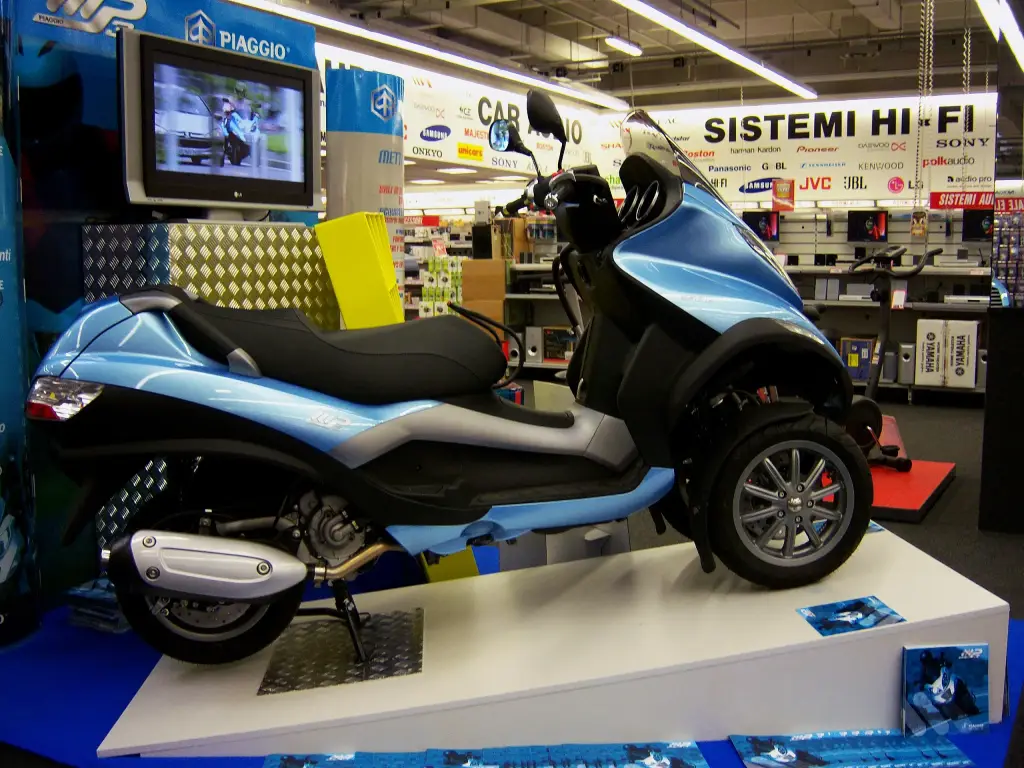
How the front end works
The three-wheel mechanism was developed by Piaggio together with Marabese Design. The MP3 can be stopped and parked without a traditional kickstand or centre stand and can be parked on irregular or side-sloping ground. The front suspension resembles the single-sided trailing arm of Vespa-style suspensions, linked by an aluminium alloy parallelogram and a central steering arm. At low speeds or at a standstill the rider keeps balance by moving forward or putting feet on the ground. The front suspension locks or unlocks with a switch just below the throttle on the right handlebar; the lock can only be activated manually at low speed or at a stop and is released automatically when engine speed exceeds 2,500 rpm. A parking brake is used with the locking mechanism, and a traditional centre stand is also provided for situations in which the suspension cannot be locked, such as a dead battery.
The LT and the licence
In June 2009 the MP3 LT 400 was launched in the UK. Its front track is slightly wider, which makes it a tricycle rather than a motorcycle, so the LT400 can be driven on a standard UK car licence instead of a motorcycle licence. The indicators moved to stalks higher up and a footbrake was added to qualify as a trike. In February 2011 the more compact MP3 Yourban was introduced.
Second generation
On 16 May 2014 the Piaggio Group president Roberto Colaninno presented the completely new second generation, which introduced the 500 LT with ABS and ASR traction control as standard, a new frame and new 13-inch front wheels. A few months later, in July 2014, the 300 model was added, and all models could be driven with a car licence. Yourban and Hybrid stayed in the price list. In July 2017 all engines became Euro 4; at EICMA 2017 Piaggio presented the 2018 range with a light front restyling, a full LED headlight and 350 HPE and 500 HPE engines, and at the end of 2018 the 300 HPE replaced the Yourban range. Reverse gear arrived in 2019 on the 500 Sport Advanced, and in May 2021 the 400 HPE replaced the 350 with 35.4 hp and 37.7 Nm, Euro 5.
Third generation
In June 2022, after 16 years and 230,000 units sold, the third generation was presented with two engines, the 400 HPE of 35.3 hp and the 530 HPE of 44.2 hp. Together with a renewed design it introduced the ARAS rider assistance system, with blind spot information and a lane change decision aid on the 530, plus a rear view camera; ABS and ASR are standard on all models.
The hybrid
In September 2009 a plug-in hybrid version was launched after trials in 2008 by the New York City Police Department. It combined a 125 cm3 Leader engine with a 2.6 kW electric motor and regenerative braking, with three user-selected hybrid modes; in electric-only mode it could cover 11 miles at up to 20 mph. A 300 plug-in hybrid with the 278 cm3 Quasar engine followed in June 2010, and all hybrid versions were discontinued in 2017.
Design and features
- Two front wheels: more grip and stability on wet or uneven roads.
- Lockable suspension: the scooter stands by itself at traffic lights and when parked.
- Car licence versions: the LT models are classified as tricycles in several countries.
- Constant updates: ABS, ASR, LED lights, keyless starting and rider assistance over the generations.
Piaggio MP3 versions
- MP3 125 and 250 (2006): the first generation with Leader and Quasar engines.
- MP3 400 Master: the 34 hp version of 2006–2007.
- MP3 LT 400 (2009): the wider-track trike for car licence holders.
- MP3 Yourban (2011): the more compact model.
- MP3 Hybrid (2009–2017): the plug-in hybrid with a 125 or a 278 cc engine.
- Second generation (2014): 500 LT, 300, then 350 and 500 HPE.
- Third generation (2022): 400 HPE and 530 HPE with ARAS assistance.
The MP3 shares its engines with conventional scooters such as the Beverly and the X9. More models are in the Piaggio collection.
Video: Piaggio MP3 500ie LT Sport Test
Video by 1000PS – die starke Motorradseite im Internet on YouTube.
Sources
- Piaggio MP3, English Wikipedia: generations, suspension, hybrid, engines