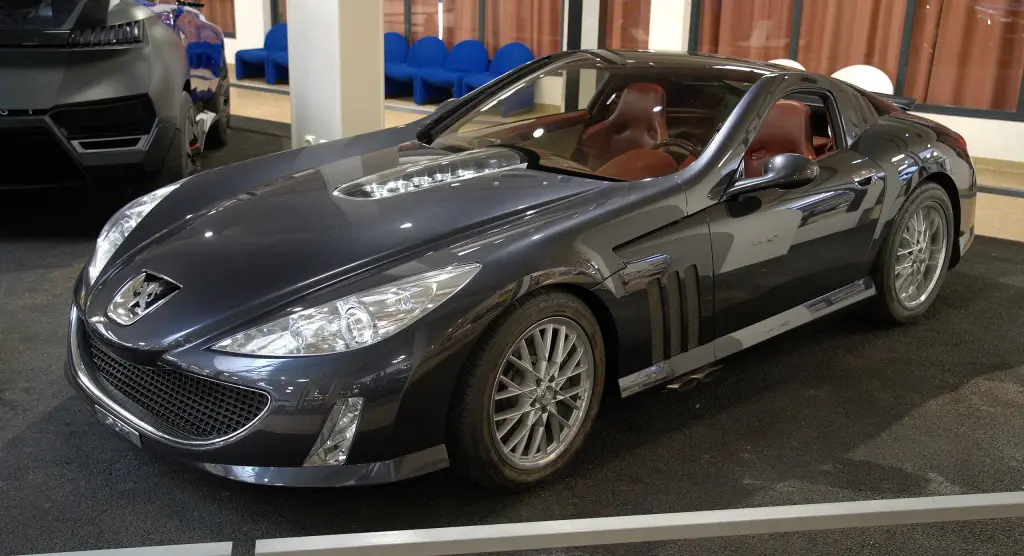
The Peugeot 907 is a concept car shown at the 2004 Paris Motor Show. It was created by styling chief Gérard Welter and designer Jean Christophe Bolle Reddat to mark the closure of Peugeot’s forty-year-old design centre at La Garenne and the opening of the new one at Vélizy.
Peugeot 907 at a glance
| Type | concept car |
|---|---|
| Shown | Paris Motor Show, 2004 |
| Designers | Gérard Welter, Jean Christophe Bolle Reddat |
| Engine | 6.0-litre V12, formed from two 3.0-litre V6 units |
| Based on | the ES9 V6 of the Peugeot 607 |
| Power | about 500 hp |
| Layout | front mid-engine, rear-wheel drive |
| Gearbox | six-speed automated manual transaxle |
| Chassis | carbon-fibre monocoque, double wishbone suspension |
| Estimated top speed | 360 km/h |
based on one short source
History of the Peugeot 907
Why it was built
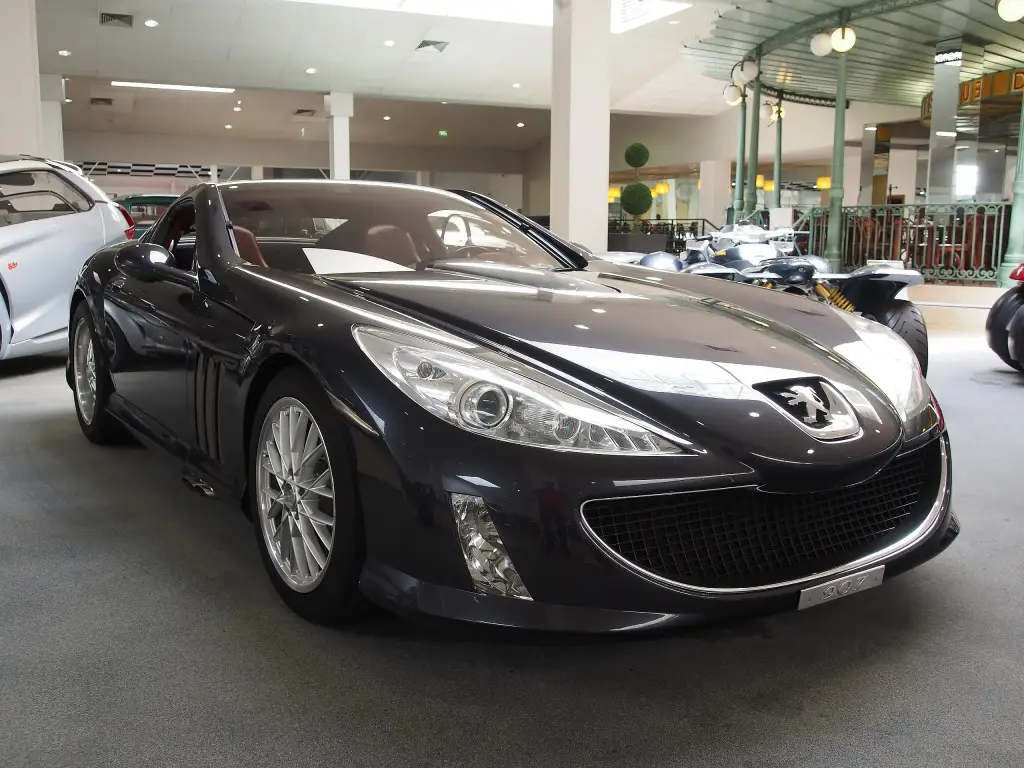
The 907 was unveiled at the 2004 Paris Motor Show as one of three Peugeot concepts there, alongside the Quark and the 1007 RC. It was created to celebrate the closure of the company’s forty-year-old design centre at La Garenne and the opening of the new centre at Vélizy. Before the reveal, Fleet News described it as Peugeot’s answer to Ferrari’s Maranello. The car was never intended for production: it was a prototype for Peugeot’s new design techniques.
The engineering
The engine sits just behind the front wheels and the exhausts exit behind each front wheel. Two 3.0-litre V6 engines are combined to form a 500 hp V12, based on the PSA ES9 unit from the Peugeot 607. The body is a carbon-fibre monocoque with double wishbone suspension all round, and a sequential-shift transmission sends power to the rear wheels through a six-speed rear-mounted automated manual transaxle. Peugeot estimated a top speed of 360 km/h and 0–97 km/h in 3.7 seconds.
Design
The car’s most obvious feature is the arcing windscreen that continues upwards to form the roof, giving the cabin a continuous glass surface. The bonnet has a see-through perspex insert that reveals the engine’s twelve intake trumpets. Unlike many concepts, the 907 can be driven like any production car.
Design and features
- V12 from two V6s: two 3.0-litre ES9 units joined to make 6.0 litres and 500 hp.
- Carbon monocoque: a lightweight structure with double wishbone suspension.
- Continuous screen: the windscreen arcs up into the roof.
- Perspex bonnet: the twelve intake trumpets are visible through it.
- Drivable concept: it runs like a production car, unlike many show cars.
Peugeot 907 versions
- 907 (2004): the single concept car shown at Paris.
The 907 uses an engine derived from the Peugeot 607 and was shown alongside the 1007 RC. More in the Peugeot collection.
Video: Peugeot 907 – DeMotores.com
Video by on YouTube.
Sources
- Peugeot 907, English Wikipedia: origin, engine, chassis, design, specifications