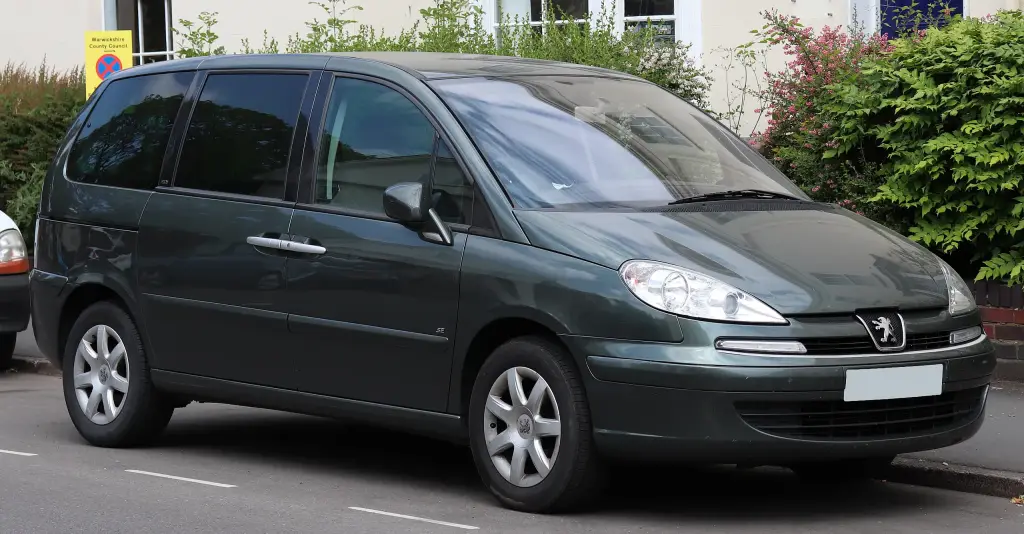
The Peugeot 806 is the Peugeot version of the first-generation Eurovans, large MPVs built from 1994 at the jointly owned Sevel Nord factory in France and sold by Citroën, Fiat, Lancia and Peugeot.
Peugeot 806 at a glance
| Production | 1994–2002 |
|---|---|
| Introduced | June 1994 |
| Class | large MPV |
| Factory | Sevel Nord, France |
| Sister models | Citroën Evasion, Fiat Ulysse, Lancia Zeta |
| Bodies | one size only, with sliding rear side doors |
| Engines | PSA XU petrol and XUD diesel, later EW and DW |
| Gearbox | five-speed manual; four-speed automatic on the 2.0 16v |
| Seats | seven, with removable middle row |
| Facelift | October 1998 |
| Replaced by | Peugeot 807, from June 2002 |
source page covers the whole Eurovan family; free photos of the Peugeot 806 were not found, the existing thumbnail stays
History of the Peugeot 806
The Eurovan project
The Eurovans were a family of large MPVs from Citroën, Peugeot, Fiat and Lancia, produced at the jointly owned Sevel Nord factory in France. The name was used by the motoring press rather than by the brands themselves. The first generation was introduced in June 1994 and the Peugeot version was called the 806. The cars were almost identical technically and visually, a prime example of badge engineering, differing in grilles, lower tailgates and lights, wheel covers or alloy wheels, badging and trim levels. They shared their mechanicals and body structure with the Sevel Nord light commercial vans: the Citroën Jumpy, Fiat Scudo and Peugeot Expert.
Unlike the Chrysler Voyager, which also came in a longer Grand version, or the Toyota Previa, the Eurovans came in one size only, although like those cars they had sliding rear side doors, a feature shared with their van siblings.
Name
The 806 was named according to Peugeot’s x0x system, in which the first digit marks the size class and the last the generation, with a central zero. The largest Peugeot series then available was the executive 605, so Peugeot chose 8 for the MPV, leaving room for a model in between. The Eurovans arrived as Peugeot was replacing its x05 models with x06 ones, so the new car became the 806.
Inside
The gear lever was mounted on the dashboard rather than on the floor, and the handbrake sat on the door side of the driver’s seat, which allowed the middle console to be removed and opened a passage between the front seats. Seating consisted of two fixed front seats, swivelling on some models, three individual removable seats in the middle row, and either two individual removable seats or a three-seat bench in the third row.
Engines and updates
The first-generation Eurovans used PSA’s XU petrol and XUD diesel engines, whichever the brand, later replaced by the PSA EW and DW families. All had five-speed manual gearboxes apart from the 2.0 16-valve EW petrol, which could be ordered with a four-speed automatic. In October 1998 the Eurovans were mildly facelifted. The second generation arrived in 2002, when the Peugeot version was renamed 807.
Design and features
- Badge engineering: one car sold as Peugeot, Citroën, Fiat and Lancia.
- Sliding doors: rear side doors that slide rather than swing, as on the vans.
- Removable seats: three individual middle seats that come out, plus an optional third row.
- Dashboard gear lever: a clean floor and a passage between the front seats.
- One size: unlike the Voyager, no long-wheelbase version.
Peugeot 806 versions
- 806 (1994): the original first-generation MPV.
- 2.0 16v automatic: the only version with a four-speed automatic.
- Facelift (1998): slightly revised car.
- Citroën Evasion, Fiat Ulysse, Lancia Zeta: the sister models.
The 806 was replaced by the Peugeot 807 in 2002, and shares its platform family with the Expert van. More in the Peugeot collection.
Video: peugeot 806
Video by on YouTube.
Sources
- Eurovans, English Wikipedia: project, first generation, engines, interior, Peugeot 806 naming