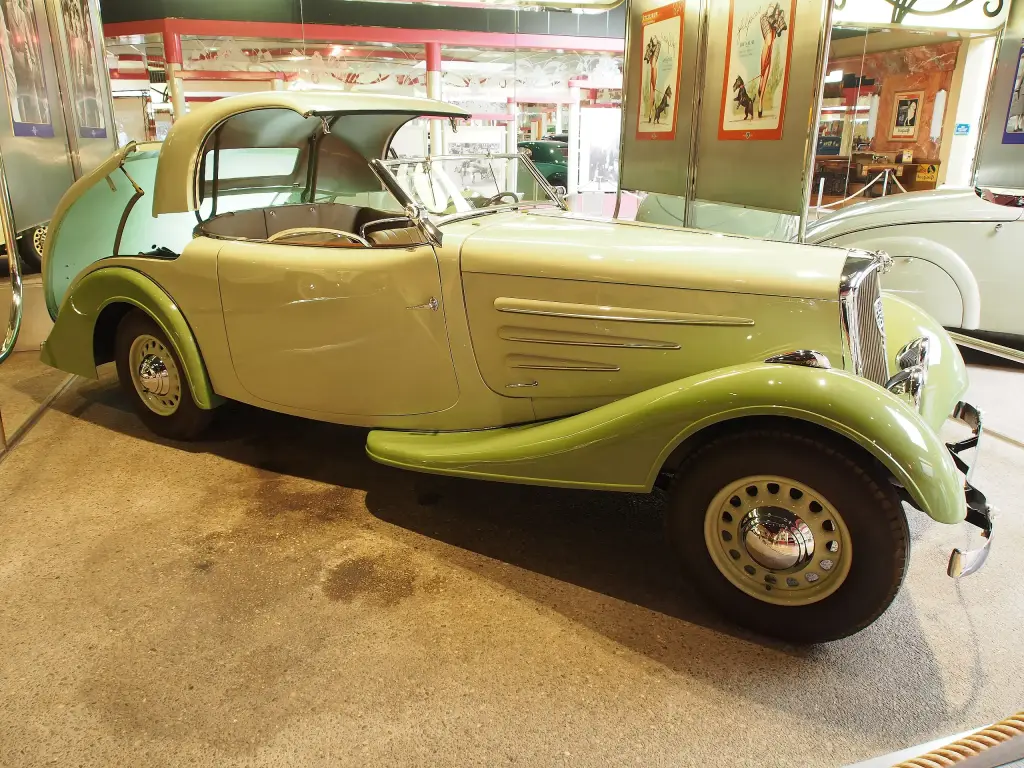
The Peugeot 601 is a range-topping car that Peugeot produced between 1934 and 1935. It had its formal launch on 5 May 1934 and marked the company’s return to six-cylinder engines.
Peugeot 601 at a glance
| Production | 1934–1935, about eighteen months |
|---|---|
| Launched | 5 May 1934 |
| Engine | 2,148 cc inline six-cylinder |
| Power | 60 hp at 3,500 rpm |
| Top speed | 105 to 110 km/h |
| Weight | 1,180 to 1,250 kg, up to 1,400 kg on long wheelbase |
| Wheelbases | 2,980 mm Normale, 3,200 mm Longue |
| Bodies | three on Normale, four on Longue, plus the Eclipse |
| Front suspension | independent |
| Total built | 3,999 |
based on one source
History of the Peugeot 601
A luxury Peugeot again
The 601 was Peugeot’s first entry into the luxury market since 1932, when the Type 183, Type 184, Type 174 and Type 176 had been discontinued, and it brought six-cylinder engines back to the range. The car was closely based on the recently rebodied 201 and 301, but the longer engine needed a longer wheelbase, so it was sold with two: 2,980 mm for the 601 Normale and 3,200 mm for the 601 Longue.
Engine and chassis
The inline six of 2,148 cc developed 60 hp at 3,500 rpm. With limited power and relatively high weight, the listed top speed was only 105 or 110 km/h depending on the body, and the car weighed between 1,180 and 1,250 kg, or 1,400 kg for some long-wheelbase versions. One feature that attracted comment was the thermostatically controlled temperature regulator for the engine oil, which worked with an oil pump to send the oil through, or away from, a heat exchanger in a chamber filled with water from the radiator. Like other Peugeots of the era, the 601 had independent front suspension.
Bodies
Three standard bodies were offered on the Normale wheelbase: a four-door Berline at 28,500 francs in the spring of 1934, a two-door four-seat Coach décapotable with a cabriolet roof at 34,000 francs of which only a handful were sold, and a two-seater Roadster that became a frequent prize winner at concours d’élégance. Four more were listed on the Longue: a six-light limousine familiale at 31,000 francs with four doors and a deep bench seat, a Berline aérodynamique with a streamlined body and a steeply raked tail more than 5,000 mm long, a two-door four-seat Coach Sport with a low streamlined look, and, from the summer of 1934, a Coach Profilé.
There was also the Eclipse, with an electrically folding metal roof. It was designed by Georges Paulin, a dentist turned car designer, built by the coachbuilder Pourtout on a chassis supplied by the Paris Peugeot dealer Emile Darl’mat, and together with the 401 Eclipse it was the first series-produced car built as a coupé-convertible with a retractable hardtop that folded under a reverse-hinged rear luggage lid. The point was made again in 1996, when Mercedes-Benz launched the SLK with a hinged steel roof and claimed a world first until Peugeot pointed out that the 401 and 601 Eclipse had used the same arrangement sixty years earlier.
End of the line
The 601 received a minor facelift for the 1935 model year, announced during the summer of 1934 only months after the launch, the most visible change being lower headlights. Sales were affected by the underwhelming engine, but 3,999 cars in eighteen months was a reasonable volume for a six-cylinder model in a crowded luxury market. Production ended in 1935, leaving a gap at the top of the range that was filled only forty years later by the 604; the 601 was Peugeot’s last straight-six, the 604 having a V6.
Design and features
- Straight six: 2,148 cc, 60 hp, the last six-cylinder Peugeot of its kind.
- Two wheelbases: Normale at 2,980 mm and Longue at 3,200 mm.
- Oil heat exchanger: thermostatically controlled engine oil temperature.
- Independent front suspension: standard, as on other Peugeots of the era.
- 601 Eclipse: the electrically folding roof by Paulin and Pourtout.
Peugeot 601 versions
- Berline: four-door saloon, 28,500 francs.
- Coach décapotable: two-door four-seater with a cabriolet roof.
- Roadster: two-seater, a concours d’élégance winner.
- Limousine familiale: long-wheelbase six-light car, 31,000 francs.
- Berline aérodynamique and Coach Sport: streamlined bodies on the long chassis.
- 601 Eclipse: coupé-convertible with a folding steel roof.
The 601 was the largest Peugeot of its day, above the 401 and the 402, and the next six-cylinder flagship was the 604. More in the Peugeot collection.
Video: Peugeot 601 en route
Video by on YouTube.
Sources
- Peugeot 601, English Wikipedia: launch, engine, wheelbases, bodies, Eclipse, production