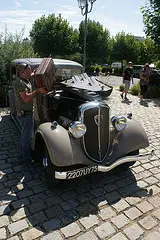
The Peugeot 401 is a mid-size model that Peugeot produced in 1934 and 1935. It was introduced at the Paris Motor Show in October 1934, shown again at the 1935 show, and out of production by August 1935.
Peugeot 401 at a glance
| Production | 1934–1935, 79 Eclipses |
|---|---|
| Introduced | October 1934 Paris Motor Show |
| Position | between the 301 and the 601 |
| Engine | 1,720 cc four-cylinder side-valve |
| Power | 44 hp at 3,500 rpm |
| Models | 401 D, 401 DL, 401 DLT |
| Body styles | eleven, mostly saloons |
| Eclipse | coupé-convertible by Pourtout, electric folding roof |
| Eclipse size | 4.67 m long, 1.52 m tall, 1,293 kg |
| Eclipse top speed | about 100 km/h |
based on one source; no free photographs of the model were found, the existing thumbnail stays
History of the Peugeot 401
A short life
The 401 was introduced at the October 1934 Paris show and displayed again at the 29th Paris show in 1935. It appeared in a full-page Peugeot advertisement in L’Argus on 10 October 1935 and then vanished from the price list only three months later, at the start of 1936, as the company cleared an inventory backlog: production had already stopped in August 1935, less than a year after the launch.
The car
The 401 was powered by an enlarged version of the engine from the smaller 301 and sat between that model and the range-topping 601. Its four-cylinder side-valve engine displaced 1,720 cc and produced 44 hp at 3,500 rpm. The range included the 401 D, 401 DL and 401 DLT, and although most cars were saloons, the model was offered with no fewer than eleven different body styles.
The Eclipse
The limited-production 401 Eclipse of 1934 was the first series-produced car built, by the coachbuilder Pourtout, as a coupé-convertible with a retractable hardtop that could be moved and stowed under a reverse-hinged rear luggage lid. The earliest known retractable roof had been patented in 1922 by Ben P. Ellerbeck and fitted to a Hudson Super Six, but the Eclipse was the first series car with an electric folding metal roof.
Peugeot was unsure what to call it: its catalogue used both “coupé transformable electrique” and “cabriolet metallique decouvrable”, while the system was simply called Eclipse by its inventor and designer Georges Paulin. The car was built on the chassis of a standard 401 D and was the longest and lowest of the 401 models at 4.67 m long and just under 1.52 m tall, weighing 1,293 kg. The engine was rated at 12 taxable horsepower, roughly equivalent to 50 to 60 hp, enough for about 100 km/h. Seventy-nine 401 Eclipses were made, and Pourtout and Paulin also built Eclipse bodies on the 301 and 601 chassis supplied by the Paris Peugeot dealer Darl’mat.
Replacement
The all-steel Peugeot 402, with styling considered strikingly futuristic at the time, was announced in October 1935, alongside significant price cuts on several of the previous generation of Peugeots, including the 401.
Design and features
- Eleven body styles: a wide range from a single basic chassis.
- Side-valve engine: 1,720 cc, 44 hp at 3,500 rpm.
- 401 Eclipse: the first series car with an electric folding steel roof.
- Paulin and Pourtout: the designer and the coachbuilder behind the Eclipse.
- Only one year: introduced in 1934, out of production by August 1935.
Peugeot 401 versions
- 401 D: the standard model, basis of the Eclipse.
- 401 DL: a higher specification version.
- 401 DLT: the third listed variant.
- 401 Eclipse: coupé-convertible with a retractable roof, 79 built.
The 401 sat between the Peugeot 301 and the 601, and was replaced by the 402. More in the Peugeot collection.
Sources
- Peugeot 401, English Wikipedia: production, engine, models, Eclipse