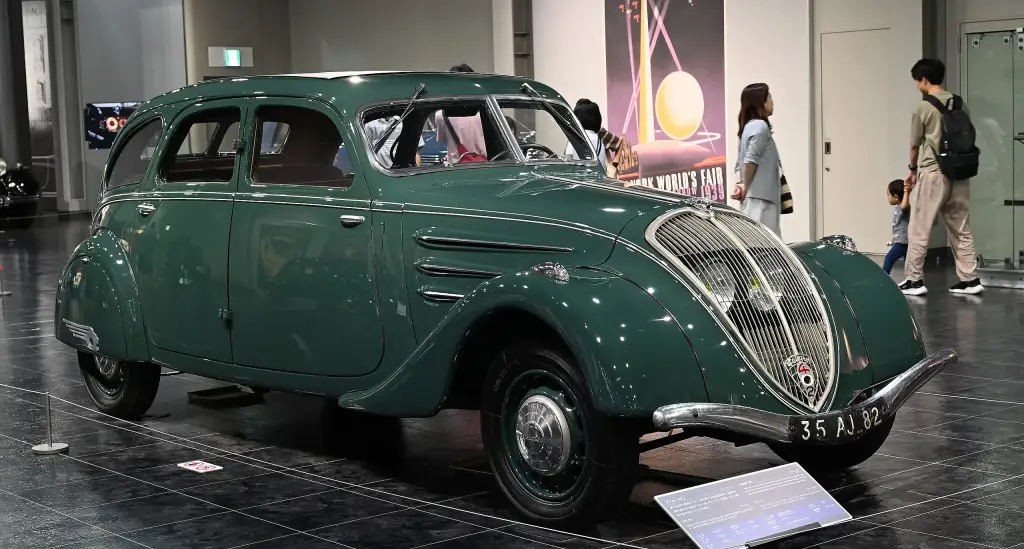
The Peugeot 402 is a large family car that Peugeot produced at Sochaux from 1935 to 1942. It was unveiled at the Paris Motor Show in 1935 as the replacement for the 401.
Peugeot 402 at a glance
| Production | 1935–1942 |
|---|---|
| Built at | Sochaux |
| Unveiled | Paris Motor Show, 1935 |
| Style | streamlined, inspired by the 1934 Chrysler Airflow |
| Headlights | set behind the grille, ahead of the radiator |
| Wheelbases | 2,880 mm short, 3,150 mm normal, 3,300 mm long |
| Body types | up to sixteen on one chassis |
| Légère (1937) | 302 body with a 1,991 cc engine, 55 hp, 11,000 built |
| Roof | 402 Éclipse with a retractable hardtop by Pourtout |
| Replaced by | 403, after the war |
History of the Peugeot 402
A streamlined Peugeot
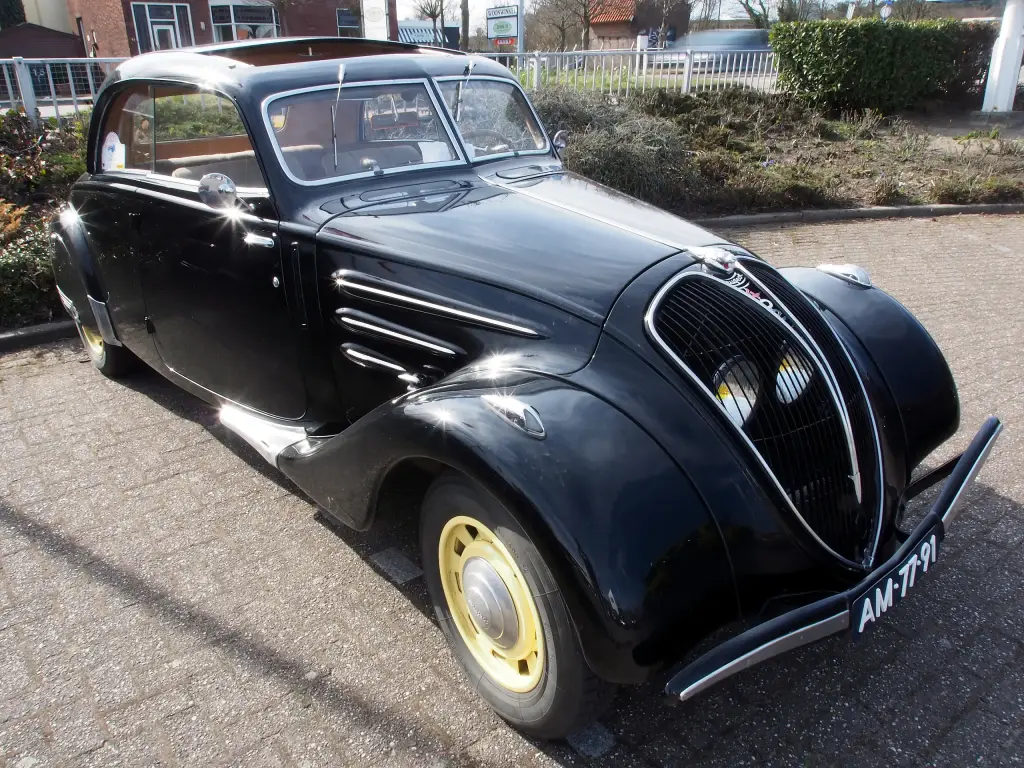
The 402 stands out in car design for its very streamlined, still somewhat Art Deco styling, strongly influenced by the 1934 Chrysler Airflow; the low-volume 402 Darl’mat coupé is often seen as distinctly Art Deco. Peugeot went two steps further than Chrysler: the grille was raked even more, and the headlights were brought to the centre, behind the grille and in front of the radiator, sixteen years before the 1951 General Motors Le Sabre concept. Unlike the Airflow, the Peugeot was not a sales flop. The car was nicknamed the “Fuseau Sochaux” in France, a reference to the spindle shape and to Peugeot’s main plant.
The 402 set the “typically Peugeot” front of the 1930s, with the lamps set well back behind the grille, and it was modelled directly on the Airflow: Peugeot bought one or two of the Chryslers and took them apart to study them. Streamlining was a feature of French design in the period, but Peugeot was among the first volume makers to apply it so thoroughly across a volume range. Recessed safety door handles, an advertised automatic transmission option and a diesel option underlined the car’s ambitions. Underneath, however, it remained conventional with a separate chassis, which made it cheaper to develop than the Citroën Traction Avant, a car that had forced Citroën to sell out to Michelin in 1934, and much easier to offer with many different bodies.
The range
Even by 1930s standards the range based on one chassis was large, reaching at one stage sixteen body types, from expensive steel-bodied convertibles to family saloons among the most spacious built in France. Because pressed steel bodies needed expensive tooling, the bodies were devised to share as many panels as possible. Advertising highlighted details such as twin windscreen wipers with their own electric motor, semaphore trafficators, a clock on the instrument panel, twin sun visors and a switchable reserve in the fuel tank.
There were three standard wheelbases, of 2,880 mm, 3,150 mm and 3,300 mm. When the car was launched there were only two; for 1937 Peugeot added the short chassis inherited from the short-lived 302 and used it for the 402 Légère. First shown in July 1937 and standing on the Peugeot stand in place of the 302 that October, the Légère combined the 302’s 2,880 mm wheelbase and body with the 1,991 cc engine of the 402, so that power rose from 43 to 55 hp and top speed from 105 to 125 km/h. About 11,000 were built. From outside it was at first almost indistinguishable from the 302, except that the starting handle hole sat below the “402” badge because the engine was slightly higher.
Eclipse and successor
The 402 Éclipse décapotable, built with the coachbuilder Pourtout, was one of the world’s first convertible hardtop production cars. The 403 that followed after the Second World War was clearly intended as the 402’s successor, but because the post-war market first needed cheaper, smaller and more frugal cars, Peugeot concentrated on the 202 and 203 during the late 1940s and early 1950s.
Design and features
- Airflow-inspired body: a streamlined shape studied from dismantled Chryslers.
- Headlights behind the grille: ahead of the radiator, a decade and a half before General Motors.
- Separate chassis: conventional underneath, which made many bodies possible.
- Three wheelbases: short, normal and long, from 2,880 to 3,300 mm.
- 402 Légère: the 302 body with the 402 engine, 11,000 built.
Peugeot 402 versions
- 402 (1935): the original range on two wheelbases.
- 402 Légère (1937): short chassis and 302 body with the 1,991 cc engine.
- 402 Darl’mat coupé: a coachbuilt Art Deco body.
- 402 Éclipse: convertible hardtop by Pourtout.
The 402 replaced the Peugeot 401, lent its body to the short-chassis 302, and was followed after the war by the 403. More in the Peugeot collection.
Video: Peugeot 402 BL 1938
Video by on YouTube.
Sources
- Peugeot 402, English Wikipedia: styling, chassis, range, wheelbases, Légère, Eclipse