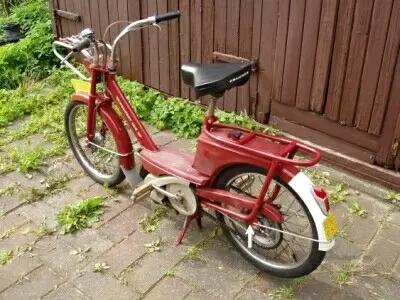
The Peugeot 102 is a moped that Peugeot launched in 1967 to succeed the BB family. It shared its design with the 101 but had the more powerful engine, and it stayed on sale as the economical model of the range until the middle of the 1980s.
Peugeot 102 at a glance
| Type | moped (cyclomoteur) |
|---|---|
| Launched | 1967 |
| Shared design with | Peugeot 101 |
| Engine | two-stroke single, 49.9 cm³ |
| Power | 1.5 hp at 5 000 rpm at launch, up to 2.4 hp (102 SP-S) |
| Clutch | automatic disc clutch, no variator |
| Transmission | belt primary, chain final |
| Carburettor | 12 mm, intake through a long horizontal tube |
| Frame | welded stamped steel |
| Wheels | 19 in, 16 in or 14 in depending on version |
| End of production | middle of the 1980s |
based on one source; no free photographs of the model were found, the existing thumbnail stays
History of the Peugeot 102
Born with the 101
The 102 arrived in 1967, in the same programme as the 101, to replace the BB range. Its peak came in the 1970s. The 103, a newer and more powerful design, gradually took its place, although the two were sold side by side for more than ten years. In the 1970s and 1980s the 102 was the cheap entry to the range, below the 103.
The engine
The 102 came from the 101 with a more powerful two-stroke engine of 49.9 cm³, 1.5 hp at 5 000 rpm, an automatic disc clutch and no variator. Transmission was by belt and chain. Intake went directly into the cylinder through a long horizontal tube connected to a 12 mm carburettor, and the engine was fixed, bolted to the frame. Over its life output rose from 1.5 to 1.75, 1.9, 2.2 and finally 2.4 hp on the last 102 SP-S models; the 1983 Peugeot catalogue listed three different engine powers for the 102 alone.
The frame was a welded pressing of stamped steel. Depending on the version the tank formed part of the diagonal tube or hung under the saddle. The engine sat low in the centre and drove a pulley-plateau through a belt, with the automatic centrifugal clutch on the left of the crankshaft and magneto ignition on the right. The rear wheel was driven by a chain through a reduction pinion. Pedals allowed the rider to start the engine on the stand and, with difficulty, to pedal the machine as the moped law required.
Versions
Like the 101, the 102 was sold with several very different bodies. The range ran through the 102 R with a front tank and 19-inch wheels and no suspension; the T with a telescopic fork and front drum brake; the MR with a 3-litre tank under the saddle and 16-inch wheels; the MT with the telescopic fork; the MS, the most complete of the early models, with a swinging arm and rear dampers; the KR and KT of 1974 with 17-inch wheels and a larger headlight; the 102 SP in KSM form from 1979, a town model with a faired fork and rear suspension; the SP série S, the sport version with a front tank like the 103; the NMR and NMT with 14-inch wheels, sometimes called the Mini 102; the City with plastic covers over both chains; and the Twenty, a modernised City with a sport fork, indicators and 15-inch tyres.
Design and features
- Stronger than the 101: the same layout with a larger carburettor and a more powerful engine.
- No variator: a simple automatic clutch, so the engine speed followed road speed.
- Fixed engine: bolted into the frame rather than swinging with the rear wheel.
- Long production life: from 1967 to the mid-1980s with continuous updates.
- Many bodies: tanks over the beam, under the saddle or in the beam, on 19, 17, 16 or 14-inch wheels.
Peugeot 102 versions
- 102 R and T: the original versions, front tank and 19-inch wheels; the T added a telescopic fork.
- 102 MR and MT: tank under the saddle, 16-inch wheels.
- 102 MS: swinging arm and rear dampers.
- 102 KR and KT (1974): 17-inch wheels and a larger headlight.
- 102 SP (1979): KSM town version and the sport S with a front tank.
- City and Twenty: plastic bodywork and, on the Twenty, a sport fork and 15-inch tyres.
The 102 was developed with the Peugeot 101 and replaced in most of the range by the 103, which was sold above it. More in the Peugeot collection.
Video: Teaser Peugeot 102 (1972) | HD
Video by on YouTube.
Sources
- Peugeot 102, French Wikipedia: launch, engine, construction, versions