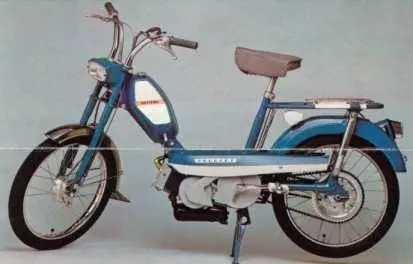
The Peugeot 101 is a moped launched in 1967 to succeed the BB family that Peugeot had sold since the 1950s. It was introduced together with the 102, a very similar machine with a more powerful engine.
Peugeot 101 at a glance
| Type | moped (cyclomoteur) |
|---|---|
| Launched | 1967 |
| Predecessor | the Peugeot BB family of the 1950s |
| Engine | single-cylinder two-stroke, 49.9 cm³ |
| Power | about 1 hp |
| Top speed | 35 km/h |
| Primary drive | belt to a large pulley-plateau |
| Final drive | chain through a reduction pinion |
| Clutch | automatic centrifugal, on the left of the crankshaft |
| Ignition | magneto and contact breaker, no battery |
| Cooling | air, finned cylinder |
| Consumption | 1.6 l/100 km (maker’s figure) |
based on one source; no free photographs of the model were found, the existing thumbnail stays
History of the Peugeot 101
A companion to the 102
The 101 was launched in 1967 as the replacement for the BB family of mopeds. It appeared at the same time as the 102, which used the same layout but had a more powerful engine, essentially through a different carburettor and intake pipe. The two machines shared their frame design and much of their cycle parts, and both were sold as the cheapest models of what became the “100” family, alongside the 103, 104 and 105.
How it was built
The frame is a welded structure of stamped steel. Depending on the version the fuel tank is either part of the diagonal tube or hangs under the saddle. The engine sits low in the centre of the frame and drives a pulley-plateau through a belt; the automatic centrifugal clutch is on the left-hand end of the crankshaft. Ignition is by magneto and contact breaker, with no battery, under a cover on the right of the crankshaft. The rear wheel, fitted with a large toothed plate, is driven by a chain through a reduction pinion fixed to that plate.
Pedals and a chainring let the rider travel in bicycle fashion, as the moped law required. They were also used to start the engine while the machine stood on its stand, and to help on hills when the small engine was not enough, despite the optimistic advertising of the period.
Versions and the end of the line
The 101 existed in several forms with very different looks: a version with a large, complex tank mounted over the front beam; a flat-beam version with the tank under the saddle and small wheels, the MR and MT; and a version with a small almond-shaped tank in the front beam, like the 103, the S and T. The model had a long career that ended in the 1980s, by which time it served as the economical bottom of the 100 range.
Design and features
- Stamped steel frame: simple, cheap to build and easy to repair.
- Belt and chain: a belt primary drive and a chain final drive through a reduction pinion.
- Automatic clutch: centrifugal unit on the crankshaft, so the rider only had to pedal away.
- Pedal start: the engine was started by pedalling with the machine on its stand.
- No battery: magneto ignition and direct lighting kept the electrical system minimal.
Peugeot 101 versions
- Large-tank version: complex tank riding over the front beam.
- MR and MT: flat beam, tank under the saddle, small wheels.
- S and T: small almond tank in the front beam, as on the 103.
The 101 was sold alongside the Peugeot 102, which had the more powerful engine, and below the 103. More in the Peugeot collection.
Sources
- Peugeot 101, French Wikipedia: launch, construction, versions, technical data