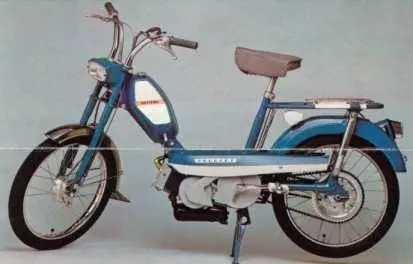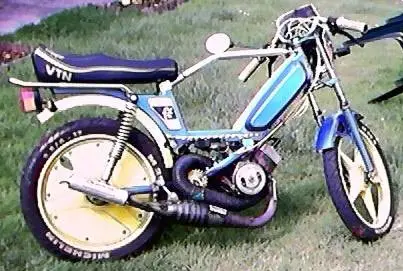
The Peugeot 103 is a moped launched in France in 1971. It was more powerful, more comfortable and more expensive than the 102, which it did not exactly replace: it sat one class above in every respect, price included.
Peugeot 103 at a glance
| Type | moped (cyclomoteur) |
|---|---|
| Launched | 1971 |
| Engine | two-stroke single, 49 cm³ (AC) or 49.13 cm³ (LC) |
| Bore and stroke | 40 × 39 mm (air), 40 × 39.1 mm (liquid) |
| Power | 1.9 hp DIN at launch, 3.3 hp at the end |
| Top speed | 45 km/h, the moped limit |
| Admission | reed valve in the crankcase |
| Transmission | variator and belt, chain final drive |
| Fuel tank | 3.7 litres, 0.5 litre reserve |
| Range | about 180 km plus reserve |
| Assembled at | Mandeure, Doubs |
| Production | 1971 to 2017 |
based on one source; no free photographs of the model were found, the existing thumbnail stays
History of the Peugeot 103
Design and launch
The 103 was designed, like the 101 and 102, under the engineer Edmond Padovani, the former technical director of the motorcycle maker Terrot, which Peugeot absorbed in 1959. Its parts were mostly made in France and assembled at Mandeure in the Doubs. The engine was a two-stroke of 49 cm³ for the air-cooled AC version, with a 40 by 39 mm bore and stroke, and 49.13 cm³ for the liquid-cooled LC, and it was restricted to 45 km/h so that it could be ridden without a licence. The 3.7-litre tank, with half a litre of reserve, gave a range of about 180 km.
The first versions included the VS, sold from 1971, which had a variator and rear suspension and could be ordered with indicators, a brake light and a horn; Peugeot’s internal documents called that form the VSC, and a two-seat saddle was offered as the VSB. Unlike the 101 and 102, the 103 used reed-valve admission in the crankcase from the start, which gave much more power and flexibility than the 102’s piston-port engine.
Engine development
Power rose from 1.9 hp DIN at the start to 3.3 hp at the end of production. The first engines had two lateral transfer ports and the same contact-breaker ignition as the 102, with two coils, one for ignition and one for lighting. Later engines received an ignition that could carry five coils, with a 15 W 6 V headlight instead of 6 W and a dedicated coil for the brake light, and then crankcases and cylinders with three transfer ports. In 1987 almost every model moved to electronic ignition, and in 2003 the lighting circuit went to 12 V. The exhaust was fixed by a flange from then on, after the threaded collars had proved fragile. Peugeot sold its first liquid-cooled 103, the SP-LC, in 1985; liquid cooling was later offered only on the SPX and RCX, and from 1996 only on the RCX.
Cycle parts and restyling
The chassis changed many times. The most important step was the short rectangular-section swinging arm of the SPX and RCX. From 1989 the five-spoke Leleu steel wheels with an 80 mm drum gave way to 17-inch Grimeca aluminium wheels with 90 mm brakes. In 1995 the range was restyled; those models took an M after their name and, from 1999, an N. They received a 5-litre tank and modified side panels, and the short swinging arm became general. That was the last major change to the 103 frame.
Decline
Faced with cheap scooters and mopeds with manual gearboxes, the 103 began to decline in the late 1990s. The SPX, one of the best known models, disappeared in 2003, and the last French-built 103 was made in 2006. The model continued to be built in Casablanca for the Moroccan market, and very similar machines were made in Turkey as the Ramzey.
Design and features
- Reed-valve engine: crankcase admission gave the 103 far more power and flexibility than the 102.
- Variator: automatic transmission that kept the engine in its useful range.
- Rear suspension: fitted from the first VS version, unlike the cheaper 102.
- Easy tuning: the model became a favourite for kits, carburettors and exhausts, the basis of a whole tuning industry.
- Long life: forty-six years in production, most of them in France.
Peugeot 103 versions
- 103 VS and VSC (1971): variator, rear suspension, optional indicators.
- 103 SP: the sport version that became the best known of the range.
- 103 SP-LC (1985): the first liquid-cooled 103.
- 103 SPX and RCX: the last high-specification models, liquid cooling on the RCX.
- 1995 restyling (M, then N): 5-litre tank, modified panels, short swinging arm.
- 103 Vogue: the long-lived simple model that carried the name to the end.
The 103 sat above the Peugeot 102 and the 101, and shared the “100” family name with the 104. More in the Peugeot collection.
Sources
- Peugeot 103, French Wikipedia: design, engine, cycle parts, decline