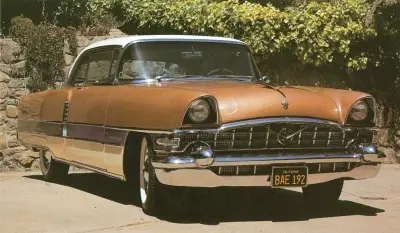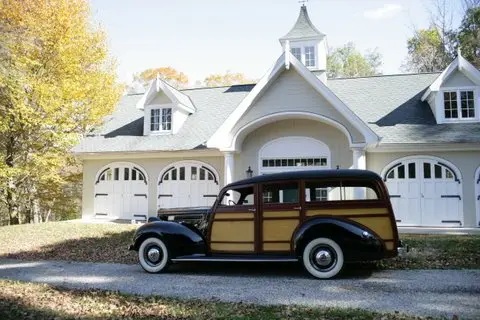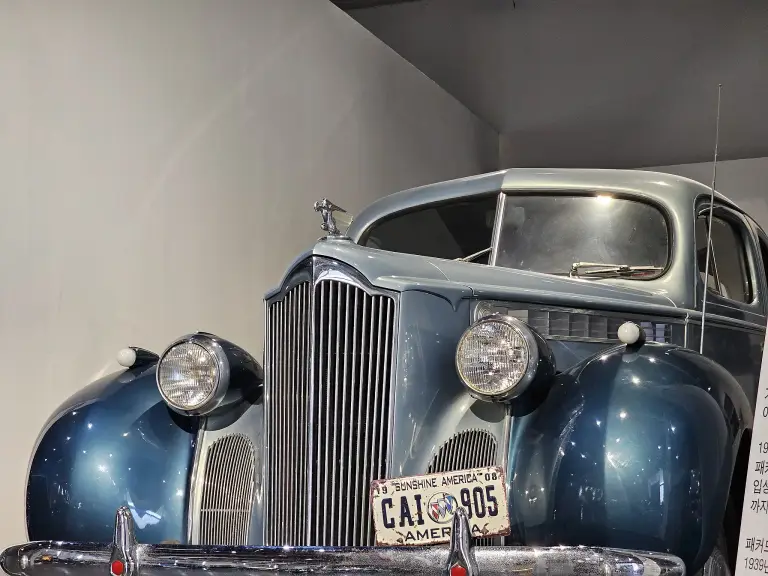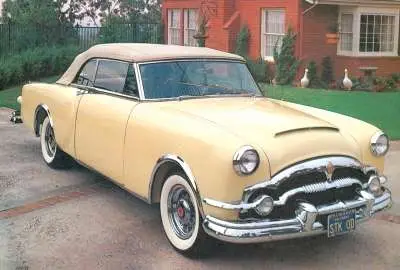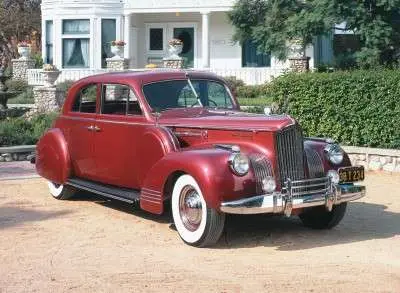
The Packard Custom Super Eight One-Eighty was introduced for 1940 to replace the Packard Twelve at the top of the range. It shared its running gear with the Super Eight One-Sixty, including a 356 cu in straight-eight advertised as the most powerful eight in America, and it was the senior car in which Packard put its most expensive ideas: air conditioning, power windows and the finest interiors it built.
Packard One Eighty at a glance
| Maker | Packard Motor Car Company, Detroit |
|---|---|
| Introduced | model year 1940 (18th series) |
| Replaced | Packard Twelve |
| Derived from | Packard Super Eight One-Sixty |
| Engine | 356 cu in (5,830 cc) straight-eight, 180 hp |
| Rival for comparison | Cadillac Series 70 V8 of 346 cu in, 150 hp |
| Firsts | air conditioning on a stock car, power windows |
| Coachwork | LeBaron L-394 and L-395 from 1937; Rollston and Brunn from 1938 |
| End | February 1942, when wartime restrictions stopped civilian cars |
| Successor in name | Custom Super Clipper, 1946–1947 |
Based on one source, the English Wikipedia article on the Packard Custom Super Eight.
History of the Packard One Eighty
The new top model
When the Twelve was discontinued after 1939, Packard needed a senior car and created one from the Super Eight: the Custom Super Eight One-Eighty of the 1940 model year. It shared the complete running gear of the Super Eight One-Sixty, including the 356 cu in (5,830 cc) inline eight that developed 180 hp. Packard advertised it as the most powerful eight-cylinder engine offered by any car maker in 1940; the Cadillac Series 70, for comparison, had a 346 cu in V8 with 150 hp.
Bodies and interiors
All Packard series in 1940 shared similar body styling, with bonnets and front wings of different lengths to suit each chassis, so the 160 and the 180 looked almost the same. The One-Eighty made up for it inside, with the best fabrics, leather and carpeting Packard had, and a special woollen headlining sewn lengthwise that no other Packard used. In the limousines the partition was built so that nothing showed when the glass was lowered, letting the owner use the car as a plain sedan — hence Packard’s name for it, the Sedan Limousine. The firm also sold LeBaron coachwork, the L-394 Cabriolet at US$4,850 and the L-395 Town Car at US$4,990 from 1937, and from 1938 Rollston and Brunn & Company added further custom bodies.
The firsts
Packard made air conditioning an option in 1940, developed with the Henney Motor Company, which had fitted air conditioning to its ambulances from 1938; it was the first time the system was offered on a stock automobile. The One-Eighty was also the first car with power windows. Henney, which had an exclusive agreement with Packard from 1937 until 1954, built the firm’s ambulances, hearses and flower cars, and its pre-war passenger cars usually carried 160 or 180 trim on the Packard 120A 156 in chassis with the smaller 288 cu in engine, though 160 and 180 versions existed too.
1941, 1942 and the Darrins
The 1941 and 1942 cars, the 19th and 20th series, had their headlamps moved into the wings, could be ordered without running boards with a rocker panel covering the chassis, and came in two-tone paint. New for 1941 was Electromatic Drive, a vacuum-operated clutch for the three-speed manual gearbox; Packard’s own Ultramatic automatic did not arrive until 1949. Designer Howard “Dutch” Darrin offered three bodies for 1940 — a four-door Sport Sedan, a four-door Convertible Sedan and a two-door Convertible Victoria — built by American Central Manufacturing in Connersville, Indiana; 59 to 72 were made in 1940, 44 or 48 of them One-Eighties. The last One-Eighties were built in February 1942, when wartime restrictions ended civilian production.
Design and features
- 180 hp straight-eight: advertised as the most powerful eight in America in 1940.
- First air conditioning: a stock-car option developed with Henney.
- First power windows: the One-Eighty had them before any other car.
- Finest interiors: special woollen headlining and the Sedan Limousine partition.
Packard One Eighty versions
- Sedan and Sedan Limousine: the standard five- and seven-seat bodies.
- LeBaron L-394 Cabriolet and L-395 Town Car: coachwork from 1937 at US$4,850 and US$4,990.
- Darrin bodies (1940): Sport Sedan, Convertible Sedan and Convertible Victoria.
- Henney-built cars: ambulances, hearses and flower cars on the commercial chassis.
The One-Eighty was derived from the Super Eight One-Sixty and replaced the Packard Twelve; its post-war successor was the Custom Super Clipper described under the Clipper. More Packards are in the Packard collection.
Sources
- Packard Custom Super Eight, English Wikipedia: 1940 launch, engine, interiors, air conditioning, Henney and Darrin bodies