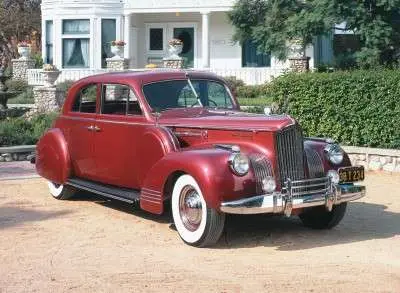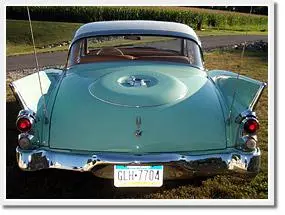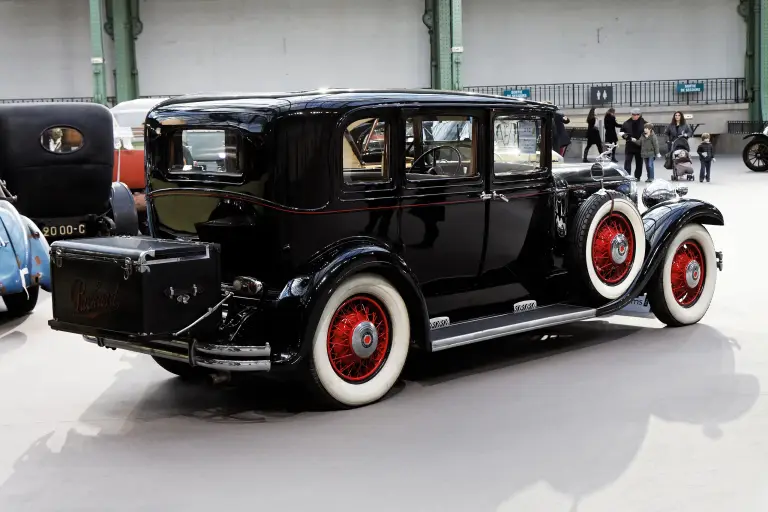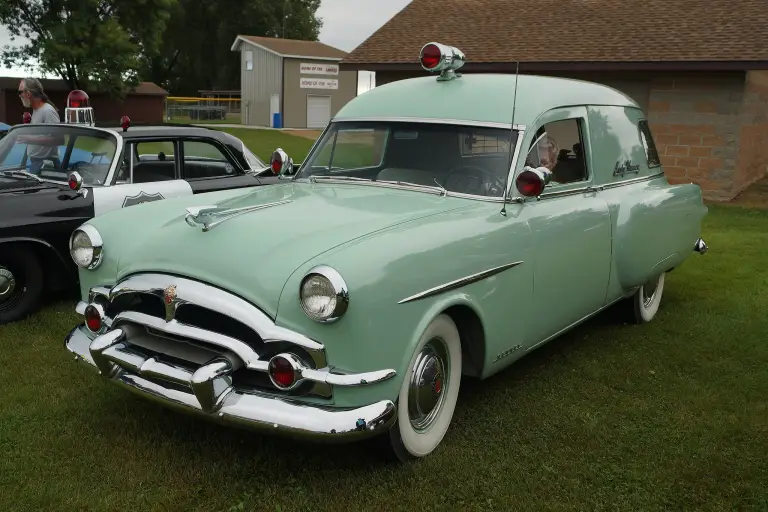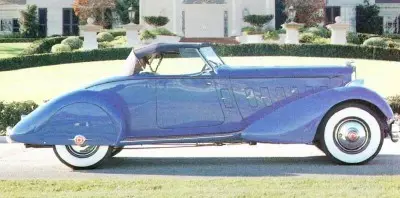
The Packard Twelve was the most exclusive car Packard built, and it existed in two separate periods. From 1915 the Twin Six was the company’s only model for most of its life and carried Packard against Marmon, Pierce-Arrow and Rolls-Royce; it returned in 1933 as the Packard Twelve, with a larger engine, coachbuilt bodies and a price to match the Cadillac V-16 and the Duesenberg.
Packard Twelve at a glance
| Maker | Packard Motor Car Company, Detroit |
|---|---|
| First generation | Twin Six, May 1915 – June 1923 |
| Second generation | Packard Twelve, 1933–1939 |
| Twin Six engine | 424.1 cu in (6,950 cc), 60° L-head, 88 hp at 2,600 rpm |
| Twin Six wheelbases | 125 in and 135 in |
| Twin Six bodies | ten styles; coupé and runabout on the 125 in chassis only |
| Twin Six production | 30,941 cars |
| Twin Six prices | US$3,050 to US$5,150 for the Imperial Limousine |
| Twelve engine | 445.5 cu in (7,300 cc), 67° V12, 160 hp at 3,200 rpm |
| Twelve wheelbases | 142 in (model 1005) and 147 in (model 1006) |
| Custom bodies | mainly by Dietrich and LeBaron |
Based on one source, the English Wikipedia article on the Packard Twelve.
History of the Packard Twelve
The Twin Six
Packard built a V12 to stay competitive with Marmon, Pierce-Arrow, Rolls-Royce, Renault and the other luxury makes of the 1910s. The Twin Six of 1916 was offered in two wheelbases, 125 in (3,200 mm) and 135 in (3,400 mm), and for four years it was the only product Packard sold, until the Single Six returned in 1921. Its 60-degree L-head engine of 424.1 cu in made 88 hp at 2,600 rpm, a large output for petrol of 40 to 65 octane. Ten body styles were offered, with coupé and runabout only on the shorter chassis. The standard paint was Packard blue with cream yellow striping, black underneath, and cream yellow wheels; brightwork was nickel plated, and a Warner speedometer and Waltham clock were standard.
Series and prices
The Twin Six was built in three series from May 1915 until June 1923, and 30,941 cars were sold at US$3,050 to US$5,150 for the Imperial Limousine. Detachable cylinder heads and larger radiators arrived in 1916, and centre-mounted gear and brake levers in 1917. A 1919 Third Series 3-25 Runabout served as the pace car at that year’s Indianapolis 500.
The Twelve returns in 1933
For 1933 Packard brought the twelve back, at first under the Twin Six name and then as the Packard Twelve to fit the rest of the range. The tenth series offered two models, the 1005 on a 142 in (3,607 mm) wheelbase and the 1006 on 147 in (3,734 mm), with a tapered frame replacing the Twin Six’s double-drop design. The V12 kept its 67-degree cylinder blocks, and with a bore and stroke of 37⁄16 and 4 in (87.3 and 101.6 mm) displaced 445.5 cu in (7,300 cc) for 160 hp at 3,200 rpm. A Bendix-Stromberg EE-3 carburettor with automatic choke, a single dry-plate clutch, a floor-shifted three-speed gearbox and a one-piece prop shaft were new.
Coachwork and rivals
The short 1005 chassis carried at least ten body styles, from a two-seat Coupe Roadster to a five-seat Formal Sedan. The long 1006 came as a Sedan or Sedan Limousine for five or seven passengers, with custom bodies mainly by Dietrich and LeBaron. Because the long-wheelbase Super Eight chassis was no longer offered, custom work was reserved for the Twelve. The car competed with the Hispano-Suiza J12, Cadillac V-16, Isotta Fraschini Tipo 8B, Duesenberg J, Lincoln K, Rolls-Royce Phantom II, Bentley 8 Litre, Mercedes-Benz 770 and Pierce-Arrow Model 53.
1934 and the Aero Sport Coupe
For 1934 the eleventh series added a third, shorter version on the 135 in Super Eight chassis. On it Packard offered an in-house Aero Sport Coupe, whose dramatic almond shape was guided by Packard stylist Ed Macauley and drawn by Count Alexis de Sakhnoffsky, and a LeBaron Runabout Speedster; only about ten of the two types were made, and just four Sport Coupes. The Twelve continued to 1939, when it was replaced at the top of the range by the Custom Super Eight One-Eighty.
Design and features
- Two generations: the 1916–1923 Twin Six and the 1933–1939 Twelve.
- Big V12: 424.1 cu in in 1916, 445.5 cu in and 160 hp in 1933.
- Coachbuilt bodies: Dietrich and LeBaron work on the long chassis.
- Racing connection: a Twin Six paced the 1919 Indianapolis 500.
Packard Twelve versions
- Twin Six 1-25 and 1-35 (1916): the first series, without detachable heads.
- Twin Six 3-25 and 3-35 (1917–1923): the final series with centre gear levers.
- Twelve 1005 (1933): 142 in chassis with up to ten body styles.
- Twelve 1006 (1933): 147 in chassis for sedans and limousines.
- Aero Sport Coupe (1934): the Sakhnoffsky-styled coupe, four built.
The Twelve was replaced at the top of the range by the Custom Super Eight One-Eighty, and it shared its frame with the Super Eight. More Packards are in the Packard collection.
Sources
- Packard Twelve, English Wikipedia: Twin Six, 1933 Twelve, bodies, engines, Aero Sport Coupe