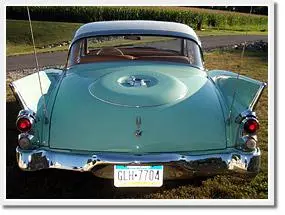
The Packard Hawk was the sportiest of the four Packard-badged Studebakers built in 1958, the last year of the marque. Under a fibre-glass nose it carried a supercharged Studebaker 289 V8 with 275 hp, which made it the fastest car ever to wear the Packard name. It was also, with 588 sold, one of the rarest.
Packard Hawk at a glance
| Maker | Studebaker-Packard Corporation |
|---|---|
| Model year | 1958 |
| Based on | Studebaker Golden Hawk 400 |
| Body | two-door five-passenger hardtop, in steel with a fibre-glass front end |
| Engine | 289 cu in (4.7 L) V8, McCulloch supercharger, 275 hp at 4,800 rpm |
| Torque | 333 lb·ft at 3,200 rpm |
| Compression | 7.5:1 |
| Transmission | Borg-Warner three-speed automatic; about 28 with three-speed overdrive |
| Wheelbase | 120.5 in (306 cm) |
| Weight | 3,470 lb (1,570 kg) |
| Top speed | 125 mph, 0–60 mph in 12.0 seconds |
| Built | 588 |
Based on one source, the English Wikipedia article on the Packard Hawk.
History of the Packard Hawk
A Studebaker with a Packard badge
By 1958 the Packard plant in Detroit had been leased to Curtiss-Wright and was about to be sold to them, and the year’s Packard models were rebadged and retrimmed Studebaker products. The Hawk was essentially a Studebaker Golden Hawk 400 with a fibre-glass front end and a modified boot lid, positioned as an alternative to the Ford Thunderbird, which was all new for 1958.
Design
Instead of the Studebaker Hawk’s upright Mercedes-style grille, the Packard Hawk had a wide, low opening above the front bumper running the full width of the car. Above it the nose and bonnet sloped smoothly, in the manner of the 1953 Studebakers but with a bulge to clear the McCulloch supercharger. At the rear the sides of the fins were covered in a metallised PET film that gave them a shiny gold appearance, and the 1953-style Studebaker boot lid carried a fake spare-wheel bulge. PACKARD was spelled across the nose, with a gold Packard script and a Hawk badge on the boot lid and fins. Detractors called the shape a vacuum cleaner or a catfish; today it is better liked than it was at the time.
Inside and underneath
The interior was trimmed in leather with full instrumentation in an engine-turned dashboard, and the padded armrests were mounted outside the windows, as on early aircraft and custom boats. Power came from the cast-iron 90-degree V8 of 289 cu in with a 3.56 x 3.63 in bore and stroke, 7.5:1 compression, a two-barrel Stromberg downdraught carburettor and a McCulloch supercharger running 5 psi, for 275 hp at 4,800 rpm and 333 lb·ft at 3,200 rpm. The electrical system was 12-volt, the brakes were power-assisted drums, and the car rode on a 120.5 in wheelbase with unequal-length front suspension and a live rear axle.
What it could do
The Hawk reached 60 mph in 12.0 seconds, ran the quarter mile in 16.7 seconds at 82.3 mph and was rated at 125 mph, with 12 mpg in town and 20 on the highway. Most cars had the Borg-Warner three-speed automatic; about 28 were built with the B-W T85 three-speed manual with overdrive. Studebaker-Packard popularised the limited-slip differential, which it called Twin-Traction, and most Hawks had it. At US$3,995 the car cost about US$700 more than the Studebaker version, with a more luxurious interior; electric window lifts and power seats were optional. Only 588 were sold, with the marque’s impending end a likely reason.
Design and features
- Supercharged 289: 275 hp and 333 lb·ft, the most powerful Packard ever.
- Fibre-glass nose: a full-width low grille opening instead of the Studebaker upright grille.
- Gold fins: metallised PET film on the sides of the tail fins.
- Twin-Traction: a limited-slip differential fitted to most cars.
Packard Hawk versions
- Hawk with Flightomatic (1958): the standard car with the three-speed automatic.
- Hawk with overdrive (1958): about 28 cars with the T85 manual gearbox.
- Golden Hawk 400: the Studebaker version the Packard was based on.
- Soft-top prototype: listed in the model’s specifications but not a production body.
The Hawk belonged to the final, Studebaker-based years of the marque, which also produced the Clipper and the Executive. More Packards are in the Packard collection.
Sources
- Packard Hawk, English Wikipedia: design, engine, transmission, performance, production