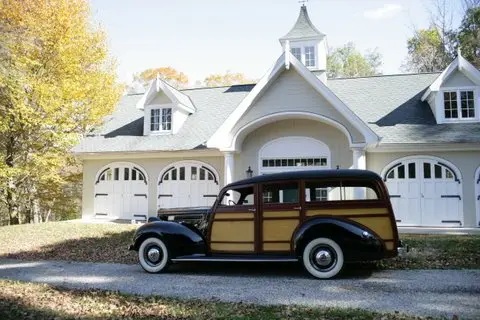
The Packard Station Sedan was Packard’s attempt at a luxury station wagon in the years after the war, when wooden-bodied cars were fashionable. It was built from 1948 to 1950 on the reintroduced Packard Eight platform, and it was neither a true sedan nor a true wagon — which is partly why it sold in modest numbers.
Packard Station Sedan at a glance
| Maker | Packard Motor Car Company, Detroit |
|---|---|
| Production | 1948–1950 |
| Platform | the reintroduced Packard Eight |
| Construction | steel subframe and steel passenger doors, with hardwood panels |
| Wood | structural panels of northern birch |
| Only wooden door | the rear gate assembly |
| Price 1950 | US$3,459 |
| Seats | two rows; the body was too short for a third row |
| Discontinued | when the 1951 Packards arrived |
Based on one source, the English Wikipedia article on the Packard Station Sedan.
History of the Packard Station Sedan
A woody without a new body
After the Second World War, wooden-bodied station wagons became popular again in America, and Packard wanted to offer one. Building a complete wagon would have meant paying for a full development programme, so instead the company took the reintroduced Packard Eight and gave it station wagon attributes with a wooden body treatment. The result was the Station Sedan, introduced in 1948.
How it was built
The car was not a wooden body on a separate chassis, as most woodies of the day were. Packard used a steel subframe and steel body parts, including steel passenger doors, and mounted structural wood panels made from northern birch onto them. The only wooden door on the whole car was the rear gate assembly. That method kept the structure rigid and the cost down, but it also meant the Station Sedan looked like a sedan with wood applied rather than a real wagon.
Why it did not sell
Because the body was shorter than those of the station wagons offered by Buick, Chrysler and Mercury, Packard could not fit the optional third row of seats that made those cars useful for large families. The Station Sedan was therefore neither a practical load carrier nor a cheaper alternative to the sedans, and it was expensive: in its final year of 1950 it listed at US$3,459. It was discontinued when the new 1951 Packards were introduced, and it is remembered today as one of the more unusual attempts to make a luxury woody out of an existing saloon.
Design and features
- Steel plus wood: a steel subframe and doors with structural birch panels.
- One wooden door: only the rear gate was made of wood.
- Two rows only: too short for the third seat of rival wagons.
- Short life: three model years, 1948–1950.
Packard Station Sedan versions
- Station Sedan (1948–1950): the only body offered.
- Packard Eight saloons: the steel cars the Station Sedan was based on.
- 1951 Packards: the new range that replaced it.
The Station Sedan was built on the Packard Eight platform and disappeared with the 1951 range, whose cheaper cars were the 200 and 250. More Packards are in the Packard collection.
Sources
- Packard Station Sedan, English Wikipedia: construction, woodwork, price, why it was dropped