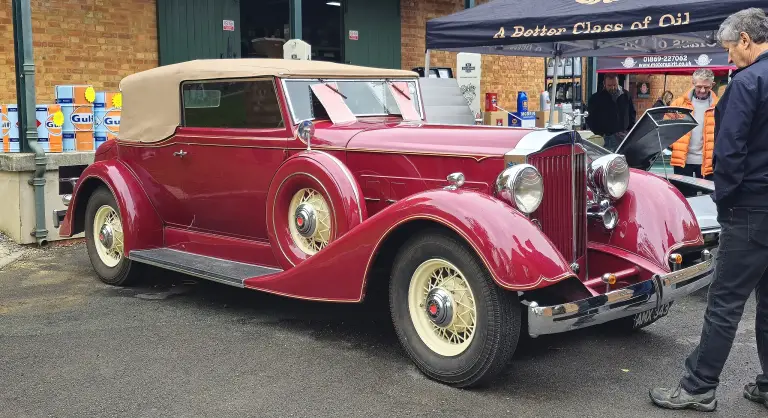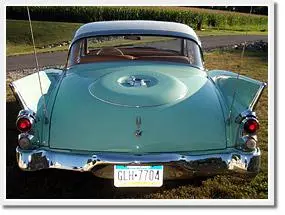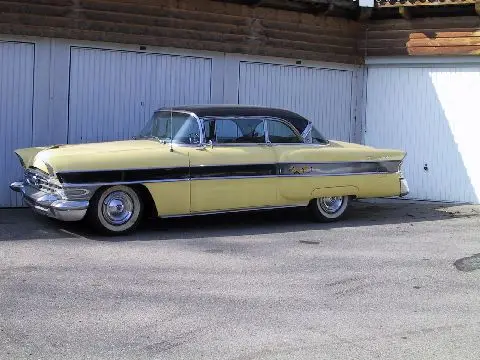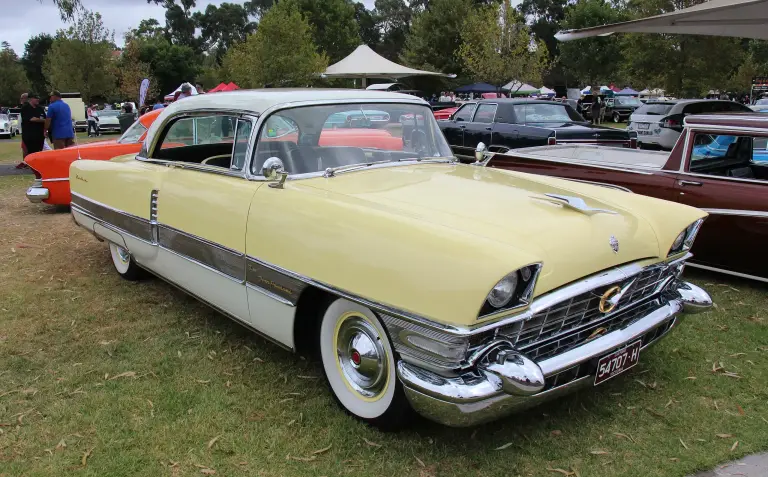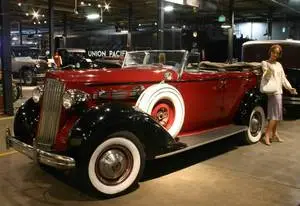
The Packard One-Twenty was the car that kept Packard in business during the last years of the Depression. Introduced in January 1935 as the company’s first entry into the mid-priced eight-cylinder market, it brought independent front suspension to Packard and sold 24,995 units in its first year against 7,000 for all other Packards.
Packard One-Twenty at a glance
| Maker | Packard Motor Car Company, Detroit |
|---|---|
| Production | 1935–1937 and 1939–1941 |
| Introduced | January 1935 |
| Engine 1935 | aluminium-head L-head straight-eight, 110 bhp at 3,850 rpm |
| Engine 1936 | larger displacement, 120 bhp, 85 mph |
| Weight 1935 | 3,688 lb (1,673 kg) |
| Suspension | Safe-T-Flex independent front suspension |
| Prices 1935 | US$980 business coupé to US$1,095 Touring Sedan |
| Built 1935 | 24,995 |
| Built 1936 | 55,042 |
| Successor | Packard 200 (1951) |
Based on one source, the English Wikipedia article on the Packard One-Twenty.
History of the Packard One-Twenty
A car for the middle market
The One-Twenty was named for its wheelbase and marked Packard’s first move into the mid-priced eight-cylinder market, the segment where LaSalle, the Chrysler Airstream and the Lincoln-Zephyr were already selling. Pouring cheaper models into the Packard range was a deliberate survival strategy: branding them as Packards gave buyers the cachet of the name, and the company’s single production line at Grand Boulevard made a separate companion marque impractical.
Safe-T-Flex suspension
The One-Twenty introduced independent front suspension to Packard. Safe-T-Flex used unequal upper and lower A-arms, with the lower arm made of two different arms bolted together at a right angle: a heavy steel support arm reached inwards from the wheel towards the centreline and carried the load, a tubular torque arm took the accelerating and braking torque, and the upper A-arm controlled camber. Packard claimed better wheel alignment from the wide spread of the lower arm, a fixed caster angle and more braking force passed to the frame through the torque arm.
1935 to 1937
At launch the One-Twenty came as two- and four-door sedans, a convertible and a Club Coupe, and cost from US$980 for the three-passenger business coupé to US$1,095 for the Touring Sedan. Its 110 bhp straight-eight made it an immediate success and it outsold the rest of the Packard range almost four to one. For 1936 the engine grew, output rose to 120 bhp and top speed to 85 mph, a convertible four-door sedan was added at US$1,395 and production reached 55,042, the highest the model would see; a built-in radio cost US$59.50. In 1937 the One-Twenty moved upmarket, offered in C and CD trim levels and joined by a wood-bodied station wagon, a Touring Sedan and a limousine on a 138 in wheelbase at under US$2,000; 50,100 were built after the September 1936 launch. For 1938 the name was dropped and the car folded into the Packard Eight range.
1939 to 1941
The One-Twenty returned for 1939 in a full range from coupé to Touring Limousine at US$1,099 to US$1,856, with column gear shifting, which Packard called Handishift; 17,647 were built after the September 1938 introduction. In 1939 the car gained a fifth, transverse shock absorber, Packard’s Unimesh three-speed synchromesh gearbox and the Econo-Drive overdrive, a fourth gear claimed to cut engine speed by 27.8 per cent and usable above 30 mph. The name was hyphenated for 1940, when the range still ran from coupé to limousine and included a semi-custom Convertible Victoria by Howard “Dutch” Darrin. The One-Twenty was replaced by the Packard 200 in 1951.
Design and features
- Independent front suspension: Safe-T-Flex with unequal A-arms and a tubular torque arm.
- New straight-eight: 110 bhp in 1935, 120 bhp and 85 mph in 1936.
- Sales success: 24,995 cars in 1935 and 55,042 in 1936.
- Econo-Drive: an overdrive fourth gear from 1939.
Packard One-Twenty versions
- One-Twenty (1935–1937): the original mid-priced eight, in C and CD trim from 1937.
- Wood-bodied station wagon (1937): on the 138 in wheelbase.
- One-Twenty (1939–1941): column shift, overdrive and a full body range.
- Darrin Convertible Victoria (1940): a semi-custom body by Howard Darrin.
The One-Twenty was the eight-cylinder partner of the Packard Six and was replaced by the 200. More Packards are in the Packard collection.
Sources
- Packard One-Twenty, English Wikipedia: launch, Safe-T-Flex, engines, prices, production