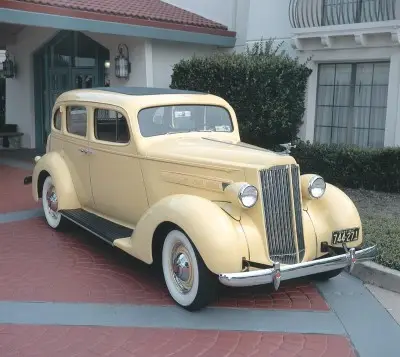
Packard used the name Six for three quite different cars. The first, from 1912, was a huge six-cylinder luxury car; the second, from 1921, was the Single Six that sat below the Eight; and the third, from 1937, was the small 115-C that was meant to save Packard during the Depression and became the One-Ten.
Packard Six at a glance
| Maker | Packard Motor Car Company, Detroit |
|---|---|
| Generations | 1912–1915, 1921–1928, 1937–1947 |
| First generation | Series 1-48 and 1-38 |
| First wheelbases | 121.5 in, 133 in and 139 in |
| 48 engine | 525 cu in (8,603 cc) T-head, 62–74 bhp |
| 38 engine | 415 cu in (6,801 cc) L-head, 60–65 bhp |
| First price | US$6,550 for the Imperial Landaulet |
| Second generation | Single Six from 1921, 116 in wheelbase |
| Third generation | Fifteenth Series Six, model 115-C, September 1936 |
| 115-C engine | 236.7 cu in (3,878 cc), 115 in wheelbase, US$895 sedan |
| From 1940 | renamed Packard One-Ten |
Based on one source, the English Wikipedia article on the Packard Six.
History of the Packard Six
The first Six
Packard’s first six-cylinder engine went into the Series 1-48 of 1912, offered on three wheelbases of 121.5 in, 133 in and 139 in. The “48” was a 525 cu in T-head producing 62 to 74 bhp, while the Series 1-38 used a 415 cu in side-valve engine of 60 to 65 bhp; the numbers were Packard’s chassis designations rather than power figures. The gearbox had three forward speeds and sat in the rear axle, and an Imperial Landaulet seven-passenger sedan cost US$6,550. The Six was replaced in 1916 by the Twin Six.
The Single Six
In 1921 the L-head six returned on a 116 in wheelbase as the Single Six, and in 1924 it was joined by the Single Eight. Once the eight arrived, the Six was repositioned as a mid-level luxury car against the Buick Master Six and later the Chrysler Six; a 1921 five-passenger sedan listed at US$4,940. The naming was systematic: the first digit gave the series and the next two the wheelbase, so a 233 was a second-series Six on the long 133 in chassis and a 326 was a third-series Six on 126 in. Packard built the 116, 126 and 133 in cars of the first series and then the 226 and 233, 326 and 333, 426 and 433 and 526 and 533 of the later series.
The 115-C
The Six disappeared after the fifth series, and Packard had no six-cylinder car until 1937. The Fifteenth Series Six, model 115-C, was introduced in September 1936 as a lower-priced companion to the One-Twenty and was named for its 115 in (2,921 mm) wheelbase. Its 236.7 cu in L-head engine was the One-Twenty’s V8 with two cylinders removed, and the car competed with the Oldsmobile L-Series and the DeSoto sixes at US$895 for a four-door sedan and US$1,295 for the station wagon.
Six, One-Ten and Clipper
For 1938 the wheelbase grew to 122 in (3,099 mm), the engine was bored out to 245.3 cu in and the name went back to plain Packard Six. The car was built until 1942 with annual improvements and was renamed the One-Ten for 1940. When production resumed in the autumn of 1945, the 1946 models with the 245.3 cu in engine were sold as the Clipper Six, the Clipper Series 2100 four-door Touring Sedan, model 1682, listing at US$1,730.
Design and features
- Three generations: a 1912 luxury six, a 1920s mid-range six and a 1937 compact six.
- Systematic names: series and wheelbase encoded in numbers such as 233 and 326.
- Engine from the V8: the 115-C used the One-Twenty’s V8 minus two cylinders.
- Volume seller: the Six and its One-Ten successor kept Packard going in the late 1930s.
Packard Six versions
- Six 1-48 (1912): 525 cu in T-head on three wheelbases.
- Six 1-38 (1913): 415 cu in side-valve version.
- Single Six (1921–1928): the 116 in mid-range car.
- 115-C (1937): the 115 in wheelbase economy Packard.
- Six (1938–1939): 122 in wheelbase and a bored-out engine.
- Clipper Six (1946): the post-war car with the same 245.3 cu in engine.
The Six was the junior companion of the Packard Eight and the direct ancestor of the One-Ten. More Packards are in the Packard collection.
Sources
- Packard Six, English Wikipedia: three generations, engines, wheelbases, prices