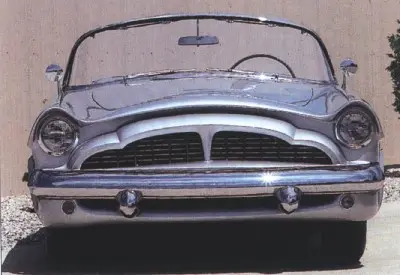
The Packard Panther was a show car built in 1954 to display ideas Packard was considering for production. It began life as the Grey Wolf, was also called the Packard Daytona, and turned out as a two-seat fibre-glass convertible with a lower stance than anything Packard sold.
Packard Panther at a glance
| Maker | Packard Motor Car Company, Detroit |
|---|---|
| Year | 1954 |
| Type | two-seat personal luxury sports convertible show car |
| Other names | Grey Wolf, Packard Daytona |
| Body | one-piece fibre-glass |
| Designer | Dick Teague, then at Mitchell-Bentley |
| Engine | 327 cu in (5.4 L) L-head straight-eight, supercharged, 275 hp |
| Transmission | Ultramatic automatic |
| Tail lights | 1955 Clipper units at first, later senior “cathedral” lights |
| Built | 4 |
Based on one source, the English Wikipedia article on the Packard Panther.
History of the Packard Panther
A show car with a purpose
The Panther was built by Packard in 1954 and taken to motor shows to show the public some of the ideas the company was weighing for its production cars. It was first named the Grey Wolf and also known as the Packard Daytona, and four examples were made in all.
Design
The car is a two-seat personal luxury sporting convertible in the same vein as the Pan-American, carrying Packard styling cues but sitting noticeably lower. Its one-piece fibre-glass body is credited to Dick Teague, who designed several Packards while working at Mitchell-Bentley and later joined American Motors. Originally the Panther wore 1955 Clipper tail lights; these were later removed and replaced with the senior series’ cathedral-style units.
Old engine, new clothes
Although the Panther was shown in late 1954 and in 1955, when Packard was already advertising its new overhead-valve V8, the car used the company’s previous 327 cu in (5.4 L) L-head straight-eight, supercharged to produce 275 hp and driving through the Ultramatic automatic. Of the four cars, one was owned by Mitchell-Bentley executive William Mitchell Sr, and it was the only Panther with a removable hardtop, which resembled the roof of the 1955 Thunderbird.
What it meant
The Panther belongs to the same effort as the Pan-American, the Packard show car of 1952: a halo car meant to make the marque look modern. Its ideas did not reach the showroom in the 1950s, but the four cars remain one of the clearest glimpses of what Packard’s designers wanted to build, and they are now collectors’ pieces rather than production models.
Design and features
- Four built: a show car made in a handful of examples.
- Fibre-glass body: a single moulded shell designed by Dick Teague.
- Supercharged straight-eight: the old 327 L-head tuned to 275 hp.
- One hardtop: the Mitchell car was the only one with a removable roof.
Packard Panther versions
- Panther (1954): the open two-seater with Clipper tail lights.
- Later Panthers: the same cars with senior cathedral tail lights.
- Mitchell car: the only one with a removable hardtop.
- Pan-American: the earlier Packard show car in the same spirit.
The Panther and the Pan-American were Packard’s two show cars of the mid-1950s, and the Caribbean was the production car that came out of the Pan-American. More Packards are in the Packard collection.
Sources
- Packard Panther, English Wikipedia: design, names, engine, the four cars