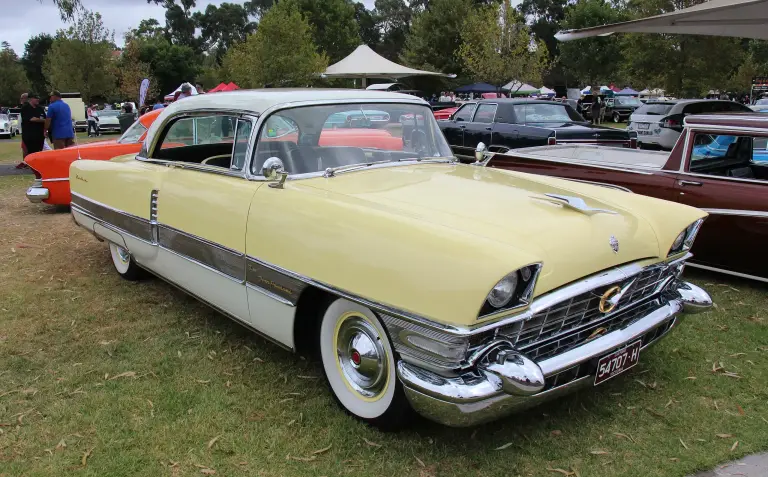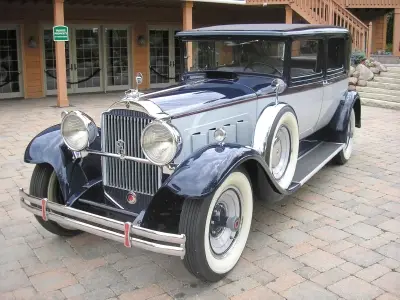
The Packard 200 was the entry-level Packard for the 1951 and 1952 model years. It replaced the One-Twenty and the One-Ten, sat on the shortest wheelbase in the range and used the smallest straight-eight Packard built, but it was still a big, quiet car with the same basic body as the far more expensive Patrician.
Packard 200 at a glance
| Maker | Packard Motor Car Company, Detroit |
|---|---|
| Production | model years 1951–1952 |
| Introduced | 24 August 1950 |
| Predecessors | Packard One-Twenty, Packard One-Ten |
| Successor | Packard Clipper (1953) |
| Wheelbase | 122 in (3,100 mm) |
| Engine | 288 cu in (4.7 L) straight-eight, 135 hp at 3,600 rpm |
| With Ultramatic | 138 hp, compression raised to 7.5:1 |
| Optional engine | 327 cu in V8 for US$45 |
| Bodies | four-door sedan, two-door coupé, business coupé (1951 only) |
| Price 1951 | US$2,616 for the four-door Touring Sedan |
| Built 1951 | 24,310 Standard and 47,052 Deluxe |
Based on one source, the English Wikipedia article on the Packard 200.
History of the Packard 200
A new line for 1951
The 200 and the 250 were presented on 24 August 1950 as Packard’s least expensive models, taking the place of the low-line Standard cars dropped for 1951. They were part of a completely redesigned range, the work of John Reinhart, whose “High Pockets” shape replaced the rounded 1948–1950 Packards and lasted until Packard production in Detroit ended in 1956. The 200 was the junior series, set apart from the 300 and the Patrician 400 by its shorter 122 in wheelbase and plainer trim.
Junior trim, senior body
The 200 looked like the senior Packards but went without their cormorant hood ornament, wore vertical rather than horizontal tail lights, and the sedans lacked the wrap-around rear window of the top cars. Buyers could choose a four-door sedan, a two-door coupé or a three-passenger business coupé without a rear seat. Even the cheapest car had twin horns, two sun visors, front and rear bumper guards and a spare wheel with jack; the Deluxe added chrome wheel rings and turn indicators, while white-wall tyres and full wheel covers cost extra.
Engines and equipment
The standard engine was Packard’s 288 cu in straight-eight, rated at 135 hp with a 7.0:1 compression ratio; cars with the Ultramatic automatic were given 7.5:1 and 138 hp. The larger 327 cu in straight-eight could be ordered for US$45, less than a heater and defroster. Packard also fitted Easamatic power brakes, made by Bendix, as the first American maker to offer them in 1951. Heater, radio, tinted glass and carpeting, standard on later cars, were all extras.
The 250, and the end of the numbers
In March 1951 Packard added the 250, which shared the 200’s body and wheelbase but used the 327 engine and offered the convertible and Mayfair hardtop the range otherwise lacked. The 200 was the volume model: 24,310 Standard and 47,052 Deluxe cars in 1951, and 13,934 Standard plus 25,880 Deluxe Touring Sedans in 1952, when the business coupé was dropped. Too many of the cars Packard sold were these cheap models, and new president James J. Nance answered by abandoning numbers altogether: for 1953 the 200 and 250 became the Clipper Special and Clipper Deluxe.
Design and features
- Short wheelbase: 122 in against 127 in for the 300 and the Patrician.
- 288 straight-eight: 135 hp, or 138 hp with the Ultramatic automatic.
- Easamatic brakes: Packard was the first American maker to offer power brakes, in 1951.
- Cheap V8 option: the 327 cu in engine for US$45.
Packard 200 versions
- 200 Standard (1951–1952): the basic car with minimal equipment.
- 200 Deluxe: chrome wheel rings and turn indicators.
- Business Coupé: a three-passenger two-door without a rear seat, 1951 only.
- 250 (1951–1952): the same body with the 327 engine, a convertible and a hardtop.
- Clipper Special and Clipper Deluxe (1953): the renamed 200 and 250.
The 200 replaced the One-Twenty and became the Clipper in 1953; the bigger 300 sat above it in the range. More Packards are in the Packard collection.
Sources
- Packard 200, English Wikipedia: design, engines, equipment, prices, production