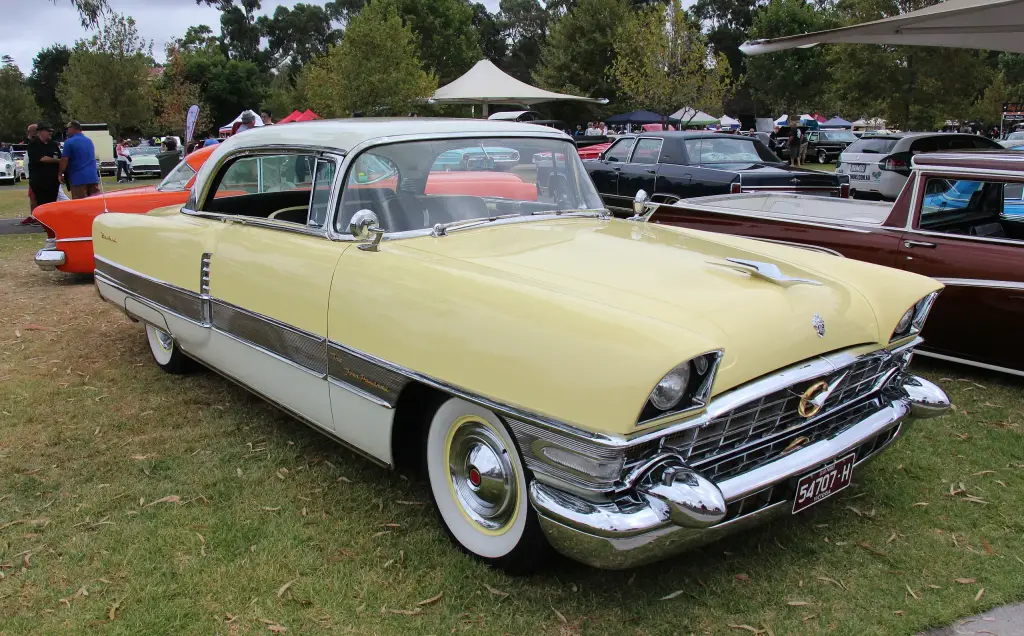
The Packard Four Hundred was the senior two-door hardtop of Packard’s final years, sold for the 1955 and 1956 model years only. It was one of several short-lived names Packard used while it tried to separate its luxury cars from the volume Clipper line, and its two seasons ended with the closure of the Detroit factory.
Packard Four Hundred at a glance
| Maker | Studebaker-Packard Corporation, Detroit |
|---|---|
| Production | model years 1955–1956 |
| Body | two-door hardtop in the senior range |
| Identification | “The Four Hundred” in gold anodised script on the front wing |
| Side trim | full colour band low on the body, with a partial band ending at the front door |
| 1956 body | shared with the new Caribbean hardtop |
| Engine 1955 | 352 cu in (5.8 L) V8 |
| Engine 1956 | 374 cu in (6.1 L) V8 |
| Transmission | column selector standard; push-button Ultramatic optional |
| Built 1955 | 7,206 |
| Built 1956 | 3,224 |
Based on one source, the English Wikipedia article on the Packard Four Hundred.
History of the Packard Four Hundred
A name in a shifting range
Between 1951 and the end of Detroit production in 1956, Packard’s naming changed constantly as the company tried to define itself as a luxury maker again and keep the cheaper Clipper cars apart. In 1951 and 1952 the range used numbers: 200 and 250 for the junior models, 300 in the middle and the Patrician 400 at the top. The “400” was dropped from the Patrician for 1953, and for 1955 Packard brought it back on a different car altogether — the senior two-door hardtop.
1955
The 1955 Four Hundred was easy to pick out. A full colour band ran along the lower part of the body, topped by a partial band that stopped at the rear edge of the front doors, and “The Four Hundred” was written in gold anodised script on the band between the front wheel opening and the door. It sat at the top of the senior range, above the Clipper, and 7,206 were sold in the model year.
1956
For 1956 the Four Hundred changed with the rest of the senior Packards, which were being pushed further away from the Clipper as that name became a separate marque. It shared its body and chassis with the new Caribbean hardtop. Senior Packards received a new grille texture and multi-tone paint schemes, an altered headlight housing with a slightly longer bonnet stretching over the headlight and a more distinctive egg-crate grille than in 1955; the Packard crest moved to the front of the bonnet, leaving the circle-V emblem in the grille looking bare. The V8 grew from 352 to 374 cu in with a matching rise in power, and the new electronic push-button control for the Ultramatic automatic was offered as an option on the Four Hundred and the Patrician and fitted as standard to the Caribbean; its buttons sat on a pod on a stalk off the steering column. It was sophisticated but troublesome, and the simpler column selector remained standard. Production fell to 3,224 cars.
The end
In 1956 Studebaker-Packard could no longer afford two separate makes built in two separate plants. For 1957 there was a single range, the Clipper, and by the end of the 1958 model year the Packard name had ceased as an American car brand. The Four Hundred, like several Packards of the period, lived for exactly two model years.
Design and features
- Senior hardtop: the two-door flagship of Packard’s last Detroit range.
- Gold script: “The Four Hundred” applied to the side band in anodised gold.
- Bigger V8 for 1956: 374 cu in instead of 352.
- Push-button Ultramatic: an optional electronic selector on a steering-column pod.
Packard Four Hundred versions
- Four Hundred 1955: the first senior hardtop with the two-band side treatment.
- Four Hundred 1956: new grille, bonnet crest and a 374 cu in engine.
- Caribbean hardtop (1956): the more expensive car that shared the Four Hundred’s body.
- Clipper (1957): the single range that replaced the senior Packards.
The Four Hundred shared its body with the Caribbean hardtop and sat above the Executive and the Patrician. More Packards are in the Packard collection.
Sources
- Packard Four Hundred, English Wikipedia: 1955 launch, 1956 changes, engines, production