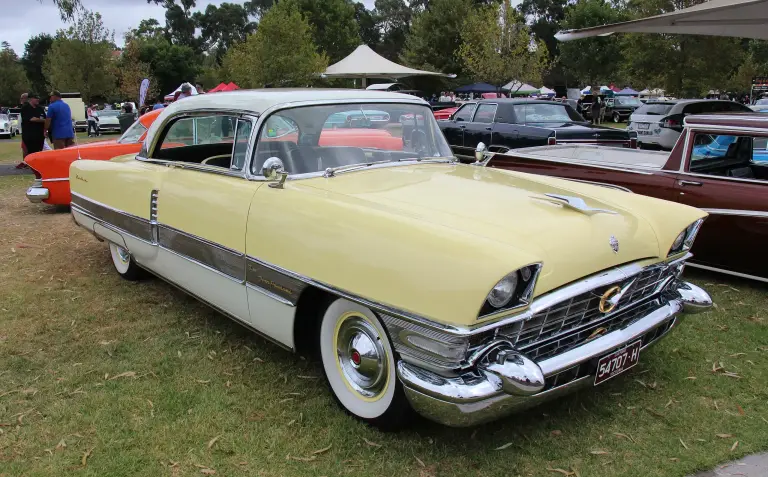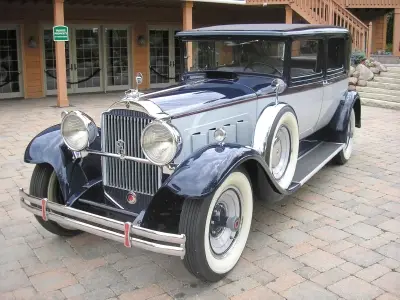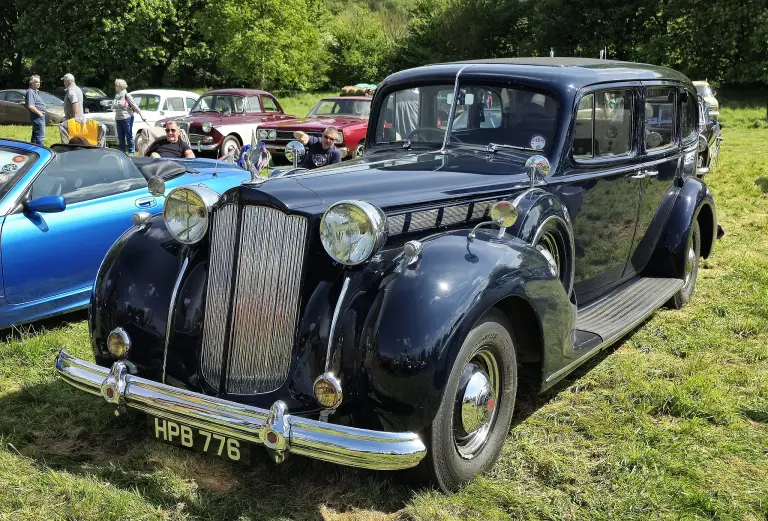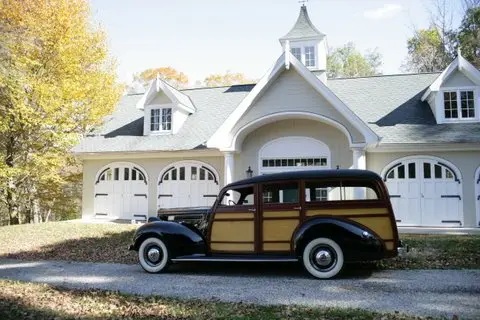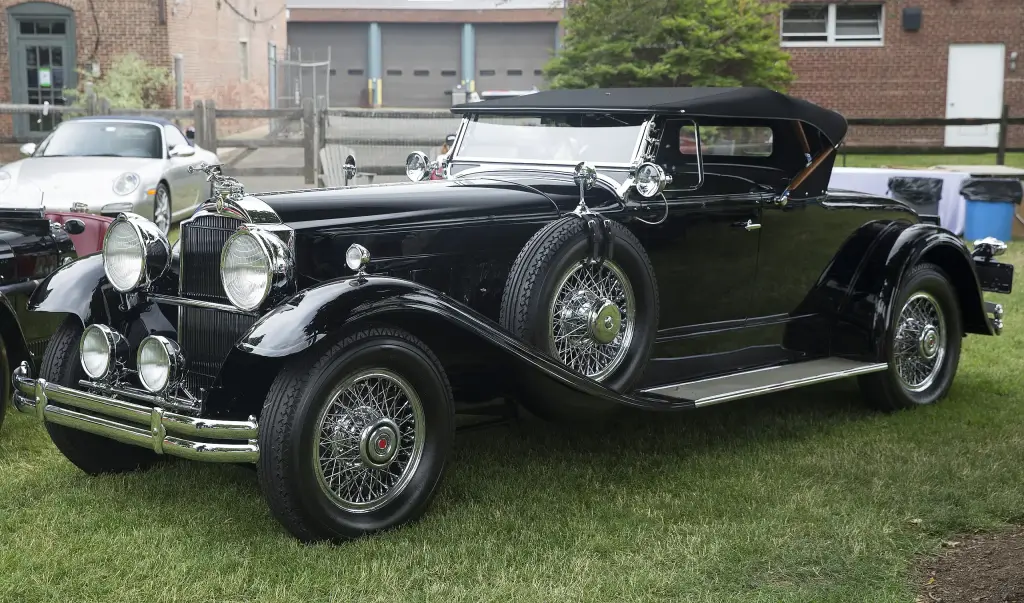
The Packard De Luxe Eight was introduced in 1929 as the richest version of Packard’s eight-cylinder range. It sat on wheelbases of 140 in (3,556 mm) and 145.5 in (3,696 mm), was offered in eleven body styles, and was built at fewer than ten cars a day. In 1932 it started at US$3,150, in 1933 at US$3,350.
Packard De Luxe Eight at a glance
| Maker | Packard Motor Car Company, Detroit |
|---|---|
| Introduced | 1929 |
| Wheelbases 1930 | 140 in (3,556 mm) and 145.5 in (3,696 mm) |
| Bodies | eleven body styles |
| Price 1932 | from US$3,150 |
| Price 1933 | from US$3,350 |
| Production rate | fewer than ten cars a day |
| Suspension | Ride Control, dash-adjustable hydraulic shock absorbers |
| Transmission | four-speed synchromesh, optional at no extra cost |
| Chassis | automatic chassis lubrication, shatterproof glass |
Based on one source, the English Wikipedia article on the Packard Eight, which lists the De Luxe Eight within the line.
History of the Packard De Luxe Eight
The top of the eight-cylinder range
Packard’s eight-cylinder car had been reorganised in 1928 into the Standard Eight and the Custom Eight, and in 1929 the company added a third, richer level, the De Luxe Eight. It was the car for buyers who wanted Packard engineering with the longest bonnet and the most formal bodywork, and it was sold alongside the Standard and Custom models rather than replacing them.
Dimensions and bodies
In 1930 the De Luxe Eight was offered on wheelbases of 140 in and 145.5 in, against 127.5 in and 134.5 in for the Standard Eight of the same year. The bigger chassis carried eleven different bodies, from open cars and phaetons to a landau, a town car and a limousine. That range of bodies was normal for Packard: the line as a whole was advertised as a roadster, convertible, convertible Victoria, phaeton, dual-cowl phaeton, sport phaeton, coupé, sedan, landau, town car and limousine.
Engineering and price
Mechanically the De Luxe Eight followed the rest of the senior line. Ride Control let the driver adjust the hydraulic shock absorbers from the dashboard, the chassis lubricated itself automatically, the glass was described as shatterproof and a four-speed synchromesh gearbox was available at no extra cost. The price reflected the size: in 1932 the Standard Eight ranged from US$2,250 to US$3,250 while the De Luxe Eight started at US$3,150, and in 1933 it began at US$3,350 against US$2,150 for the base Standard Eight. Cars of this kind were made in small numbers — fewer than ten a day — and the Depression cut demand for them sharply.
The end of the name
The eight-cylinder Packard was dropped after 1936 and returned for a single year in 1938, when it used the One-Twenty’s 282.1 cu in engine with 120 hp and a wheelbase stretched 7 in over 1937. From 1940 the senior place in the range belonged to the Super Eight and the Custom Super Eight, and the old De Luxe Eight name disappeared.
Design and features
- Longest wheelbases: 140 in and 145.5 in in 1930.
- Eleven bodies: open cars, phaetons, landau, town car and limousine.
- Senior engineering: Ride Control, automatic lubrication, free four-speed option.
- Rarity: fewer than ten cars built each day.
Packard De Luxe Eight versions
- De Luxe Eight (1929–1933): the luxury eight-cylinder series.
- Open and closed bodies: roadster, convertible, phaeton, coupé, sedan, landau.
- Formal bodies: town car and limousine on the 145.5 in chassis.
- 1938 Eight: the one-year return of the line with the One-Twenty engine.
The De Luxe Eight was the richest version of the Packard Eight, above the Custom Eight. More Packards are in the Packard collection.
Sources
- Packard Eight, English Wikipedia: wheelbases, prices, bodies, production rate