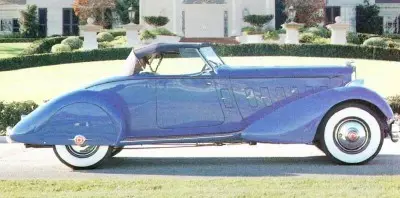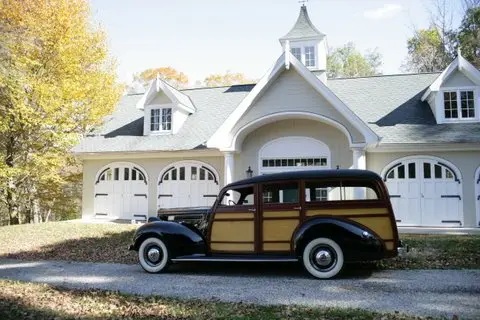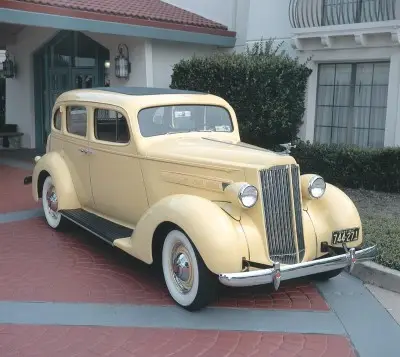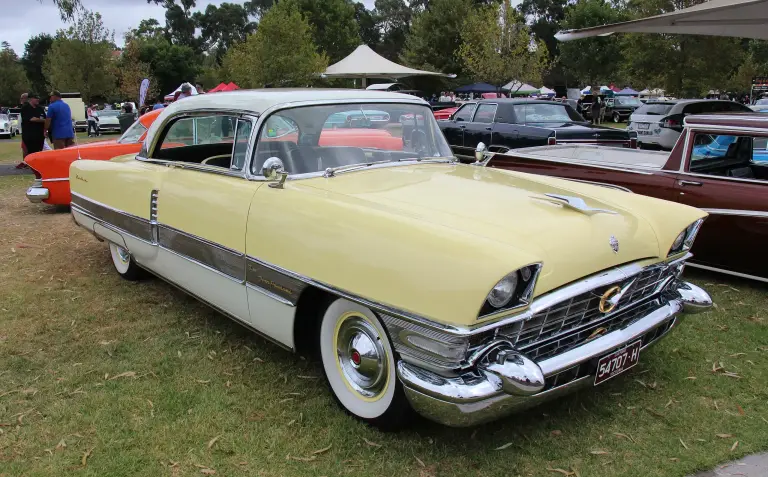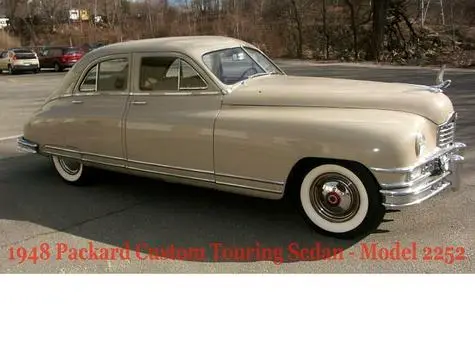
The Packard Custom Eight was the expensive version of Packard’s eight-cylinder car, introduced with the Standard Eight in 1928. It offered the same engineering in longer wheelbases and richer bodies, and buyers paid from US$3,190 in 1930 for the privilege. Production ran at fewer than ten cars a day.
Packard Custom Eight at a glance
| Maker | Packard Motor Car Company, Detroit |
|---|---|
| Introduced | 1928, alongside the Standard Eight |
| Position | above the Standard Eight, below the twelve-cylinder cars |
| Price 1930 | US$3,190 to US$3,885 |
| Bodies | eleven body styles |
| Production rate | fewer than ten cars a day |
| Long-wheelbase version | Individual Custom Eight, from 1931 |
| Speedster engine | the 734 Speedster Eight used the 740 Custom Eight unit |
| Standard engine output 1930 | 106 hp in the Custom Eight |
| Finish | body-coloured radiator grilles on Individual Custom cars |
Based on one source, the English Wikipedia article on the Packard Eight, which describes the Custom Eight as part of the line.
History of the Packard Custom Eight
A matter of trim and length
Packard reorganised its naming in 1928, splitting the eight-cylinder range into the Standard Eight and the more opulent Custom Eight. The two cars shared the same basic engineering, but the Custom Eight came on longer wheelbases and with more elaborate coachwork, and its buyers were the people who had previously ordered a Packard with a body from an outside coachbuilder. In 1930 it was priced between US$3,190 and US$3,885, against US$2,425 to US$2,885 for the Standard Eight, while the twelve-cylinder cars started at US$4,585. The Custom Eight was offered in eleven body styles.
Individual Custom and Speedster
In 1931 Packard added the Individual Custom Eight, a longer-wheelbase version of the Standard Eight chassis intended for buyers who wanted something more personal; period advertisements showed these cars with body-coloured radiator grilles, where standard models had chrome. The Custom Eight also supplied the engine for the most exciting Packard of the era: the 1930 Speedster Eight, model 734, took its straight-eight from the 740 Custom Eight and, with revised valves and manifolds, a Detroit Lubricator dual updraft carburettor, a vacuum booster pump and a ribbed exhaust manifold, raised output from 106 to 145 hp at 3,400 rpm without changing bore or stroke. The Speedster cost US$5,200 to US$6,000 and only 113 were built.
What the money bought
The Custom Eight was built to the same recipe as every senior Packard of the period: Ride Control hydraulic shock absorbers adjustable from the dashboard, automatic chassis lubrication, shatterproof glass and an optional four-speed synchromesh gearbox at no extra cost. The difference was in the length of the bonnet and the quality of the trim, and in the fact that a Custom Eight was a rare sight — fewer than ten left the works each day. Production of the eight-cylinder Packard ended in 1936, returned for 1938, and from 1940 the senior position passed to the Super Eight and Custom Super Eight.
Design and features
- Longer wheelbase: the Custom Eight was built on the longest eight-cylinder chassis.
- Eleven bodies: from coupé and convertible to town car and limousine.
- Individual Custom: a 1931 long-wheelbase variant with body-coloured grille.
- Speedster engine: the 145 hp unit of the 734 came from the Custom Eight.
Packard Custom Eight versions
- Custom Eight (1928–1936, 1938): the standard long-wheelbase car.
- Individual Custom Eight (1931): longer still, with body-coloured grille.
- Speedster Eight 734 (1930): a 145 hp performance model using the Custom Eight engine.
- De Luxe Eight (1929–): the separate luxury series introduced a year later.
The Custom Eight was the expensive sister of the Standard Eight and the ancestor of the De Luxe Eight, all described in the Packard Eight article. More Packards are in the Packard collection.
Sources
- Packard Eight, English Wikipedia: Custom Eight prices, bodies, Individual Custom, Speedster