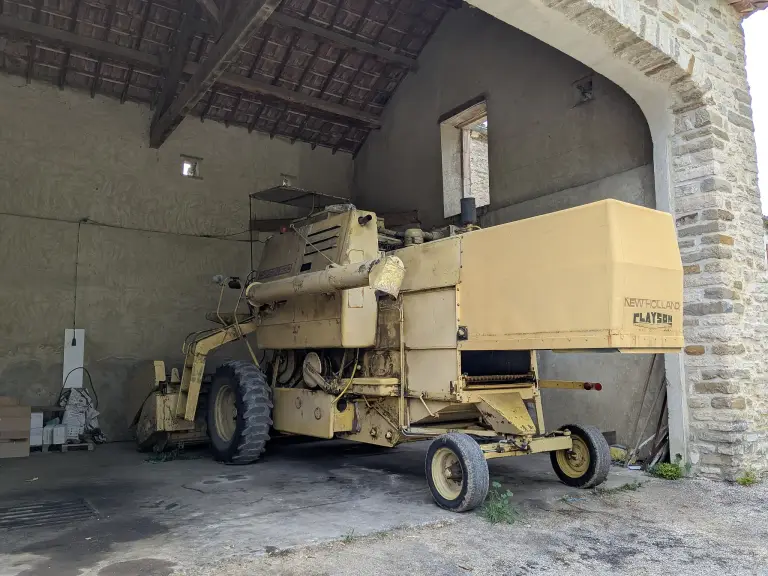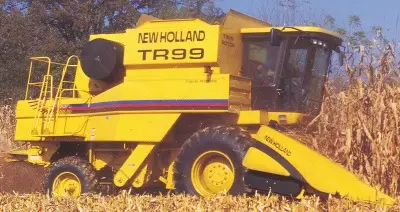
The New Holland TR series is the company’s line of twin-rotor combines from the 1980s and 1990s — the machines that took the rotor technology New Holland had introduced in 1975 into large-scale grain harvesting. The sources used for this page describe the company and its combine business, not the series.
New Holland TR series at a glance
| Maker | New Holland |
|---|---|
| Type | twin-rotor combine harvester |
| Technology | two longitudinal rotors instead of a transverse cylinder |
| Introduced by the company | 1975, the world’s first twin-rotor combine |
| Combine heritage | Claeys of Belgium, bought into in 1964 |
| European works | Zedelgem, Belgium, Claeys’s factory since 1909 |
| Polish works | Płock, bought with Bizon in 1998 |
| Group | CNH Industrial, after the 1999 Case merger |
| Technical data | not given in the sources used here |
| Film | no film specifically of this series is available |
The sources describe the company and its combine programme, not the TR models; no model data is given because none is in them.
History of the New Holland TR series
Rotor threshing
In 1975 Sperry New Holland introduced the world’s first twin-rotor combine, a machine that separated the grain between two longitudinal rotors running along the body of the machine instead of beating it out with a transverse cylinder. Rotor machines thresh more gently and work well in wet or heavy crops, and the principle proved so sound that it is still used today. The TR models were the combines that carried that idea through the 1980s and 1990s, and their name became a byword for New Holland rotor harvesting before the CX and CR ranges took over.
The factories behind them
New Holland’s combines were European machines as much as American ones. The Claeys works at Zedelgem in Belgium, built by Leon Claeys in 1909, came into the company when Sperry New Holland bought a major interest in Claeys in 1964; by the 1960s Claeys had been one of Europe’s largest combine manufacturers. The 1998 purchase of Bizon of Płock in Poland, which held around 60 per cent of the Polish combine market, added a second big harvesting plant. Combines, self-propelled forage harvesters and big square balers are still built at Zedelgem, and combines and round balers at Płock.
What the sources do not say
The encyclopedic sources used here record the company, its inventions and its factories, but they do not list the TR models individually: there is no entry for engine sizes, header widths or production totals. This page does not invent those numbers. It sets the series where the record places it — in the line of rotor combines that made New Holland one of the major harvesting brands of the late twentieth century.
Design and features
- Twin-rotor threshing: the technology New Holland introduced to the world in 1975.
- Large-scale harvesting: combines built for big grain farms.
- European production: machines from the Claeys works at Zedelgem and, later, Bizon at Płock.
- Name that carried on: the rotor idea survived into the CX and CR ranges.
New Holland TR series versions
- New Holland TR series: the rotor combines described here in general terms.
- Clayson combines: the line that preceded the TR, covered on its own page.
- New Holland CR and CX: the combine ranges sold today.
The Belgian combines that came before are on the New Holland Clayson page, and the TX combines on the New Holland 66 page. More machines are in the New Holland section.
Sources
- New Holland Agriculture, English Wikipedia: twin-rotor combine, Claeys, Bizon
- New Holland, Dutch Wikipedia: Zedelgem and Płock plants