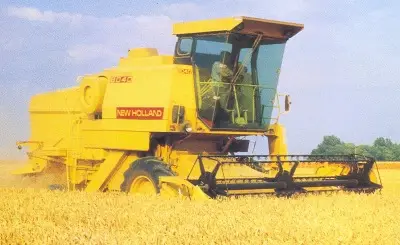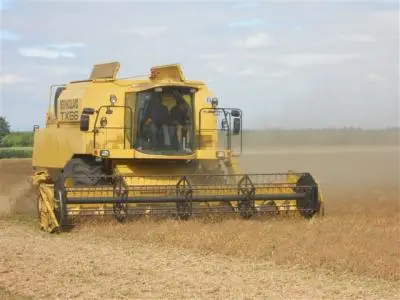
The New Holland 66 belongs to the TX family of combines, as the film below makes clear by showing a TX 66 working with a TX 68. That places it in the line that grew from New Holland’s twin-rotor technology. The sources used for this page describe the company and its combines in general, not this model.
New Holland 66 at a glance
| Maker | New Holland |
|---|---|
| Family | TX, the twin-rotor combine line |
| Seen in the film | a TX 66 working with a TX 68 |
| Twin-rotor combine | introduced by the company in 1975, still in use today |
| Combine heritage | the Claeys works at Zedelgem, Belgium, bought into from 1964 |
| Other combine plants | Płock, Poland, after the 1998 Bizon purchase |
| Company founded | 1895, New Holland, Pennsylvania |
| Group | CNH Industrial |
| Technical data | not given in the sources used here |
| Example filmed | a TX 66 harvesting grain |
The sources describe the company and its combine programme, not the TX 66; the model’s technical data is left out because it is not in them.
History of the New Holland 66
Twin rotors came from New Holland
New Holland’s place in combine history rests on one invention: in 1975 Sperry New Holland introduced the world’s first twin-rotor combine, a machine that threshed the crop between two longitudinal rotors instead of a transverse cylinder. The idea worked and is still used today. The company had entered combine building a decade earlier, when it bought a major interest in Claeys in 1964; that Belgian firm, founded by Leon Claeys in 1906, had been one of Europe’s largest combine manufacturers, and its factory at Zedelgem is still one of New Holland’s harvesting plants.
The TX range
TX is the name New Holland gave to its twin-rotor conventional combines. The film below shows a TX 66 with a TX 68, and it is from that pairing rather than from any encyclopedic entry that the model’s place can be identified. The sources used here do not list its engine, header width or production years, and this page does not fill the gap with invented figures. What they do show is the engineering tradition behind it: rotor threshing, developed in the 1970s, refined across the following decades.
Combines in the group
The combine business grew with the company: Bizon of Płock, bought in 1998, held around 60 per cent of the Polish combine market, and harvesting machinery is still built at Zedelgem in Belgium and at Płock in Poland. After the 1999 merger with Case, these works became part of CNH Industrial, and the machines are sold today under the CR and CX names, with the biggest of them, the CR11, shown at international fairs.
Design and features
- Twin-rotor threshing: the technology New Holland introduced to the world in 1975.
- TX family: part of the line of rotor combines sold after the Ford and Fiat mergers.
- European works: combines of this heritage were built at Zedelgem in Belgium.
- Working machine: the example in the film is still harvesting grain.
New Holland 66 versions
- New Holland 66 (TX 66): the combine described here.
- New Holland TX 68: the larger model shown alongside it in the film.
- New Holland CR and CX: the combine ranges sold today.
The Clayson combines that started New Holland’s harvesting business are on the New Holland Clayson page, and the TR rotor combines on the New Holland TR page. More machines are in the New Holland section.
Video: New Holland TX 66/68
Video by lexionterratrac on YouTube.
Sources
- New Holland Agriculture, English Wikipedia: twin-rotor combine, Claeys, Bizon, plants
- New Holland, Dutch Wikipedia: combine plants at Zedelgem and Płock