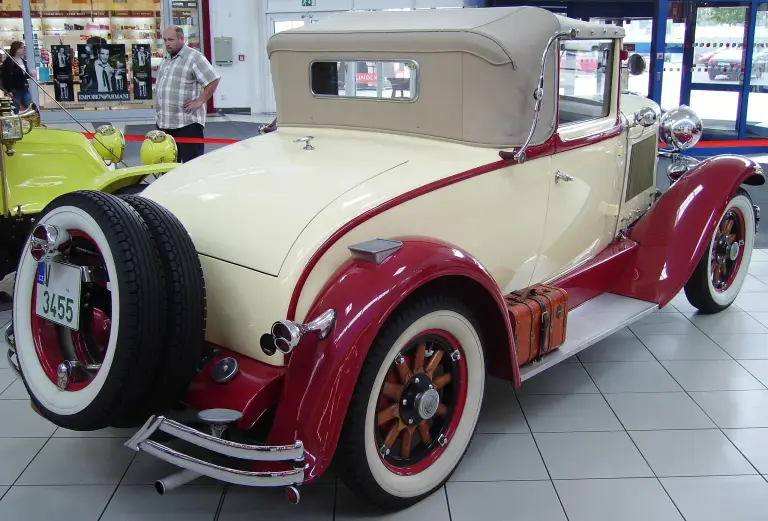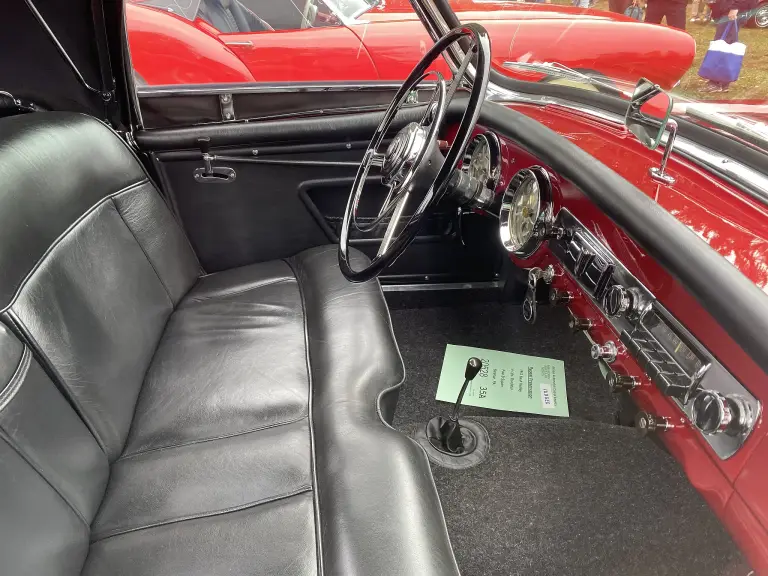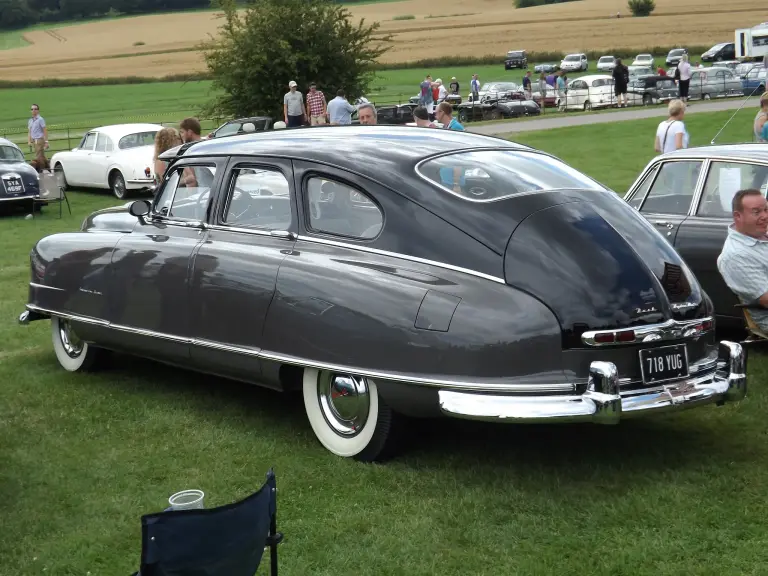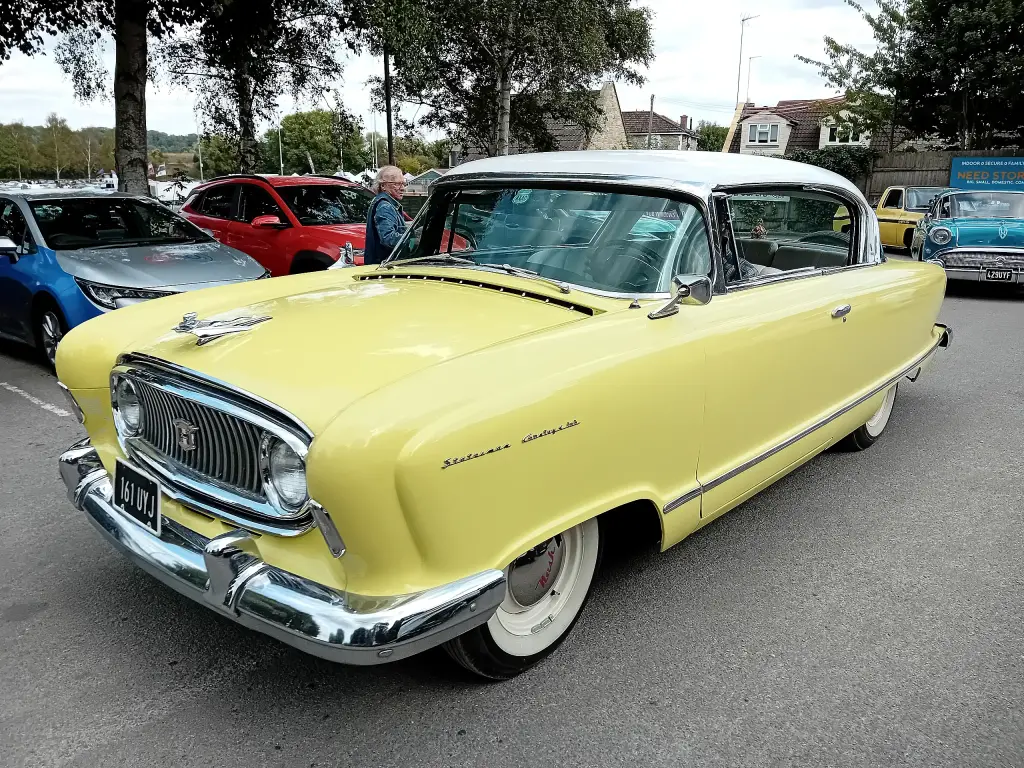
The Nash Statesman was built for the 1950 to 1956 model years in two generations. It replaced the Nash 600, sat below the Ambassador and above the compact Rambler, and became one of the company’s volume sellers.
Nash Statesman at a glance
| Production | 1950–1956 |
|---|---|
| Position | below the Ambassador, above the Rambler |
| First generation | 1950–1951 |
| Second generation | 1952–1956 |
| Engine | L-head Light Six; 195.6 cu in (3.2 L) from 1952 |
| Power | 85 hp (1952), 100 hp (1953) |
| Wheelbase | 2,845 mm (1950–51), 2,902 mm (1952–56) |
| Bodies | two- and four-door sedan; Country Club hardtop from 1952 |
| Trims | Super, Custom and a fleet-only model |
| Front track | 1,397 mm |
| Rear track | 1,537 mm |
| Last cars | August 1956 |
History of the Nash Statesman
The Statesman was the base Nash 600 renamed for 1950, and it kept the Airflyte body of the previous year. It came in three trims: the entry-level Super, the top-line Custom and a base model sold mainly to fleets. Two- and four-door sedans were offered. All Nashes had skirted fenders, and the Statesman’s front track was almost three inches narrower than its rear track to make room for the wheels. Its wheelbase was 9 inches shorter than the Ambassador’s because it used a shorter front section from the cowl forward; the two cars were identical behind the cowl. Two-door models had Nash’s Airliner Reclining front seat, which could be converted into a bed and was optional on the four-door.
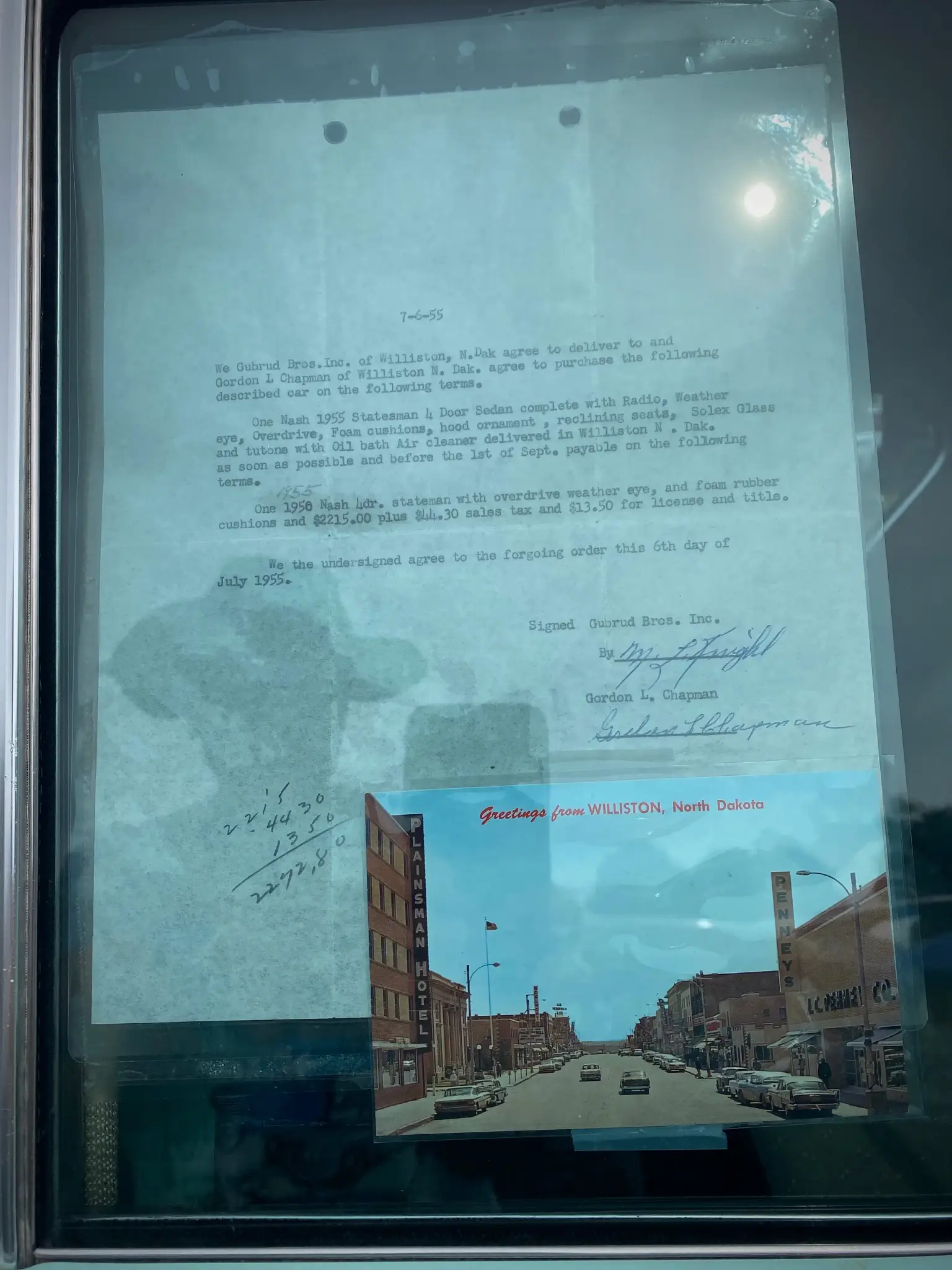
A new design arrived for 1952: a large envelope-bodied sedan with enclosed wheels, a notchback profile and styling by Pininfarina, introduced in Nash’s 50th-anniversary year. The wheelbase was cut to 114.25 in (2,902 mm), and the range grew to include a two-door Country Club hardtop alongside the two- and four-door sedans. All used the 195.6 cu in (3.2 L) Super Flying Scott six of 85 hp. For 1953 the engine was tuned to 100 hp and renamed Powerflyte. The 1954 cars gained an outside-mounted continental spare tyre and a higher-compression, twin-carburettor engine option worth another 10 hp. The 1955 facelift brought a wraparound windscreen and headlights integrated into the grille, and 1956 cars had larger, slanted parking lights and bigger tail lamps.
The Statesman’s engine was derived from the L-head Light Six designed in the 1920s, with its intake and exhaust manifolds cast into the block, and it survived in the LaFayette and 600 into the 1940s. Because the Statesman was relatively light, owners and testers reported good fuel economy. The model was discontinued after August 1956; for 1957 every full-size Nash was an Ambassador.
Design and features
- Airliner seat: the two-door’s front seat folded into a bed, an option on four-door cars.
- Skirted fenders: Nash’s enclosed wheels, with a narrower front track to allow steering.
- Shared body: identical to the Ambassador from the cowl back, with its own shorter front end.
- Economical six: the long-serving L-head Light Six, with manifolds cast into the block.
- Annual updates: Powerflyte power, a continental spare and a wraparound windscreen arrived through the 1950s.
Nash Statesman versions
- Super: the entry-level trim.
- Custom: the top-line Statesman.
- Fleet model: a base version for companies and institutions.
- Country Club (1952): two-door hardtop added to the range.
- 1955 facelift: wraparound windscreen and grille-mounted headlights.
- 1956: larger slanted parking lights and tail lamps.
The Statesman replaced the Nash 600, sat below the Nash Ambassador and above the Nash Rambler. More cars are in the Nash collection.
Video: 1953 Nash Statesman Super Airflyte
Video by John Mosser on YouTube.
Sources
- Nash Statesman, English Wikipedia: generations, trims, engines, updates
- Nash Statesman, German Wikipedia: position, engine origin, dimensions