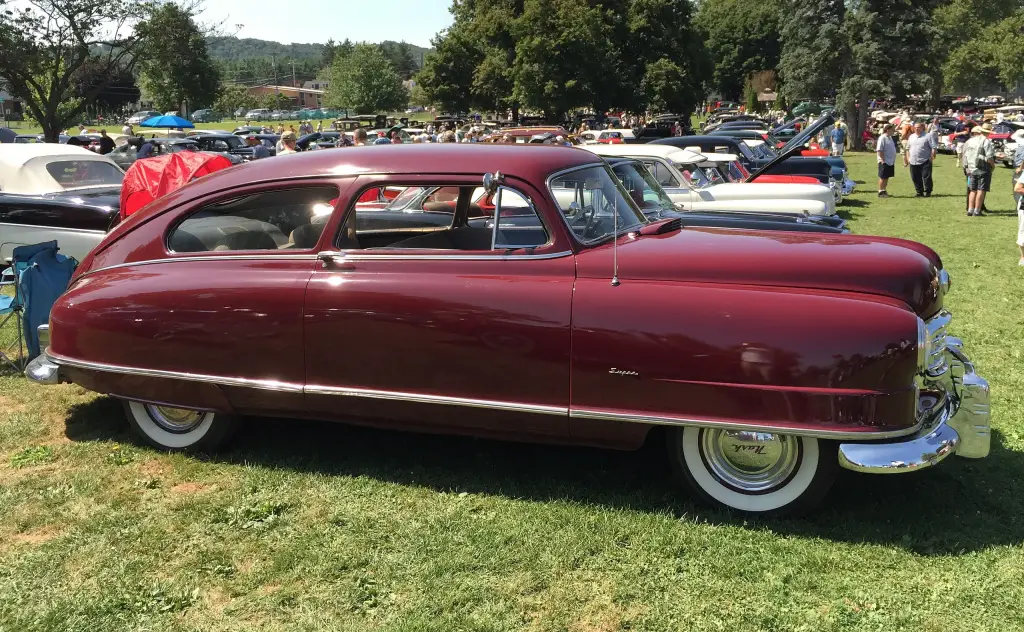
The Nash 600 was introduced for the 1941 model year as Nash’s low-priced car, replacing the LaFayette. It was the first mass-produced American automobile built with a welded unit body and frame, and its name referred to the 600 miles it could cover on a single tank of petrol.
Nash 600 at a glance
| Maker | Nash-Kelvinator Corporation, Kenosha, Wisconsin |
|---|---|
| Production | 1941–1949 model years |
| Body | Welded unit body and frame (unibody) |
| Engine | 172.6 cu in (2.8 L) L-head straight-six, 75 hp |
| Gearbox | Three-speed manual with electric overdrive |
| Suspension | Independent front, coil springs all round |
| Fuel tank | 20 US gallons (76 L) |
| Claimed range | 600 miles (966 km) |
| Fuel economy | 25–30 mpg US in period use |
| 1941 output | 80,428 cars |
| Replaced by | Nash Statesman for 1950 |
The English article gives 1941 as the first model year, the German article 1940; this page follows the English source.
History of the Nash 600
Under George W. Mason, president of the newly merged Nash-Kelvinator Corporation, Nash set out to change its image. The 600, introduced for 1941, was the first result. Its body was developed with help from Theodore Ulrich of the Budd Company, and the car was built as a single welded unit rather than a body bolted to a separate frame. Nash invested $7.5 million in design and tooling, a large sum for an independent maker. The structure saved about 500 lb (227 kg) and gave a stiffer body without the rattles of separate frame construction. It also required new collision-repair methods, including a portable body-and-frame puller that sold internationally.
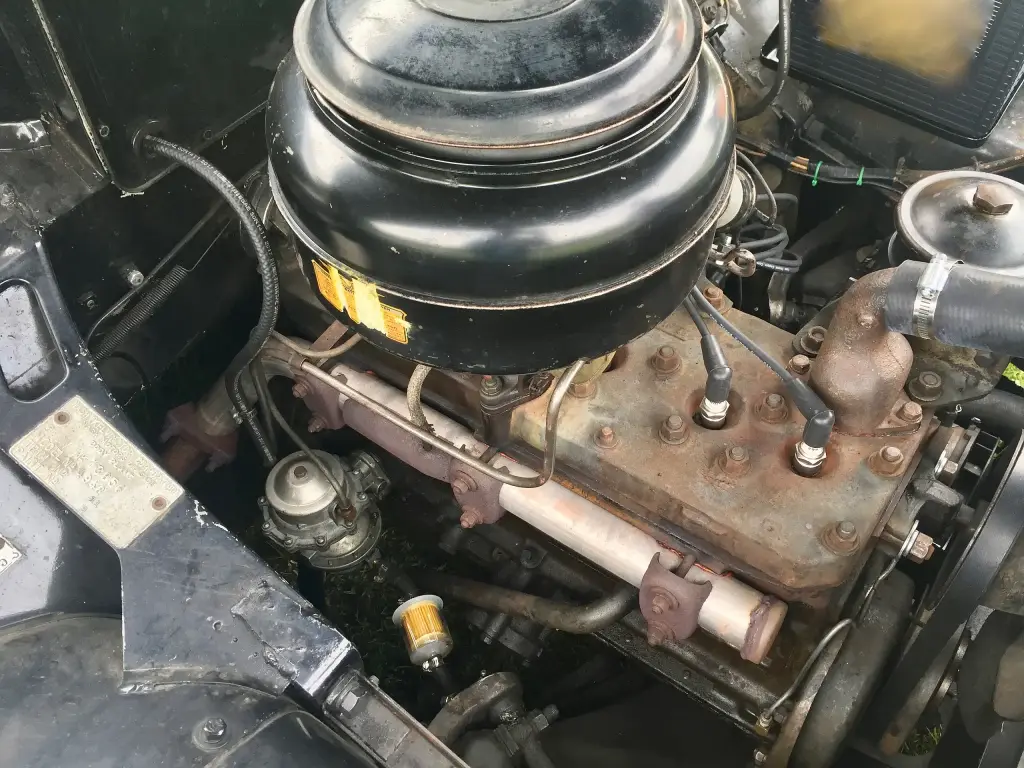
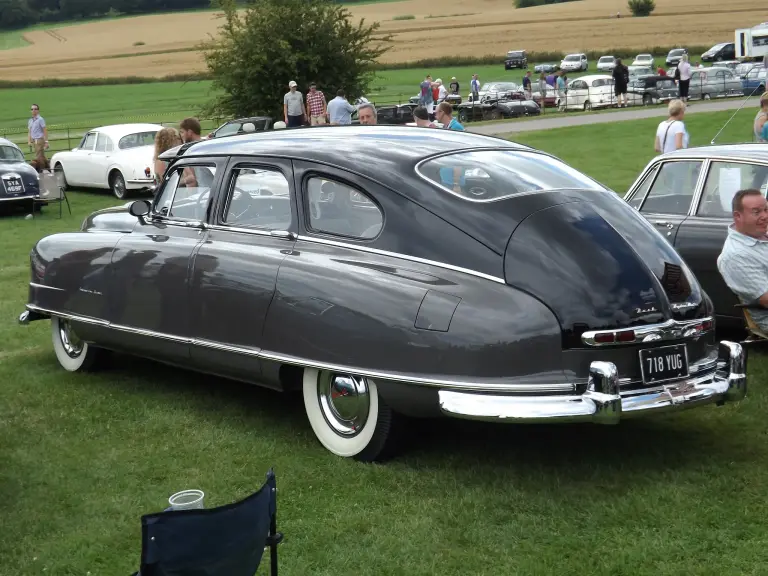
The new car was launched as the Ambassador 600 and described by Time magazine as the only completely new car for 1941. Buyers could choose a fastback “Slipstream” four-door sedan, a notchback Sedan with a built-in boot, a six-seat Coupe Brougham or a Business Coupe with a bench seat and a large lined cargo area. The rear seat of the sedans folded out to make a bed. Power came from a 172.6 cu in (2.8 L) side-valve six of 75 hp at 3,600 rpm, driving through a three-speed gearbox with electric overdrive. Coil springs at all four wheels and a 33-foot turning circle were part of the package. In an AAA and Gilmore economy run the 600 recorded 25.81 mpg US and won its class, and Nash built 80,428 cars in the 1941 calendar year.
For 1942 the front gained chrome “NASH” lettering in the grille and the interior was upgraded, but only about 5,400 cars were built before civilian production stopped for the war. Nash resumed car production on 27 October 1945. In 1948 the interiors were styled by Helene Rother, and for 1949 the 600 received the rounded Airflyte ponton body. For 1950 the line was renamed the Nash Statesman.
Design and features
- Unit body: the first mass-produced American car with a welded body-and-frame structure, about 500 lb lighter than a conventional car.
- Economy: a 20-gallon tank and 25–30 mpg gave the advertised 600-mile range.
- Comfort: coil springs on all four wheels and independent front suspension.
- Sleeping car: the rear seat folded and a mattress unfolded over the boot platform.
- Overdrive: a three-speed manual gearbox with an electric overdrive unit.
Nash 600 versions
- Slipstream sedan (1941): four-door fastback with an integrated rear.
- Sedan (1941): notchback four-door with a conventional boot.
- Coupe Brougham: two-door with full-width seating for six.
- Business Coupe: front bench only and a large lined cargo compartment.
- 1942 facelift: chrome NASH lettering and a revised interior.
- 1949 Airflyte: the rounded post-war body, renamed Statesman for 1950.
The 600 became the Nash Statesman in 1950, and its larger stablemate was the Nash Ambassador. More cars are in the Nash collection.
Video: 1947 Nash 600, inside and out
Video by skcarter2009 on YouTube.
Sources
- Nash 600, English Wikipedia: unibody, launch, body styles, production
- Nash 600, German Wikipedia: Airflyte body, Statesman rename, interiors