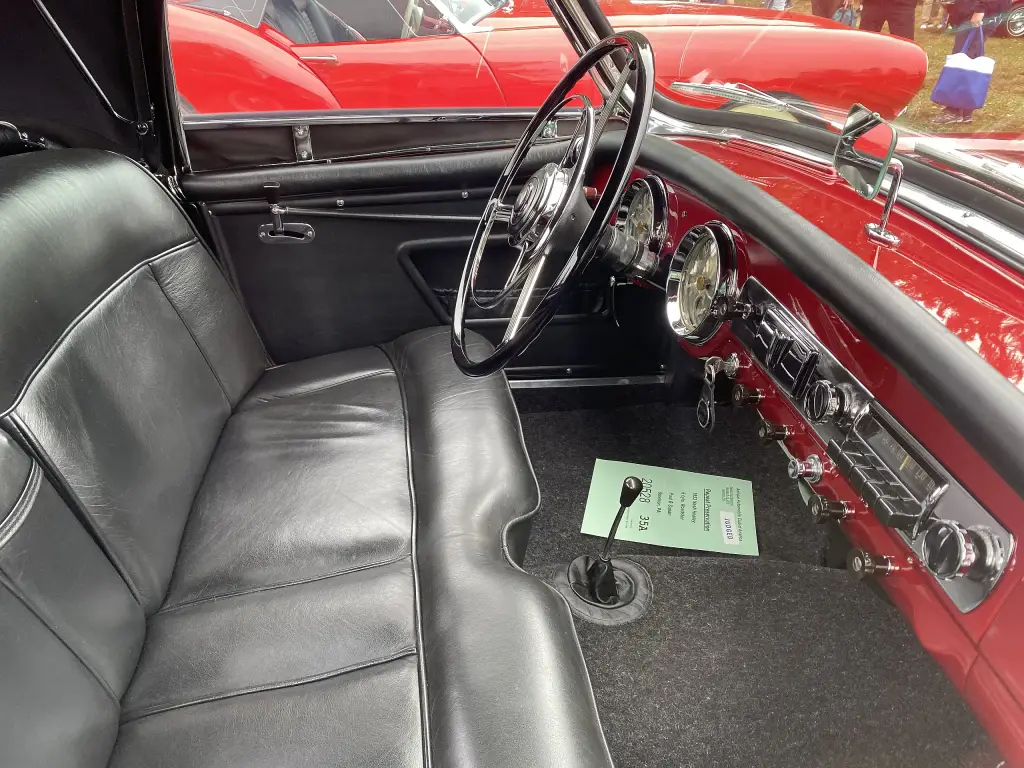
The Nash-Healey was a three-seat luxury sports car built from 1951 to 1954. It combined a chassis from Donald Healey’s British company with the Nash Ambassador’s six-cylinder engine, and it is often called the first post-war sports car from a major American manufacturer.
Nash-Healey at a glance
| Production | 1951–1954 |
|---|---|
| Built | Warwick, England; from 1952 Turin, Italy |
| Engine | 3.85 L OHV straight-six, 125 hp |
| Gearbox | Three-speed manual with Borg-Warner overdrive |
| Chassis | Healey Silverstone box-section ladder frame |
| Body | Aluminium in 1951, steel by Pininfarina from 1952 |
| Wheelbase | 2,591 mm |
| Brakes | Drum, all round |
| Seats | Three |
| 1951 price | $3,767 F.O.B. New York |
| Le Mans 1952 | third overall |
History of the Nash-Healey
In December 1949 Donald Healey sailed to America hoping to buy Cadillac’s new 331 cu in V8 for his Silverstone racer. General Motors refused because of its defence commitments, but on the crossing Healey had met George W. Mason, president of Nash-Kelvinator, who told him to get in touch if the deal failed. Healey did, and Nash agreed to supply engines, gearboxes, prop shafts and axles. As part of the arrangement Nash paid off Healey’s £50,000 bank debt, to be repaid in assembled cars. A prototype was shown at the Paris Motor Show in 1950 and the production car made its debut at the Chicago Auto Show in February 1951.
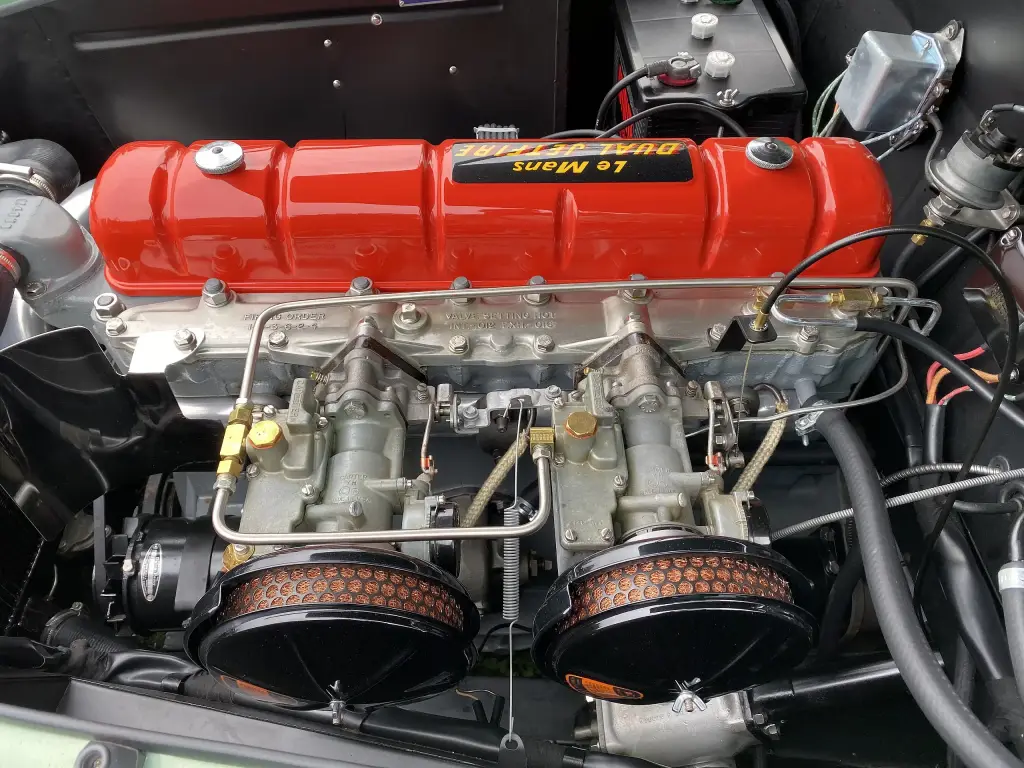
Nash supplied the Ambassador’s 234.8 cu in (3.85 L) overhead-valve six and a three-speed manual with Borg-Warner overdrive. Healey fitted a lighter aluminium cylinder head, twin SU carburettors and a sharper camshaft, raising output from the stock 112 hp to 125 hp. The chassis was a widened and reinforced Healey Silverstone ladder frame with independent front suspension by coil springs, trailing links and an anti-roll bar. At the rear a Nash torque tube and live axle replaced the Silverstone parts, located by a Panhard rod. Panelcraft Sheet Metal of Birmingham made the aluminium body, which wore a Nash grille and bumpers, and Healey carried out final assembly.
For 1952 Nash asked Pininfarina to restyle the car. The new body had a grille with inboard headlights, fender lines ending in small tailfins and a curved windscreen, and steel bodies were built in Turin with final assembly moved to Italy. The restyled car appeared at the Chicago Auto Show that year. Nash-Healeys also went racing, and a car finished third overall at the 1952 24 Hours of Le Mans. The model’s grille later inspired the 1955 Nash Ambassador and Statesman. Production ended in 1954.
Design and features
- Ambassador power: Nash’s 3.85 L six, tuned by Healey to 125 hp with an aluminium head and twin SU carburettors.
- Healey chassis: a widened Silverstone ladder frame with independent front suspension and a Panhard rod.
- Pininfarina body: the 1952 restyle brought inboard headlights and small tailfins.
- Luxury trim: leather upholstery, foam cushions and an adjustable steering wheel.
- Racing record: third overall at Le Mans in 1952.
Nash-Healey versions
- 1951 roadster: aluminium body by Panelcraft, finished in Champagne Ivory or Sunset Maroon.
- 1952 Pininfarina: restyled body with inboard headlights and a curved windscreen.
- 1953–1954: the final steel-bodied cars built in Turin.
- Competition cars: modified road cars and purpose-built racers, including the Le Mans entry.
The Nash-Healey used the engine of the Nash Ambassador, and it was sold alongside the smaller Nash Metropolitan. More cars are in the Nash collection.
Video: 1954 Nash Healey LeMans Coupe Wht KissimmeeAuction012014
Video by Jack R on YouTube.
Sources
- Nash-Healey, English Wikipedia: origin, engineering, model years
- Nash-Healey, German Wikipedia: engine tuning, chassis, production