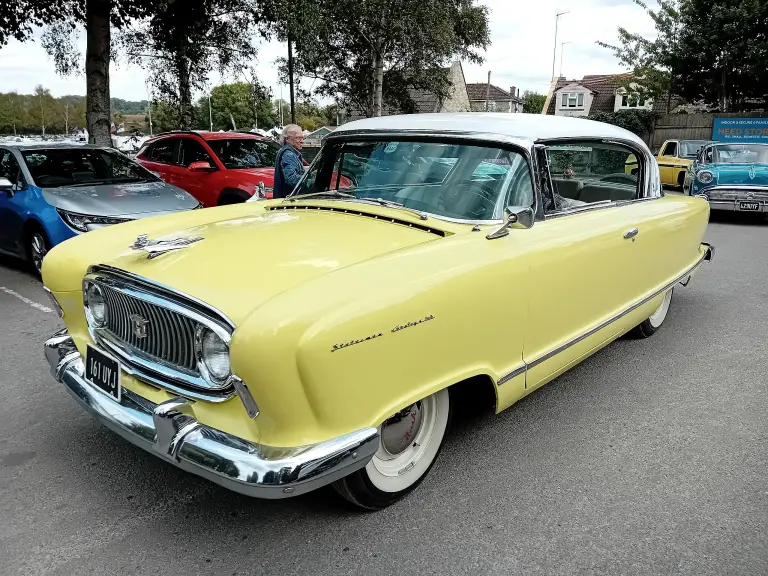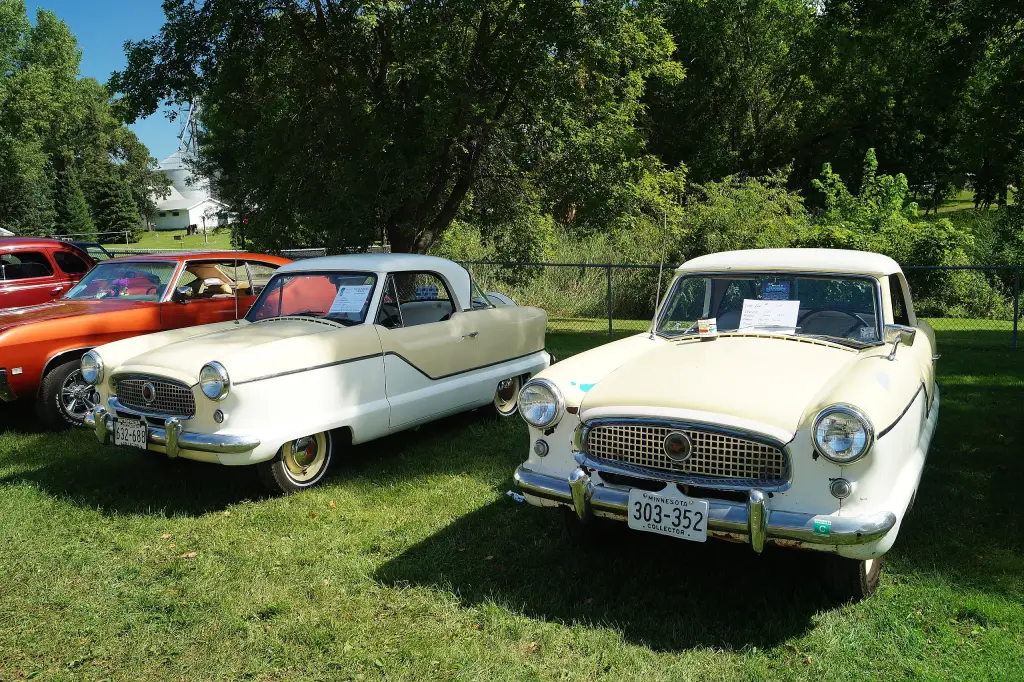
The Nash Metropolitan was designed in Kenosha but built entirely in England by the British Motor Corporation. Marketed from 1953 to 1962, it was aimed at families who wanted a small, economical second car and became one of the best-selling imports in the United States.
Nash Metropolitan at a glance
| Marketed | 1953–1962 |
|---|---|
| Built | Austin works, Longbridge, Birmingham, England |
| Bodies | Fisher & Ludlow, Birmingham |
| Design | William J. Flajole, from the NXI concept |
| Wheelbase | 2,159 mm |
| Length | 3,797 mm |
| Weight | 818 kg |
| Engine | 1,200 cc Austin A40, later B-series; 1,500 cc from 1956 |
| Power | 55 bhp after the 1959 update |
| Gearbox | Three-speed manual |
| US sales | about 95,000 |
| Production ended | April 1961 |
History of the Nash Metropolitan
While most American makers followed a bigger-is-better philosophy, Nash looked for an economical alternative. The Metropolitan was designed in Kenosha and based on the NXI (Nash Experimental International), a concept built by William J. Flajole for Nash-Kelvinator. It was conceived as the second car in a two-car family, for shopping, school runs or the drive to the station, and its wheelbase was shorter than that of the Volkswagen Beetle. The NXI was shown at a series of “surviews” from 4 January 1950 at the Waldorf-Astoria in New York, and the reaction convinced Nash that such a car could sell if it was cheap enough. Building it from scratch in the United States was ruled out by tooling costs, so Nash looked for a European partner.
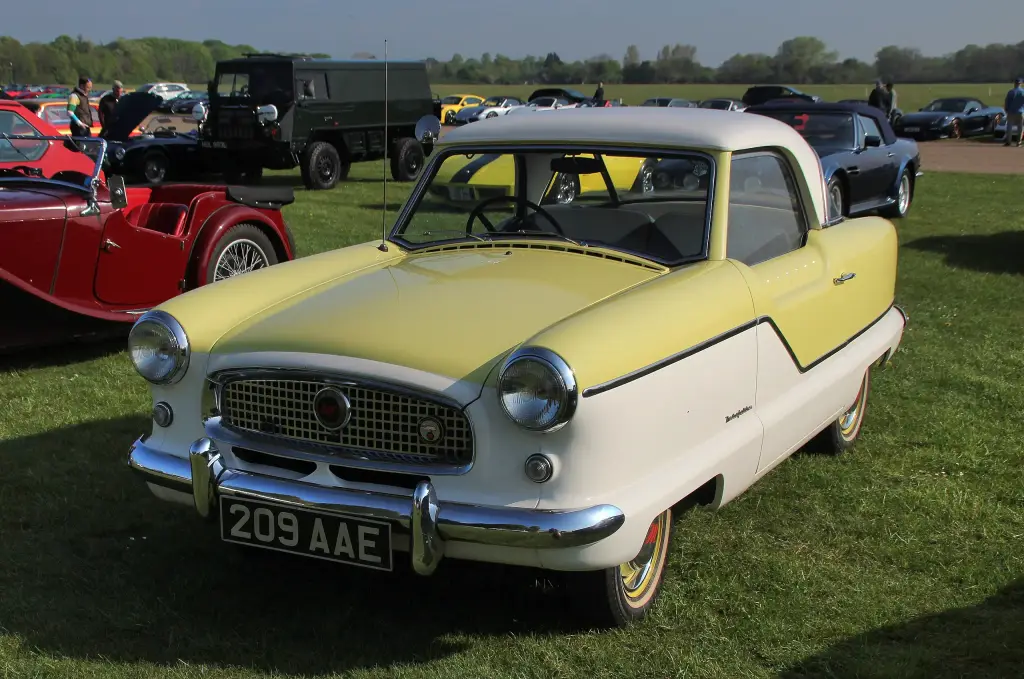
On 5 October 1952 Nash announced that it had chosen the Austin Motor Company, by then part of BMC, and Fisher & Ludlow. Fisher & Ludlow made the bodies, Austin supplied the mechanical parts and carried out final assembly. Total tooling cost was $1,018,475.94, a fraction of the cost of a US-built car. Production began at Longbridge in October 1953 under the name NKI Custom, changed to Metropolitan two months before the March 1954 launch. The first cars used the 1,200 cc A40 engine; after the first 10,000 a B-series 1,200 cc unit was fitted, and in 1956 it grew to 1,500 cc. The 1956 cars also gained two-tone paint and a new grille, and the 1959 update brought an externally accessible boot, front vent windows and a higher compression ratio giving 55 bhp.
The Metropolitan was the first post-war American car marketed specifically to women; its first spokesperson was Miss America 1954, Evelyn Ay Sempier. It was sold as a Nash, as a Hudson after the 1954 merger and, from 1957, as a standalone brand with a stylised M on the grille and hubcaps. About 95,000 were sold in the United States, with 1959 the best year, and the model helped American Motors compete with the Big Three in small cars. Production ended in April 1961 with chassis E95981, though cars were sold into 1962. Austin also built the Austin Metropolitan for Britain and third countries, about 9,400 cars in right- or left-hand drive.
Design and features
- Compact size: shorter in wheelbase than a VW Beetle, with room for two.
- Standard equipment: map light, electric wipers, cigar lighter and a continental spare wheel were fitted as standard.
- American styling in miniature: Nash grille, enclosed front wheels and two-tone paint.
- Unit body: the little car used Nash’s welded unit construction.
- Two body styles: a convertible and a hardtop, both with Bedford cord upholstery.
Nash Metropolitan versions
- Convertible: the open version with a folding roof.
- Hardtop: the closed two-door.
- Hudson Metropolitan: the same car sold through Hudson dealers after 1954.
- Metropolitan (1957–1962): a standalone brand with the M badge.
- Austin Metropolitan: British and export version, about 9,400 built.
- 1,500 cc cars: from 1956, with the larger B-series engine.
The Metropolitan was the smallest Nash, below the Nash Rambler, and it shared the family look with the Nash Ambassador. More cars are in the Nash collection.
Video: 1957 Nash Metropolitan
Video by samspace81 on YouTube.
Sources
- Nash Metropolitan, English Wikipedia: design, BMC deal, marketing
- Nash Metropolitan, German Wikipedia: dimensions, engines, production figures