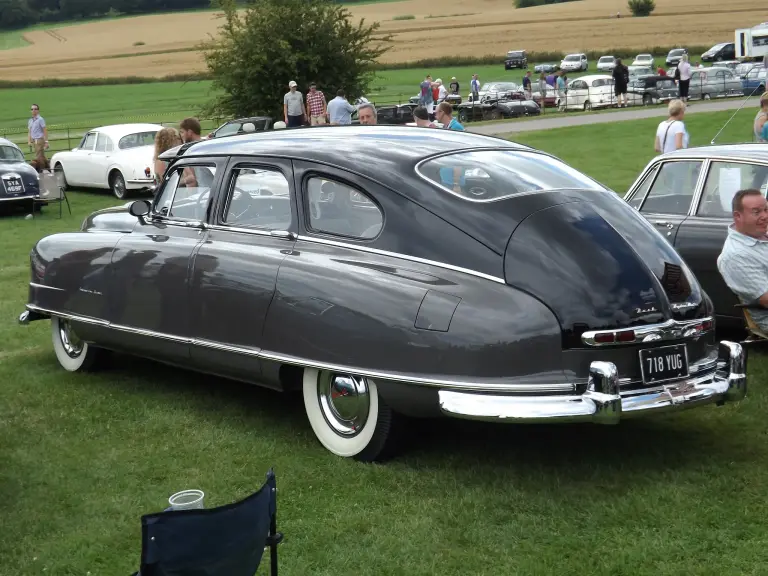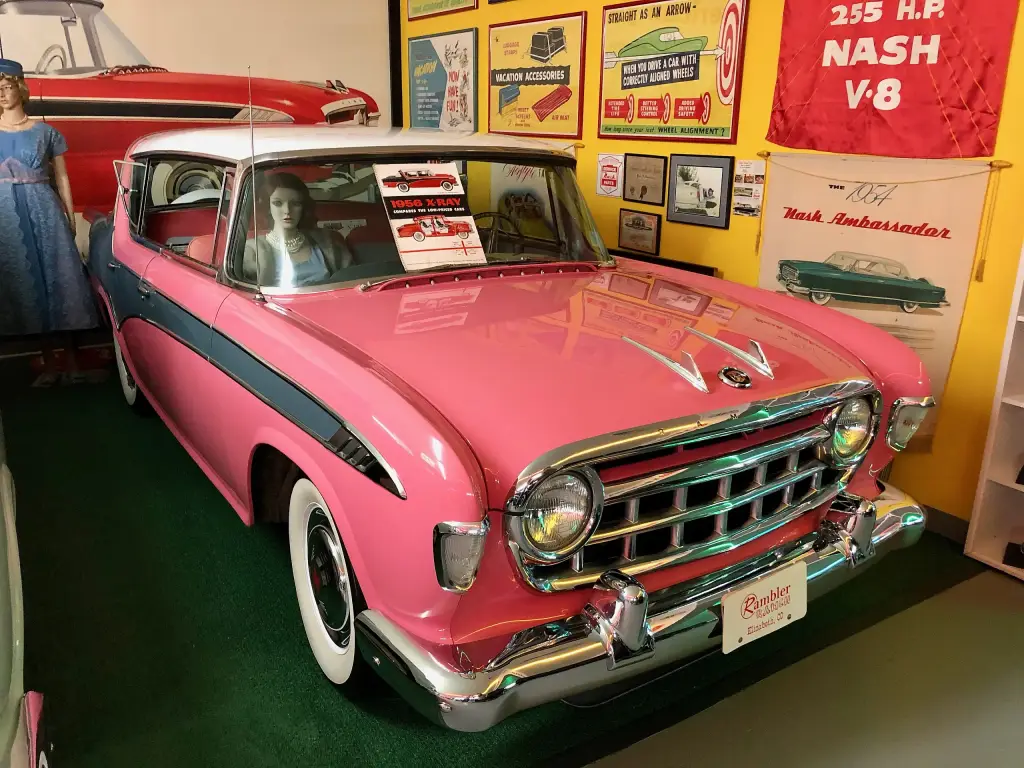
The Nash Rambler was introduced in April 1950 as a small, economical car that was still big enough for a family of five. It created the American compact class, was built in Kenosha and later became a brand in its own right.
Nash Rambler at a glance
| Production | 1950–1954 as a Nash model; Nash-badged until 1956 |
|---|---|
| Wheelbase | 2,540 mm (100 in) |
| Engine | 172.6 cu in (2.8 L) L-head straight-six, 82 hp |
| Gearbox | Three-speed manual with optional overdrive |
| Bodies | fixed-profile convertible, station wagon, hardtop, sedan |
| 1950 price | $1,808 |
| Built | Kenosha, Wisconsin |
| Merger | Nash-Kelvinator and Hudson formed AMC in 1954 |
| Name revived | 1958–1960 |
History of the Nash Rambler
Nash’s president George W. Mason believed a small car would only sell in volume if it was big enough to serve as a family’s main car, and the Rambler was designed to carry five passengers on a 100-inch wheelbase. Power came from Nash’s proven 172.6 cu in (2.8 L) side-valve six of 82 hp. The car was originally to be called the Diplomat, completing the Nash range alongside the Statesman and Ambassador, but Dodge had already reserved that name, so Nash revived Rambler from its own history, a name used on a 1897 prototype and a 1902 production car. The Rambler was launched on 13 April 1950, in the middle of the model year, and the first year was limited to a single model: a fully equipped two-door fixed-profile convertible.
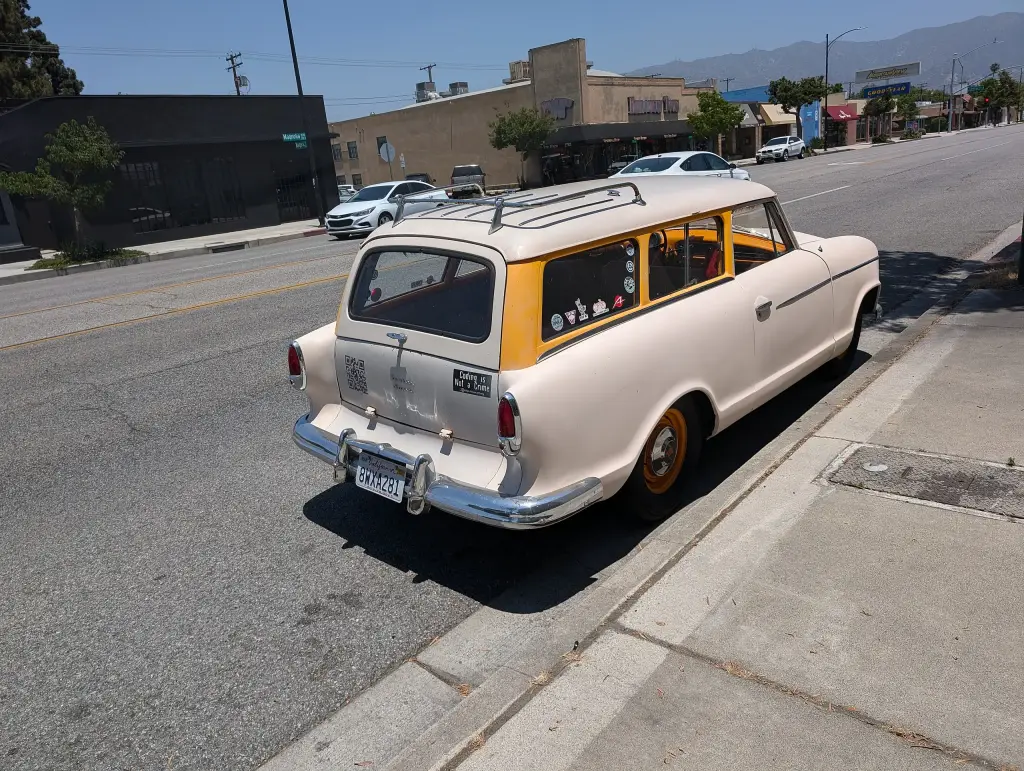
The fixed-profile convertible kept the doors and side-window frames of a closed car, with the metal structure guiding a cable-driven electric roof. That made the body rigid enough for Nash’s unibody construction without extra bracing, and the company demonstrated the strength by turning a car upside down undamaged. A three-door station wagon and a two-door Country Club hardtop joined the range in 1951. The 1953 facelift made the Rambler look like the larger Nashes, and a two-door sedan was added. For 1954 came a four-door sedan and the five-door Cross Country wagon on a longer 2,743 mm wheelbase, and the front wheel arches were opened up from 1955. In January 1954 Nash-Kelvinator merged with Hudson to form American Motors, and the same car was also sold as the Hudson Rambler.
A completely new Rambler arrived for 1956 with a longer body, four- and five-door models and the first hardtop station wagon. In 1957 Rambler became a separate brand and the Nash and Hudson names were dropped.
Design and features
- Compact class: a 100-inch wheelbase and room for five, smaller and lighter than the Big Three’s cars.
- Fixed-profile convertible: a power roof with the side frames of a closed car, stiff enough for unibody construction.
- Well equipped: whitewall tyres, full wheel covers, an electric clock and a push-button AM radio.
- Economy: lower weight and a small six gave better fuel consumption than larger cars.
- Nash styling: rounded ponton body and enclosed front wheels.
Nash Rambler versions
- 1950 convertible: the only body style at launch, also offered in Landau trim.
- 1951 station wagon: a three-door wagon added to the range.
- Country Club: two-door hardtop from 1951.
- 1953 facelift: new styling and a two-door sedan.
- 1954 Cross Country: five-door wagon on the longer wheelbase.
- 1956 range: new body, four-door hardtop and the first hardtop wagon.
The Rambler was the smallest Nash, below the Nash Statesman, and it shared the compact market with the Nash Metropolitan. More cars are in the Nash collection.
Sources
- Nash Rambler, English Wikipedia: development, launch, body styles
- Nash Rambler, German Wikipedia: model years, updates, merger