The Mitsubishi Lancer Evolution, usually called the Lancer Evo or simply Evo, is a sports saloon and rally car based on the Lancer and built from 1992 to 2016. Ten official versions were made, all with two-litre intercooled turbocharged four-cylinder engines and four-wheel drive.
Mitsubishi Lancer Evolution at a glance
| Maker | Mitsubishi Motors |
|---|---|
| Production | 1992–2016 |
| Versions | ten, most named by Roman numeral |
| Engine | two-litre intercooled turbo four, the 4G63 |
| Drive | four-wheel drive |
| Evolution I | 250 PS, 309 Nm, 5,000 built |
| Evolution II | 260 PS, December 1993 |
| Evolution III | 270 PS, 10,080 built |
| Japanese power limit | 280 PS by gentlemen’s agreement until 2005 |
| UK specials | up to 446 PS |
| Final version | Evolution X, 2007–2016 |
| Also sold as | Carisma GT in some European markets, Proton variants for rallying |
Based on one source: the English Wikipedia article on the Lancer Evolution, which describes the early versions in most detail.
History of the Mitsubishi Lancer Evolution
Rally parts in a Lancer
The first Lancer Evolution used the 2.0-litre turbocharged double-overhead-camshaft engine and four-wheel-drive drivetrain of the Galant VR-4 in a Lancer chassis. It was sold as the GSR Evolution and the stripped-down GSR Evolution RS, which lacked power windows and seats, anti-lock brakes and a rear wiper, had steel wheels and weighed about 70 kg less than the 1,238 kg GSR, ready for racing or tuning. The 4G63 produced 250 PS at 6,000 rpm and 309 Nm at 3,000 rpm; 5,000 first-generation cars were sold in 1992 and 1993, with a top speed of 228 km/h. The GSR was the only Evolution with a viscous limited-slip rear differential; later cars used a mechanical plate type.
The Evolution II of December 1993, built until February 1995, concentrated on handling: small wheelbase adjustments, a lighter front anti-roll bar linked to the struts, a larger spoiler, tyres 10 mm wider and a 50-litre fuel tank. Power rose to 260 PS. Most cars came with 15-inch OZ five-spoke wheels, while RS models, mostly sold to privateer racing teams, left the factory on steel wheels.
Evolution III to X
The Evolution III arrived in February 1995 with more aggressive styling and a new nose moulding that improved the air supply to the radiator, intercooler and brakes. New side skirts, a rear bumper moulding and a larger spoiler reduced lift, and a higher compression ratio and a larger turbocharger compressor raised output to 270 PS at 6,250 rpm. A total of 10,080 were built, 8,998 GSRs and 1,082 RS models.
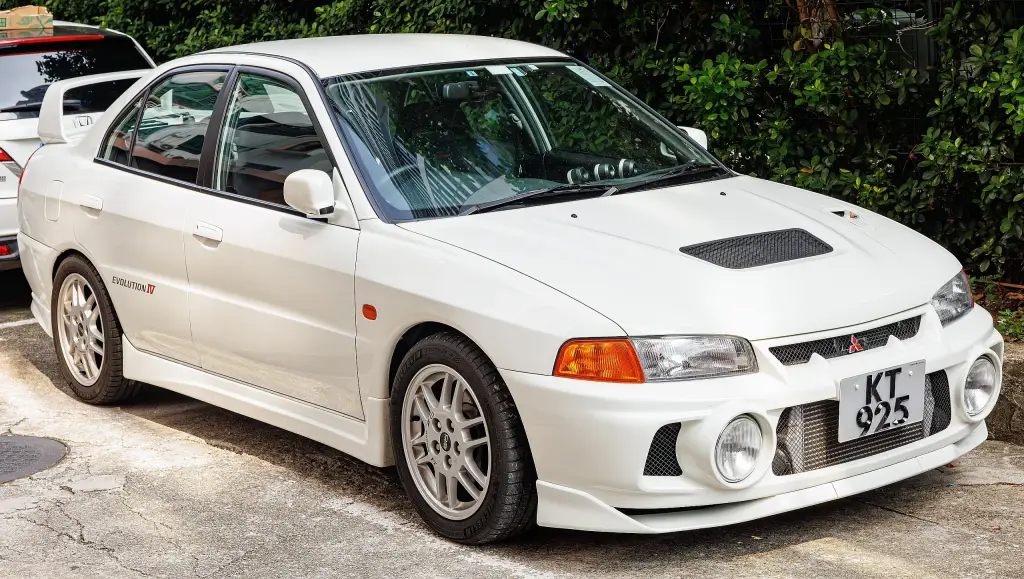
The platform was redesigned in 1996, and with it the Evolution IV, whose engine and transaxle were turned through 180 degrees to improve weight balance. The Evolution was intended for Japan only, but grey-import demand led Mitsubishi to sell it through Ralliart dealers in Britain and other European markets from about 1997 with the Evolution IV; in some of those markets the IV, V, VI and VII were sold as the Carisma GT because the regular Lancer was not widely available. The Evolution VIII went to the United States in 2003 after Subaru’s success there with the Impreza WRX.
The 280 PS agreement
Until the Evolution IX of 2005, every Japanese-market version was limited by a gentlemen’s agreement among Japanese makers to advertise no more than 280 PS. Sources say Mitsubishi was already building more powerful cars and underrating them to comply, so each version unofficially exceeded its published figure, and the Japanese Evolution IX was alleged to produce around 320 PS. Special versions elsewhere, particularly in Britain, had official outputs of up to 446 PS. Some Evolutions were also homologated by the FIA for Proton, the Evolution II and III as the Proton Wira 4WD Turbo and the V, VI and VII as the Proton PERT.
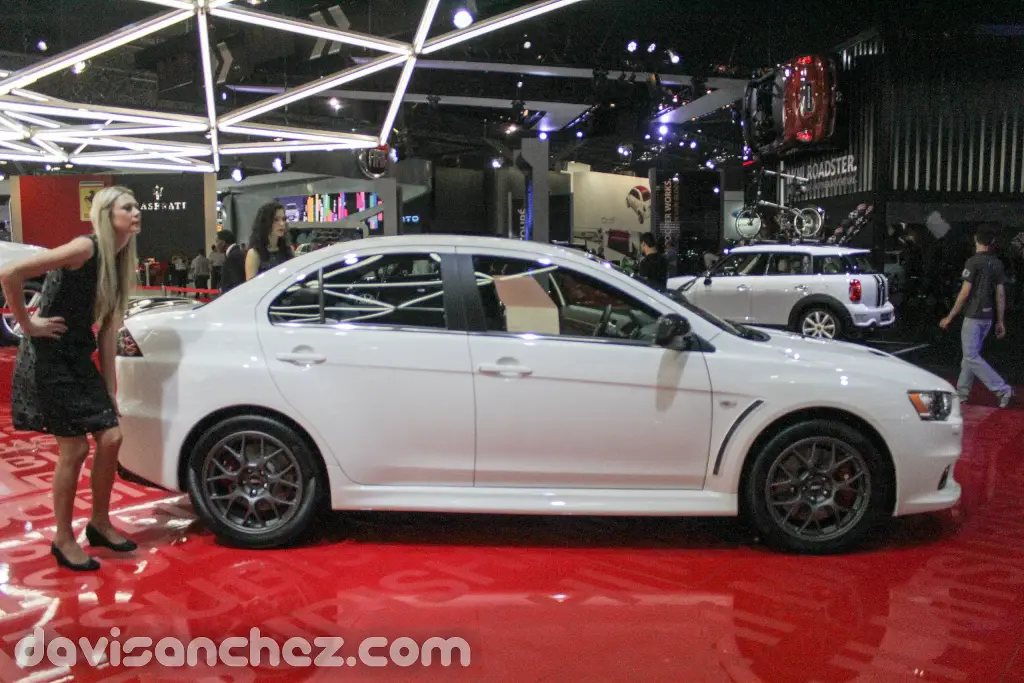
The tenth and last version, the Evolution X, was launched in Japan in 2007 and overseas in 2008, and was built for nine years until Mitsubishi retired the Lancer Evolution in April 2016.
Design and features
- Ten versions: all with a two-litre turbo engine and four-wheel drive.
- RS models: lightened cars for racing and tuning.
- Galant VR-4 engine: the first Evolution used the drivetrain of the larger car.
- Carisma GT: the name used in some European markets.
- Understated power: official figures were capped at 280 PS in Japan.
Mitsubishi Lancer Evolution versions
- Evolution I (1992): 250 PS, GSR and RS, 5,000 built.
- Evolution II (1993): 260 PS with handling changes.
- Evolution III (1995): 270 PS and new aerodynamics.
- Evolution IV (1996): new platform and rotated drivetrain.
- Evolution VIII (2003): first officially sold in the United States.
- Evolution IX (2005): the last under the 280 PS agreement.
- Evolution X (2007): the final version, built until 2016.
The Evolution is the rally derivative of the Lancer and shares its engine with the Galant VR-4. Its European badge was the Carisma GT, and more cars are in the Mitsubishi collection.
Sources
- Mitsubishi Lancer Evolution, English Wikipedia: versions, engines, power figures, markets