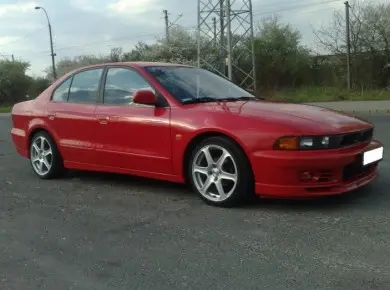
The Mitsubishi Galant is an automobile produced from 1969 until 2012. Its name comes from the French word galant, meaning chivalrous, and it went through nine distinct generations with total sales of more than five million units, growing from a compact sedan into a mid-size car along the way.
Mitsubishi Galant at a glance
| Maker | Mitsubishi Motors |
|---|---|
| Production | 1969–2012 |
| Generations | nine |
| Sales | over five million |
| Name | from the French galant, chivalrous |
| First generation | A50, December 1969 |
| First generation style | Dynawedge |
| First engines | Saturn 1.3 and 1.5 |
| Coupés | Galant GTO from 1970, Galant FTO from 1971 |
| Second generation | A112, A114, A115, from May 1973 |
Based on one source: the English Wikipedia article on the Mitsubishi Galant, of which the material available covers the first two generations in detail and the other seven only in outline. The page follows that balance.
History of the Mitsubishi Galant
The Colt Galant of 1969
The first generation was released in December 1969 as the Colt Galant at a new Japanese dealership chain called Galant Shop. Mitsubishi called the design Dynawedge, referring to the influence of aerodynamics on the silhouette. Three models were available with the new Saturn engine in 1.3 and 1.5-litre form, coded AI, AII and AIII; 1.4 and 1.6-litre versions replaced them in September 1971, and a larger 115 PS 1.7-litre arrived for the top GS model in January 1973.
At first only a four-door sedan was sold, with five-door estate and two-door hardtop A53 variants added in 1970. The hardtop was Mitsubishi’s first production passenger car with full side windows and no side pillars. In March 1973, with only two months of production left, the cleaner MCA-II version of the 1.6 arrived with 97 PS, three horsepower down on the regular engine. The Galant competed with the Toyota Corona, Nissan Bluebird, Honda Accord and Mazda Capella.
The Galant was Mitsubishi’s first car sold in the United States, from 1971, when Chrysler began importing it as the Dodge Colt as an answer to the Ford Pinto, Chevrolet Vega and AMC Gremlin. It was also built by Chrysler Australia and sold as the Chrysler Valiant Galant, and in South Africa the A53 Colt Galant arrived in late 1972 as the Dodge Colt 1600 GS with Rostyle wheels.
GTO and FTO
From 1970 a fastback coupé was developed as the Galant GTO, styled after contemporary American muscle cars and sold with a choice of two Saturn engines and the 2-litre Astron 80 until 1975. The name was held in such regard in Japan that it was revived for the 1990 Mitsubishi GTO coupé. A third, more compact coupé followed in 1971 on a chassis shortened by 12 cm: the Galant FTO, powered by the 1.4-litre 4G41, whose name Mitsubishi returned to in the 1990s with the FTO.
In New Zealand, this generation in 1.6-litre coupé form was the first model to establish the Mitsubishi brand from 1971, when the new distributor Todd Motors began selling Japanese-assembled cars to supplement its Hillman range. The coupé was assembled locally from 1972, first at Petone and from 1974 at a new factory in Porirua.
The second generation
The second-generation Colt Galant A11 series was introduced on 24 May 1973 and went on sale on 1 June, and was more widely exported as Mitsubishi’s ambitions grew. It was again sold by Chrysler in many guises: as the Dodge Colt in the United States, the Plymouth Colt and Plymouth Cricket in Canada from 1974, the Chrysler Valiant Galant and Chrysler Galant in Australia and the Colt Galant in Europe. Transmissions were all floor-mounted, with a four-speed manual, a five-speed for sportier models and a three-speed automatic.
The 1.6-litre engine was available in MCA-II form from the start, meeting Japan’s 1975 emissions standards at 97 PS rather than 100. The new Galant was more curvaceous, influenced by coke-bottle styling, and used larger Astron engines of up to 125 PS in 2.0-litre form alongside the Saturn units. The first Astron 80 engines brought Mitsubishi’s Silent Shaft balance-shaft technology. Body styles stayed the same as before, with the addition of a fixed-post coupé for some markets, and new models included the GL-II, SL-5, GT and GS-II; the estate was sold as a commercial vehicle in Japan with the 100 PS 1.6.
Seven more generations followed between 1976 and 2012, including the front-wheel-drive cars of the 1980s and the mid-size Galants of the 1990s and 2000s, and cumulative sales passed five million. The material available for this page describes only the first two generations in detail.
Design and features
- Dynawedge: the aerodynamic name Mitsubishi gave the 1969 shape.
- Galant Shop: the Japanese dealership chain launched with the car.
- Two famous coupés: the GTO of 1970 and the FTO of 1971.
- Chrysler exports: sold as the Dodge Colt and Chrysler Valiant Galant.
- Nine generations: production ran from 1969 to 2012.
Mitsubishi Galant versions
- A50 (1969): first-generation Colt Galant with Saturn engines.
- Galant GTO (1970): fastback coupé with muscle-car styling.
- Galant FTO (1971): short-chassis 1.4-litre coupé.
- A53 hardtop: pillarless two-door.
- Second generation (1973): A112, A114 and A115 with Astron engines.
The Galant gave its name and engines to the FTO and the 3000GT, and it shared its platform with the Diamante. Its rally relative was the Lancer Evolution, and more cars are in the Mitsubishi collection.
Sources
- Mitsubishi Galant, English Wikipedia: first and second generations, coupés, exports