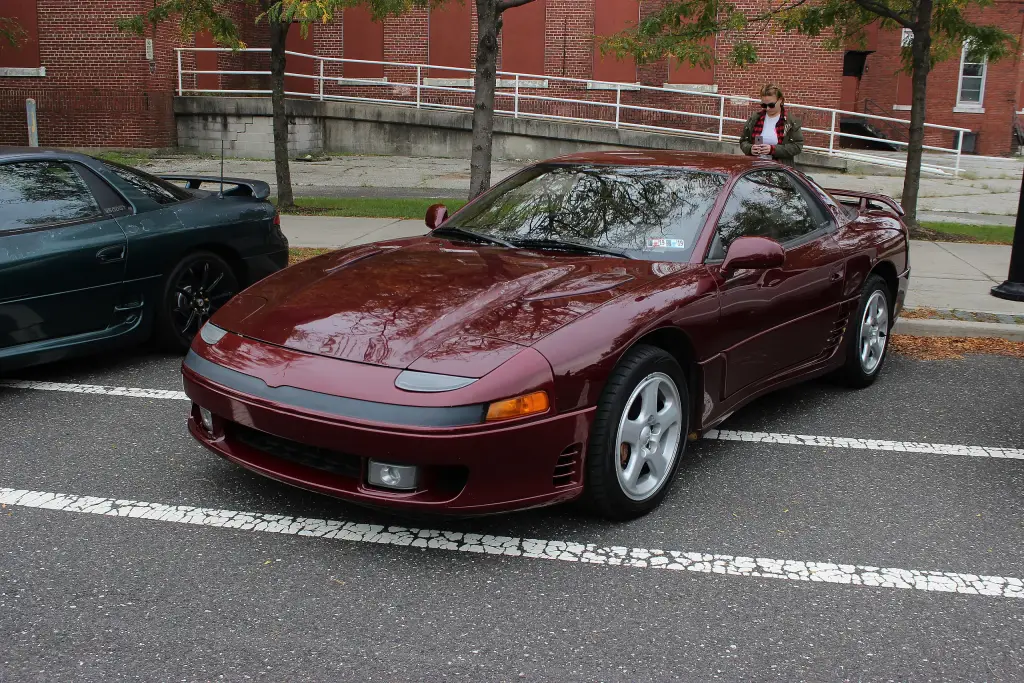
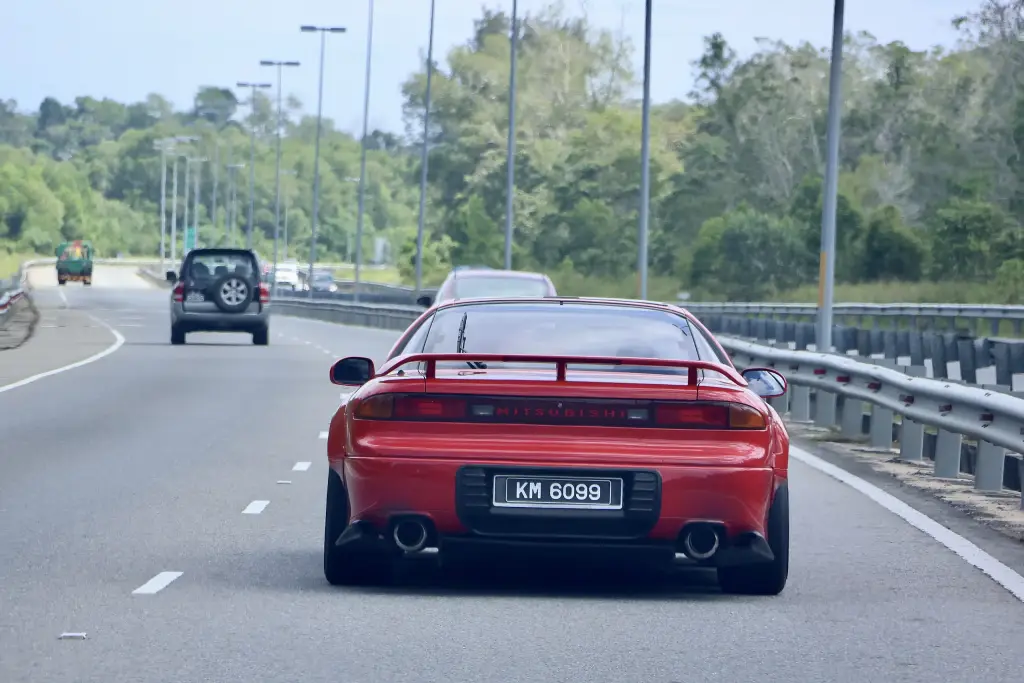
The Mitsubishi 3000GT is a front-engined grand tourer built from 1990 to 2000 and sold in Japan as the GTO. In its VR-4 form it combined a twin-turbocharged 3.0-litre V6 with four-wheel drive, four-wheel steering and active aerodynamics, and it was Mitsubishi’s flagship for most of the decade.
Mitsubishi 3000GT at a glance
| Maker | Mitsubishi Motors, Nagoya, Japan |
|---|---|
| Production | 1990–2000 |
| Also sold as | GTO in Japan, Dodge Stealth in North America |
| Layout | front engine, front- or all-wheel drive |
| Body | three-door hatchback coupé, 2+2 seats |
| Engines | 3.0-litre V6: 164 hp SOHC, 222 hp DOHC, 300 hp twin-turbo |
| European turbo | 286 PS, larger TD04-13G turbochargers |
| Gearbox | five-speed manual, four-speed automatic |
| Chassis code | Z16A |
| Drag coefficient | Cd 0.33 |
| Retractable hardtop | GT Spyder and VR-4 Spyder, 1993–1995 |
| Built | 86,151, plus 65,303 Dodge Stealths |
Based on one source: the English Wikipedia article on the Mitsubishi 3000GT.
History of the Mitsubishi 3000GT
A flagship from the bubble years
After showing the HSR and HSX concept cars at the 1989 Tokyo Motor Show, Mitsubishi unveiled the new GTO as a 2+2 grand tourer aimed at the Mazda RX-7, Nissan 300ZX, Honda NSX, Subaru SVX and Toyota Supra. The name came from the Galant GTO of the early 1970s, which in turn took it from the Ferrari 250 GTO. Outside Japan the car was called the 3000GT, because Mitsubishi feared that buyers would object to the historic name being used on a Japanese car. In North America it was also sold as the Dodge Stealth, a badge-engineered version styled by Chrysler.
The car was based on the Sigma and Diamante and kept their transversely mounted 3.0-litre 24-valve V6 engines. The first series, internally Z16A, had permanent four-wheel drive and four-wheel steering under the name Mitsubishi AWC, together with an Active Aero Control System that deployed front and rear spoilers automatically and a switchable exhaust. Pop-up headlights and articulated caps on the bonnet for the suspension controllers completed the look, which reached a drag coefficient of 0.33.
Three series and three engines
In North America the base 3000GT and SL used a 222 hp double-overhead-camshaft V6, while the VR-4 had a twin-turbocharged version of the same engine with 300 hp, a five-speed Getrag gearbox, limited-slip differential, electronically controlled suspension and 17-inch Z-rated tyres. A 164 hp single-overhead-camshaft V6 was offered in the cheapest Dodge Stealth. European models, on sale from the autumn of 1992, used larger TD04-13G turbochargers running 13 psi instead of 9 psi, which gave 286 PS and lower charge temperatures for sustained Autobahn speeds, along with an upgraded transmission.
For model years 1993 to 1995 Mitsubishi offered a retractable hardtop built in California by ASC and sold as the GT Spyder or VR-4 Spyder. It was the first fully automated retractable hardtop on the market since the 1959 Ford Skyliner. A Dodge Stealth had been scheduled as the 1991 Indianapolis 500 pace car, but the United Auto Workers objected to a Japanese-built car, and a Dodge Viper prototype took its place.
The end
Japanese sales coincided with the collapse of the bubble economy, and the GTO carried extra annual road tax at home because its size put it in the large-car class. Production ended in 2000 after three series. In total about 86,151 Mitsubishi 3000GTs and 65,303 Dodge Stealths were built on the same line in Nagoya.
Design and features
- VR-4 running gear: permanent four-wheel drive, four-wheel steering and a limited-slip differential.
- Twin-turbo V6: 300 hp in Japan and America, 286 PS in Europe with larger turbochargers.
- Active aero: automatically deploying spoilers and a switchable exhaust on early cars.
- Spyder: a factory retractable hardtop, the first since the Ford Skyliner.
- Two badges: Mitsubishi 3000GT and Dodge Stealth, built on one line.
Mitsubishi 3000GT versions
- 3000GT and 3000GT SL: 222 hp DOHC V6, front-wheel drive.
- VR-4: twin-turbo 300 hp, all-wheel drive, four-wheel steering and active aero.
- Dodge Stealth: Chrysler-styled version, 1991–1996, with a 164 hp base engine.
- GT Spyder and VR-4 Spyder: retractable hardtop, 1993–1995.
- European twin turbo: 286 PS with TD04-13G turbochargers from 1992.
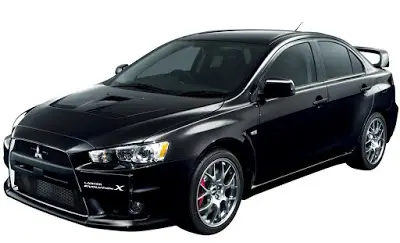
The 3000GT shared its engines with the Diamante and took its name from the earlier Galant GTO. Its rally-bred stablemate was the Lancer Evolution, and more cars are in the Mitsubishi collection.
Sources
- Mitsubishi 3000GT, English Wikipedia: history, engines, production totals, markets