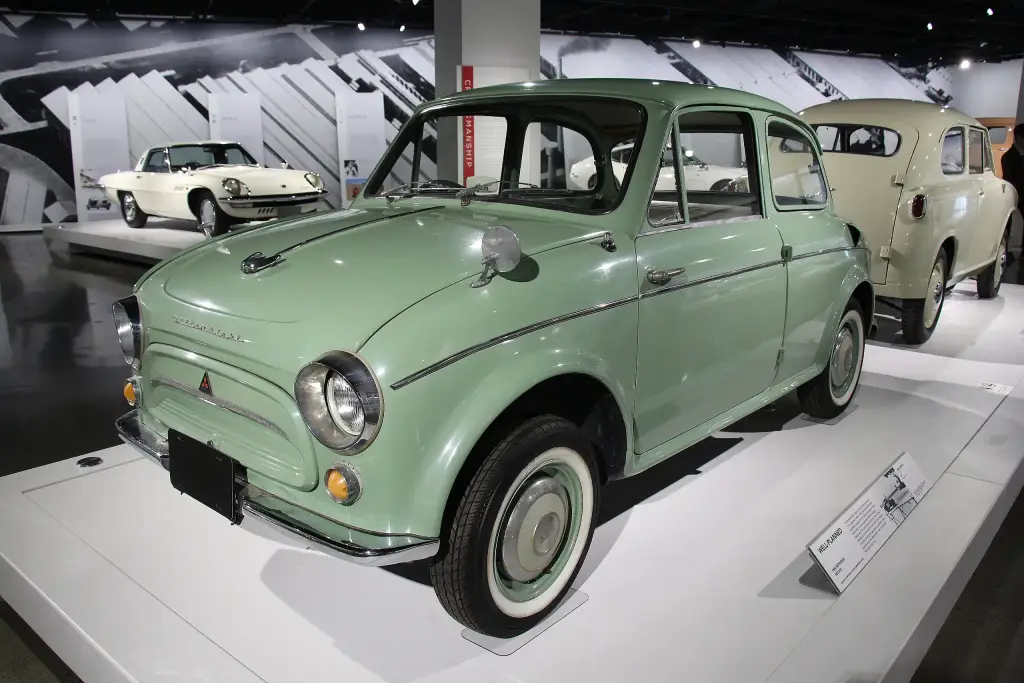
The Mitsubishi 500 was the first passenger car produced after the Second World War by Shin Mitsubishi Heavy-Industries, one of the companies that became Mitsubishi Motors. Built from 1960 to 1962, it was a small rear-engined saloon that formed the basis for the Colt 600.
Mitsubishi 500 at a glance
| Maker | Shin Mitsubishi Heavy-Industries |
|---|---|
| Production | 1960–1962 |
| First shown | 1959 Tokyo Motor Show |
| Price | 390,000 yen |
| Engine | 493 cc air-cooled two-cylinder, 21 PS |
| Layout | rear engine, rear-wheel drive |
| Gearbox | three-speed manual |
| Body | monocoque, four seats |
| Chassis codes | A10, later A11 |
| 500 Super DeLuxe | August 1961, 594 cc, 25 PS |
| Survivors | eight known in 1999, four as of 2026 |
Based on one source: the English Wikipedia article on the Mitsubishi 500.
History of the Mitsubishi 500
A people’s car for Japan
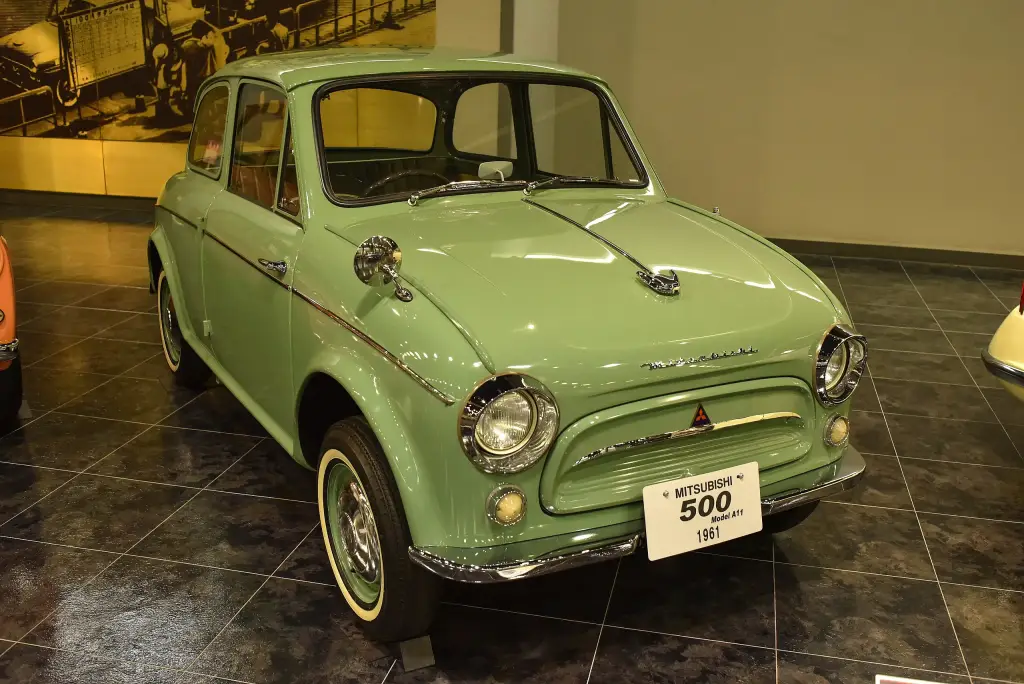
The 500 was first shown at the 1959 Tokyo Motor Show and went on sale in 1960 for 390,000 yen. Behind the rear axle sat an air-cooled 493 cc two-cylinder engine with a single downdraught carburettor, producing 21 PS at 5,000 rpm and driving through a three-speed manual gearbox. The body was a monocoque, chosen to be light and strong enough to seat four people and reach 100 km/h with such a small engine.
The car was not a kei car: the kei rules of the time limited engines to 360 cc, a limit that stayed until it was raised to 550 cc on 1 January 1976. The 500 was therefore a small ordinary car, exported in small numbers.
500 Super DeLuxe
In August 1961 the engine was enlarged to 594 cc and 25 PS for better acceleration and durability, and the model became the 500 Super DeLuxe. The succeeding Colt 600 used much of the Super DeLuxe’s underpinnings, including the engine and the rear-engined layout.
Rarity and racing
Correspondence from 1999 recorded just eight surviving cars, and as of 2026 four remain. Two are in Japanese museums, at the Mitsubishi Auto Gallery in Okazaki and the Toyota Automobile Museum, one was shown at the Petersen Automotive Museum in Los Angeles in 2018 and 2019, and one is in private hands in Great Britain, bought in 1999 for 2,400,000 yen and still in unmolested original condition.
Mitsubishi’s first homologation special was a Super DeLuxe-based touring car prepared for the 1962 Macau Grand Prix. Kazuo Togawa took class honours on its debut, and the little saloons swept the top four places in the under-750 cc category.
Design and features
- First postwar car: the beginning of Mitsubishi passenger car production.
- Air-cooled twin: 493 cc, 21 PS, mounted behind the rear axle.
- Monocoque body: light and stiff enough for four seats and 100 km/h.
- Super DeLuxe: a 594 cc, 25 PS engine from August 1961.
- Macau class win: a works touring car won its class in 1962.
Mitsubishi 500 versions
- 500 (1960–1962): 493 cc A10, later A11.
- 500 Super DeLuxe (1961): 594 cc NE35A engine with 25 PS.
- Macau touring car (1962): a Super DeLuxe prepared for racing.
The 500 led to the Colt line and to the Minica kei car; more early Mitsubishi models are in the Mitsubishi collection.
Sources
- Mitsubishi 500, English Wikipedia: history, engine, survivors, motorsport