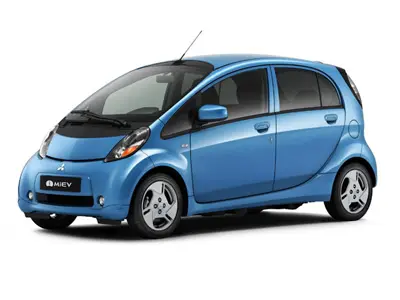
The Mitsubishi i-MiEV is a five-door electric city car produced from 2009, the electric version of the Mitsubishi i kei car. MiEV stands for Mitsubishi innovative Electric Vehicle, and the car was the world’s first modern highway-capable mass-production electric car. It was also sold by PSA as the Peugeot iOn and Citroën C-Zero.
Mitsubishi i-MiEV at a glance
| Maker | Mitsubishi Motors |
|---|---|
| On sale | July 2009 to fleets, April 2010 to the public |
| Type | five-door electric city car |
| Basis | Mitsubishi i kei car |
| Motor | permanent magnet synchronous, 49 kW, 180 Nm |
| Drive | rear wheels through a single-speed reduction gear |
| Battery | 16 kWh lithium-ion, 88 cells |
| Range | 160 km on the Japanese cycle, 100 km on the US EPA cycle |
| Top speed | 130 km/h |
| Rebadged versions | Peugeot iOn, Citroën C-Zero |
| Global sales | over 50,000 by March 2015 |
Based on one source: the English Wikipedia article on the Mitsubishi i-MiEV. No free photos of the model were found in the material, so the article keeps the earlier picture.
History of the Mitsubishi i-MiEV
An electric kei car
The i-MiEV is based on the Mitsubishi i kei car and was first exhibited at the 22nd International Battery, Hybrid and Fuel Cell Electric Vehicle Symposium in Yokohama. Mitsubishi chose not to use in-wheel motors, preferring a conventional arrangement of batteries, motor and inverter in place of the rear midship engine and fuel tank of the petrol car. The company gave three power companies vehicles in 2006 and 2007 for joint research on fast-charging infrastructure, and five power companies ran fleet tests in 2007. Early cars had a range of 130 km with a 16 kWh lithium-ion pack and 160 km with a 20 kWh pack, and a top speed of 130 km/h.
The i-MiEV went on sale to fleet customers in Japan in July 2009 and to the wider public on 1 April 2010. International sales to Asia, Australia and Europe began in 2010, with Central and South America following in 2011, and fleet and retail deliveries in the United States and Canada started in December 2011. The American version is larger than the Japanese car and has several additional features.
Powertrain and battery
The production car has a single permanent magnet synchronous motor on the rear axle with a peak output of 49 kW between 2,500 and 8,000 rpm and 180 Nm from 0 to 2,000 rpm, with a continuous rating of 35 kW. The North American model had a rated stall torque of 197 Nm. The motor is water-cooled through a conventional radiator and electric fan, and a single-speed reduction gear drives the rear wheels.
The 16 kWh pack has 88 cells under the floor in 12 modules at a nominal 330 V, with two four-cell modules standing vertically in the middle and ten eight-cell modules lying horizontally. The LEV50 cells were developed by Mitsubishi and GS Yuasa and made by Lithium Energy Japan, a joint venture of GS Yuasa, Mitsubishi Corporation and Mitsubishi Motors. The pack has a specific energy of 80 Wh/kg; each cell is rated at 3.7 V and 50 Ah and weighs 1.7 kg. Forced air cooling protects the battery during high charge and discharge rates, a heater is optional for cold-weather charging, and rapid charging cools the pack with refrigerated air from the air conditioning.
Range, sales and versions
Mitsubishi quotes 160 km on the Japanese test cycle, and the 2012 American version was rated at 62 miles on the EPA cycle. In November 2011 the Mitsubishi i topped the EPA’s 2012 Fuel Economy Guide and became the most efficient EPA-certified vehicle for all fuels until the Honda Fit EV passed it in June 2012. By July 2014 Japan was the leading market with over 10,000 cars, followed by Norway with more than 4,900, France with over 4,700 and Germany with over 2,400, while the United States had over 1,800 by August 2014. Including the two Minicab MiEV versions sold in Japan, global sales passed 50,000 by early March 2015. PSA sold the car as the Peugeot iOn and Citroën C-Zero from 2010 and was contracted to buy 100,000 i-MiEVs over a period that remained confidential.
Design and features
- First of its kind: the first modern mass-produced highway-capable electric car.
- 16 kWh battery: 88 LEV50 cells under the floor.
- Rear motor: 49 kW and 180 Nm through a single-speed gearbox.
- PSA twins: sold as the Peugeot iOn and Citroën C-Zero.
- 50,000 cars: global sales by early 2015.
Mitsubishi i-MiEV versions
- i-MiEV (2009): the original Japanese car.
- American version (2011): larger, with more equipment.
- Peugeot iOn and Citroën C-Zero: PSA versions from 2010.
- Minicab MiEV: commercial versions sold in Japan.
The i-MiEV is the electric version of the Mitsubishi i kei car and the electric relative of the Minicab MiEV. More cars are in the Mitsubishi collection.
Sources
- Mitsubishi i-MiEV, English Wikipedia: history, powertrain, battery, range, sales