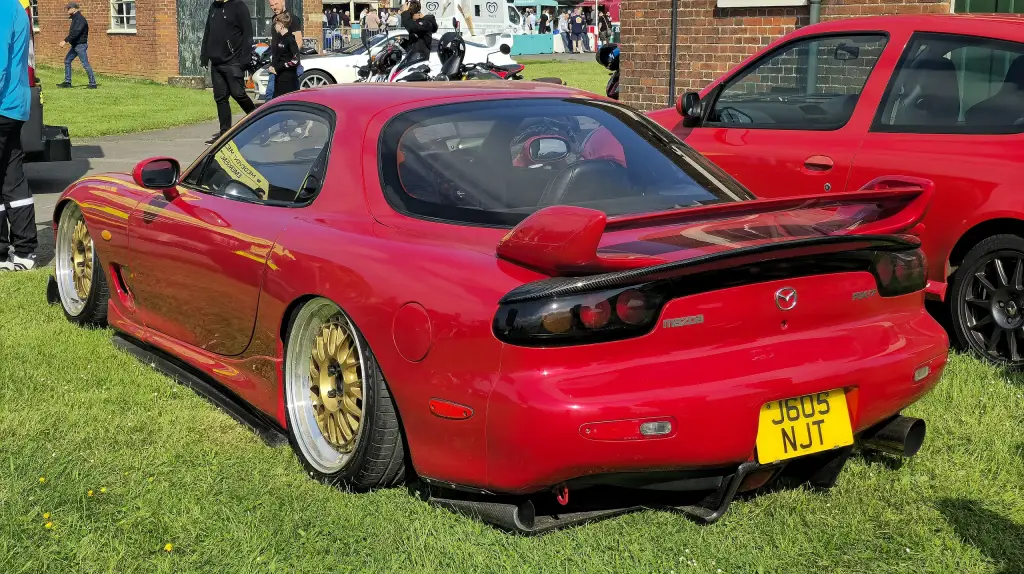
The Mazda RX-7 is a sports car that Mazda built from 1978 to 2002 over three generations. It has a front mid-mounted engine, rear-wheel drive and a compact, light Wankel rotary engine. More than 800,000 RX-7s were built, making it the most successful rotary sports car in history.
Mazda RX-7 at a glance
| Built | 1978–2002, three generations |
|---|---|
| Generations | SA/FB, FC and FD |
| Layout | front mid-engine, rear-wheel drive |
| First generation | SA (early) and FB (late), two-seater coupé with a rear hatch |
| First-generation engines | 12A carburettor, later 13B with electronic fuel injection |
| Second generation | FC, coupé with optional 2+2 and a convertible |
| Second-generation engine | 13B, naturally aspirated or turbocharged |
| Third generation | FD, 2+2 for Japan, sequential twin-turbo 13B REW |
| First-generation launch | March 1978 in Japan |
| Built | over 800,000 |
History of the Mazda RX-7
The first-generation RX-7, codenamed SA early and FB late, was a two-seater coupé with a rear hatchback and a 12A carburetted rotary engine, with the option of a 13B with electronic fuel injection in later years. Mazda’s internal project number for the car was X605. In Japan it was introduced in March 1978, replacing the Savanna RX-3 and joining the Cosmo and Luce as Mazda’s remaining rotary models. The lead designer was Matasaburo Maeda, whose son Ikuo would later design the Demio and the RX-7’s successor, the RX-8. The RX-7’s advantage was its minimal size and weight: the compact rotary engine sat behind the front axle, helping weight distribution and giving a low centre of gravity.
In Japan the Savanna RX-7 used a 12A rotary refined to meet stricter emissions, producing 130 PS. In March 1979 Mazda added an SE line with a sunroof, and in 1980 it introduced a limited North American model called the Leathersport, essentially an uprated GS with LS badges on the B-pillars, exterior stripes, gold anodised wheels, brown leather upholstery, a leather-wrapped wheel and gear knob, a removable sunroof and a four-speaker radio with power antenna, available in Aurora White, Brilliant Black and Solar Gold. Buyers could choose a three-speed JATCO automatic and air conditioning.
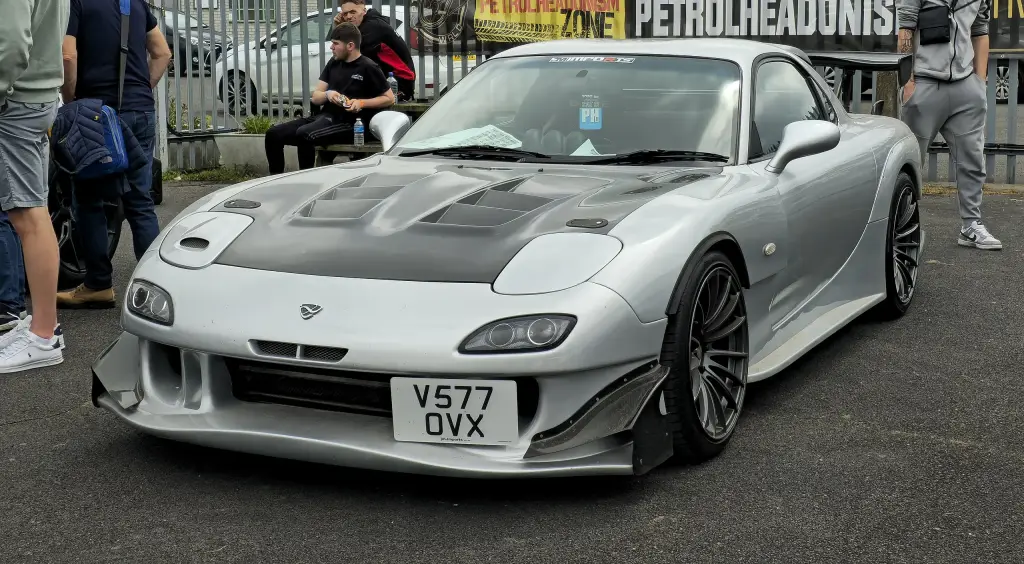
The second-generation FC was offered as a two-seater coupé with a 2+2 option in some markets, as well as a convertible, and used the 13B engine in naturally aspirated or turbocharged forms. The third-generation FD came as a two-seater coupé, with a 2+2 version offered as an option in Japan, and used a sequentially turbocharged 13B REW. The RX-7 was withdrawn from North America after 1995 and continued mainly in Japan until production ended in 2002.
Design and features
- Rotary engines: 12A at first, then the 13B in naturally aspirated and turbocharged forms.
- Front mid-engine: the engine sat behind the front axle for balance.
- Light and compact: the RX-7’s main advantage over larger sports cars.
- Three characters: a simple first generation, a grand-touring second and a twin-turbo third.
Mazda RX-7 versions
- SA/FB (1978–1985): first generation, 12A and later 13B engines, including the 1980 Leathersport.
- FC (1986–1992): second generation, 13B, turbo and convertible.
- FD (1992–2002): third generation, sequential twin-turbo 13B REW.
The RX-7 came after the Mazda Cosmo and was succeeded by the RX-8; its racing relative was the 787B. More Mazdas are in the Mazda collection.
Sources
- Mazda RX-7, English Wikipedia: generations, engines, first-generation detail
- Mazda RX-7, German Wikipedia: European versions
- マツダ・RX-7, Japanese Wikipedia: Japanese market