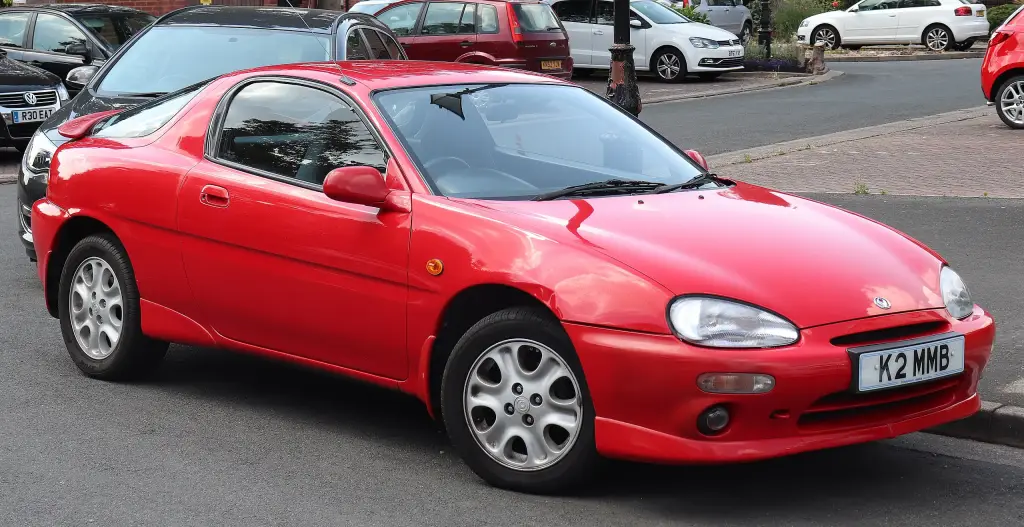
The Mazda MX-3 is a 2+2-seat, front-wheel-drive coupé of kammback design, introduced at the Geneva Motor Show in March 1991 and sold until 1998. Its unusual feature was a 1.8-litre V6, a tiny engine for the layout, which set the small coupé apart from its rivals.
Mazda MX-3 at a glance
| Shown | Geneva Motor Show, March 1991 |
|---|---|
| Sold | 1991–1998 |
| Type | 2+2 front-wheel-drive coupé |
| Platform | EC, related to the BG Familia/323 |
| Engines | 1.6 SOHC four, 1.8 V6; a 1.5 in the Autozam AZ-3 |
| V6 codes | K8-DE in North America, K8-ZE elsewhere |
| Transmissions | five-speed manual or four-speed automatic |
| Names | Eunos Presso and Autozam AZ-3 in Japan, MX-3 Precidia in Canada, Eunos 30X in Australia |
| V6 top speed | 202 km/h in European trim |
| V6 acceleration | 0–60 mph in 8.4 seconds, 0.89 g lateral |
History of the Mazda MX-3
The MX-3 used the EC platform, which shared much with the BG platform of the Familia/323/Protegé. The first model year was sold in Japan, Europe, Australia and North America, where it went on sale in September 1991 as a 1992 model. It was originally available with a single-cam 1.6-litre four or a 1.8-litre twin-cam V6. In the summer of 1991 the Autozam AZ-3 was added to the Japanese line-up; Autozam was meant to be Mazda’s more youthful brand, so that version combined a lower price with a sportier but smaller twin-cam 1.5-litre four, and it was also sold as the Eunos Presso, a cheaper sports hatchback companion to the Eunos Roadster.
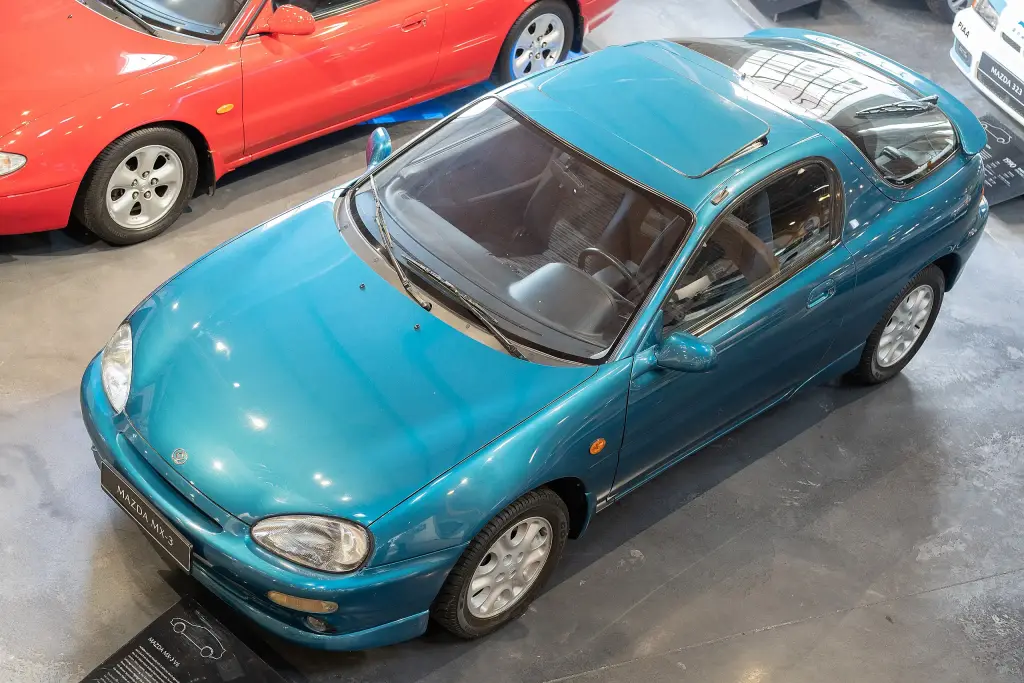
The small V6 was chosen to make the coupé stand out and to give smooth, balanced running. Project manager Tadayuki Hayashi had been an avid motorcyclist and liked engines with a peaky power delivery. In January 1994 a DOHC version of the familiar B6 engine, the B6D, replaced the earlier unit, which gave a useful power increase and in turn made the considerably more expensive V6 less attractive; V6 sales in the United States ended after 1994, although they continued in Canada, Japan and many export markets. Mazda called the car a four-seater, but the rear seats were designed for people of AF 50 dimensions (50th percentile Asian female), so it was in practice a 2+2. It was made for one generation only, as the MX-5 proved more popular, and was cancelled as Mazda cut models that were not selling well during the Japanese asset bubble’s aftermath.
In European trim the V6 was claimed to reach 202 km/h, and the US-specification MX-3 GS could accelerate from 0 to 60 mph in 8.4 seconds and reach 0.89 g of lateral grip, among the best in its class. The V6 belonged to Mazda’s K-series and used a variable length intake manifold, which Mazda called the Variable Resonance Induction System, with a 7,000 rpm redline and a 7,800 rpm fuel cut-off. At the rear, the MX-3 used Mazda’s Twin-Trapezoidal Link suspension, which gave some of the benefits of active four-wheel steering at lower weight and complexity.
Design and features
- 1.8 V6: a very small V6 for a compact coupe, with Mazda’s VRIS variable intake.
- Twin-Trapezoidal Link: rear suspension giving some four-wheel-steering benefits.
- 2+2 layout: usable rear seats only for smaller passengers, in practice a two-seater plus two.
- Many names: Eunos Presso, Autozam AZ-3, MX-3 Precidia and Eunos 30X in different markets.
Mazda MX-3 versions
- MX-3 1.6 (1991–1998): single-cam four, with the B6D DOHC engine from 1994.
- MX-3 GS 1.8 V6 (1991–1998): K8 engine, the best-known version.
- Autozam AZ-3 / Eunos Presso: Japanese versions, the AZ-3 with a 1.5 four.
- Eunos 30X: the Australian name until late 1996, then Mazda-Eunos 30X.
The MX-3 shared its platform family with the Mazda 323 and was a companion to the MX-5 in Mazda’s small sports models. More Mazdas are in the Mazda collection.
Sources
- Mazda MX-3, English Wikipedia: platform, engines, names, performance
- Mazda MX-3, German Wikipedia: European versions