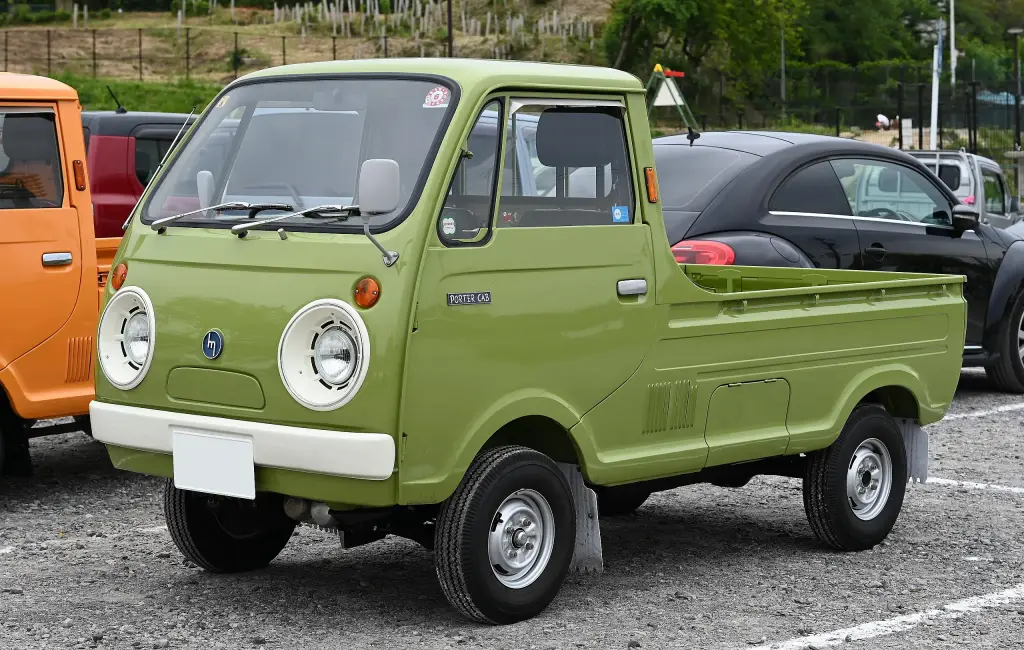
The Mazda Porter and Porter Cab are small kei trucks that Mazda built from 1961 to 1989, known as the B360 and B600 until 1968. The B360 was the pickup and light van version of the R360 kei car, and export versions were called the E360. The Porter was replaced by the Autozam Scrum, a rebadged Suzuki Carry.
Mazda Porter at a glance
| Built | 1961–1989 |
|---|---|
| First models | B360 and B600, until 1968 |
| B360 layout | pickup or light van based on the R360 |
| B360 engine | 356 cc air-cooled OHV V-twin, 13 PS |
| B600 engine | 577 cc V-twin, 20 PS, export only |
| 1963 update | 358 cc four-cylinder from the Carol, 20 PS, 79 km/h |
| Porter | from November 1968, E360 for export |
| Porter engine from 1973 | 359 cc water-cooled two-stroke, 35 PS |
| Replaced by | Autozam Scrum, a rebadged Suzuki Carry |
The B360 record is merged here; the B360 was the Porter’s predecessor.
History of the Mazda Porter
The predecessor of the Porter was the Mazda B360, introduced in February 1961 as a pickup (KBBA33) or light van (KBBAV) version of the R360 kei passenger car. It had a 356 cc air-cooled overhead-valve V-twin producing 13 PS and weighed 535 kg. The 1961 export-only Mazda B600 (KBEA) was similar but used an enlarged 577 cc version of the air-cooled V-twin with 20 PS and 37 N·m.
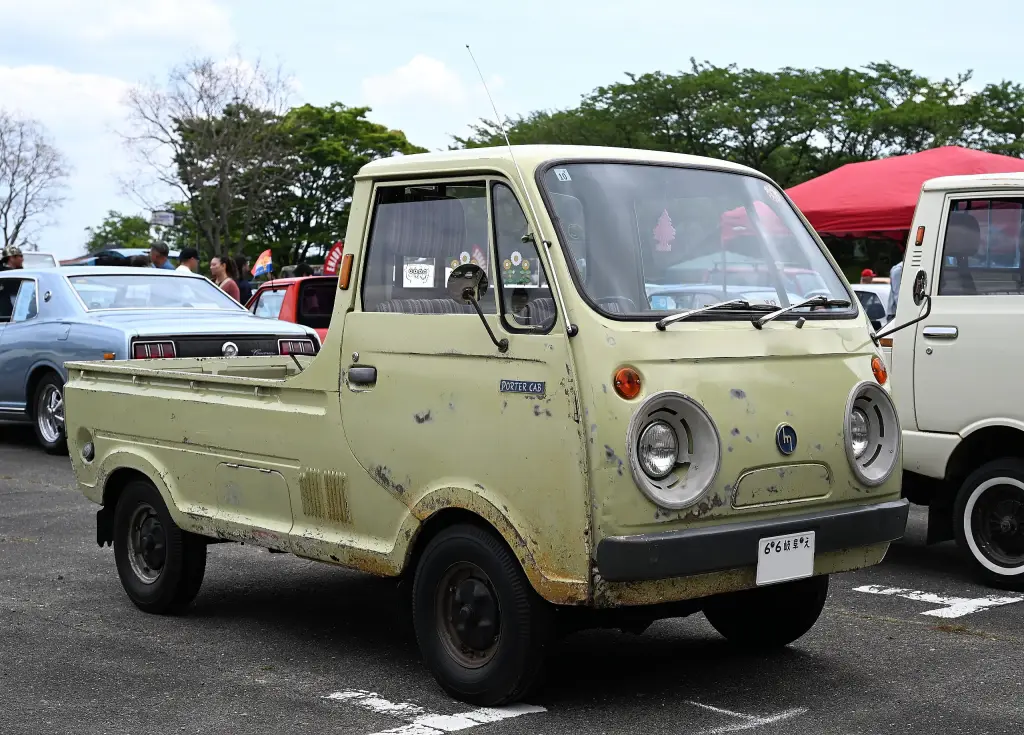
In September 1963 the B360 gained the four-cylinder 358 cc 20 PS DB overhead-valve engine from the Carol, along with a facelift and a larger grille that matched the B1500 truck, a DeLuxe Van version, and a top speed that rose from 67 to 79 km/h. Another facelift in October 1966 gave the B360 a much more modern look. The two-cylinder B600 was one of the first Japanese cars to make an impact in Indonesia, where it was nicknamed Soap Box for its square shape and used by government agencies and utilities, sold only as a van. It was so common there for decades that its V-twin engine became popular for custom motorcycles.
In 1972 the B360 and B600 entered licence production in Burma, now Myanmar; Mazda shipped the production equipment as part of Japanese war reparations. After sanctions were imposed in 1988 and Japanese parts could no longer be imported, manufacture moved to MADI (Myanmar Automobile and Diesel Engine Industries), which built the trucks at its No 2 Automobile Industry plant near Yangon until the mid-1990s with fully local content. Always painted blue from the factory, they were ubiquitous as taxis in Burma, particularly in Mandalay, until the markets opened up after 2011.
The first Porter (KBDB33 as a pickup, KBDBV as a van, E360 for export) was produced from November 1968 to April 1976. It was closely based on the B360 but with all-new body panels, and it was briefly assembled in South Africa by Motor Assemblies, which built 942 E360s in 1969 and 1970. It started with the carry-over 358 cc four of 20 PS and 23.5 N·m, replaced in April 1973 by the 35 PS water-cooled two-stroke two-cylinder from the Chantez. The Porter Cab continued the line until 1989.
Design and features
- R360 basis: the B360 was the commercial version of Mazda’s first kei car.
- Air-cooled V-twin: the original 356 cc engine, enlarged to 577 cc for the export B600.
- Soap Box: the B600 became a long-running favourite in Indonesia.
- Burmese production: licence-built in Myanmar from 1972 into the mid-1990s.
Mazda Porter versions
- B360 (1961–1968): pickup and light van, 356 cc V-twin then a 358 cc four.
- B600 (1961): export-only 577 cc V-twin.
- Porter / E360 (1968–1976): new body on the B360 base.
- Porter Cab (to 1989): the final version of the line.
The Porter’s four-wheeled relatives include the Mazda K360 three-wheeler and the larger Mazda B series pickups. More Mazdas are in the Mazda collection.
Sources
- Mazda Porter, English Wikipedia: B360, B600, Porter, Burma production
- Mazda B360, German Wikipedia: B360 data
- マツダ・ポーター, Japanese Wikipedia: Japanese market