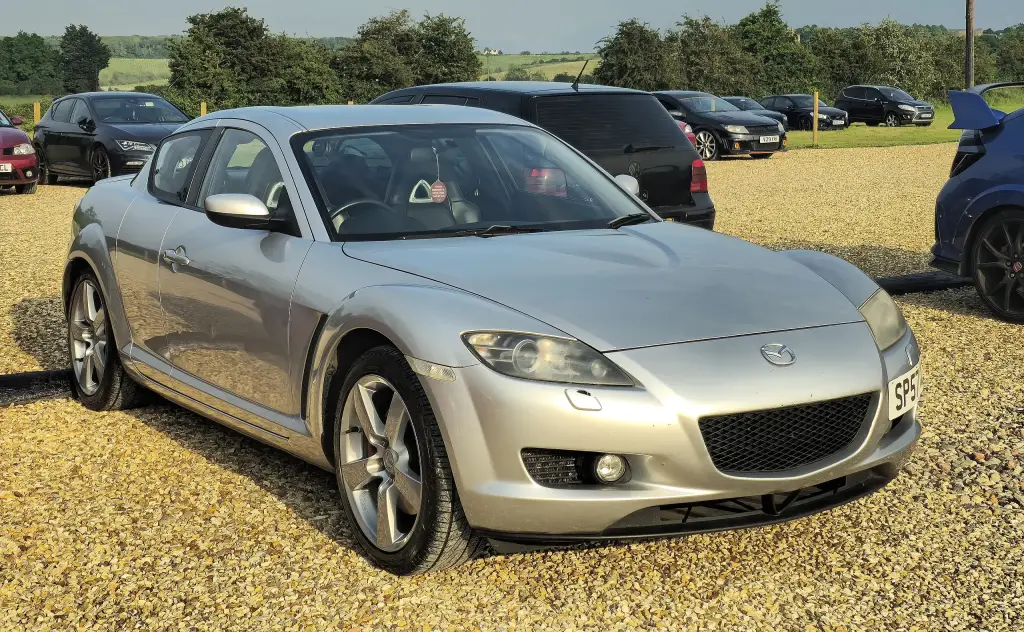
The Mazda RX-8 is a sports car that Mazda built between 2003 and 2012 as the direct successor to the RX-7. It was first shown at the 2001 North American International Auto Show and used a naturally aspirated rotary engine, the 13B-MSP known as RENESIS. It was the last rotary-engined production car Mazda built.
Mazda RX-8 at a glance
| Built | 2003–2012 |
|---|---|
| First shown | 2001 North American International Auto Show |
| Predecessor | Mazda RX-7 |
| Engine | 13B-MSP RENESIS, naturally aspirated rotary |
| Power | 141 kW (189 hp) to 177 kW (237 hp) |
| Torque | 216 to 222 N·m |
| Successor | none |
| Left Europe | 2010, after failing emissions standards |
| Built | 192,094 |
History of the Mazda RX-8
Mazda had introduced rotary vehicles in the United States in 1971, beginning with the R100 and going on to the RX-2, RX-3, RX-4, RX-5 and three generations of the RX-7. The RX-7’s lack of convenience, high price and falling interest in sports cars led Mazda to withdraw it from most major markets except Japan after 1995, and for a while the MX-5 was the company’s only truly distinctive product in the United States. As interest in import tuning and performance cars returned in the late 1990s, and with financial and management help from Ford, Mazda developed a new range of cars beginning with the Mazda 6 and Mazda 3, which paved the way for a new rotary sports car.
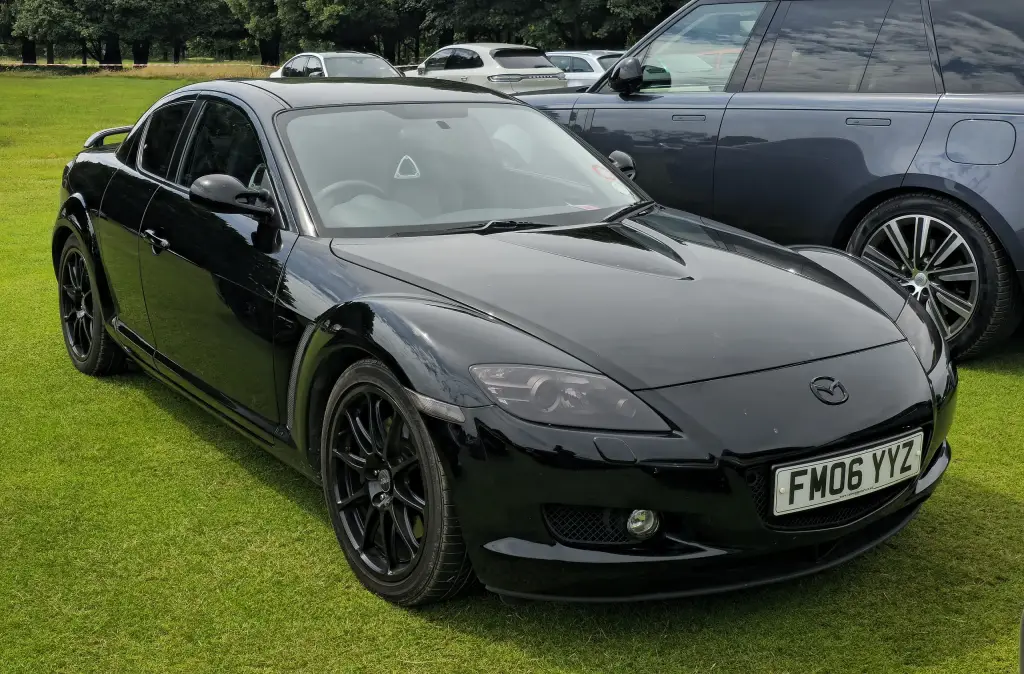
The RX-8 combined two previous products, the internationally sold RX-7 and the Japan-only Cosmo, and was slightly smaller than the Cosmo. Mazda chose not to use the 2.0-litre three-rotor 20B-REW, which had been discontinued in 1996 when the Cosmo ended. The RENESIS engine can be traced back to the 1995 RX-01 concept, which used an early 13B-MSP with side exhaust ports and 210 hp. With Mazda’s finances weak and interest shifting to SUVs, the RX-01 was not developed further, but an internal skunkworks team kept the 13B-MSP alive in an elongated MX-5 chassis known internally as gokiburi-ka, or cockroach car, until management noticed and development advanced.
The production RX-8’s rotary engine produced from 141 kW (189 hp) and 222 N·m to 177 kW (237 hp) and 216 N·m from launch. The car was discontinued for the 2012 model year without a successor, having already been removed from the European market in 2010 after failing to meet emissions standards; falling European sales and a rising yen made continued sales elsewhere hard to justify. In its nine-year production run Mazda built 192,094 RX-8s.
Design and features
- RENESIS: a naturally aspirated 13B-MSP rotary with side exhaust ports.
- Four-door coupe: the RX-8 offered rear-seat access unusual for a sports car.
- RX-01 heritage: the engine came from the 1995 concept via a secret development programme.
- Last rotary: the final rotary-engined production car Mazda made.
Mazda RX-8 versions
- RX-8 (2003–2012): the only generation, with engines from 189 to 237 hp.
The RX-8 succeeded the Mazda RX-7 and its engine began with the RX-01 concept. More Mazdas are in the Mazda collection.
Sources
- Mazda RX-8, English Wikipedia: development, engines, production total, end of the line
- Mazda RX-8, German Wikipedia: European versions
- マツダ・RX-8, Japanese Wikipedia: Japanese market