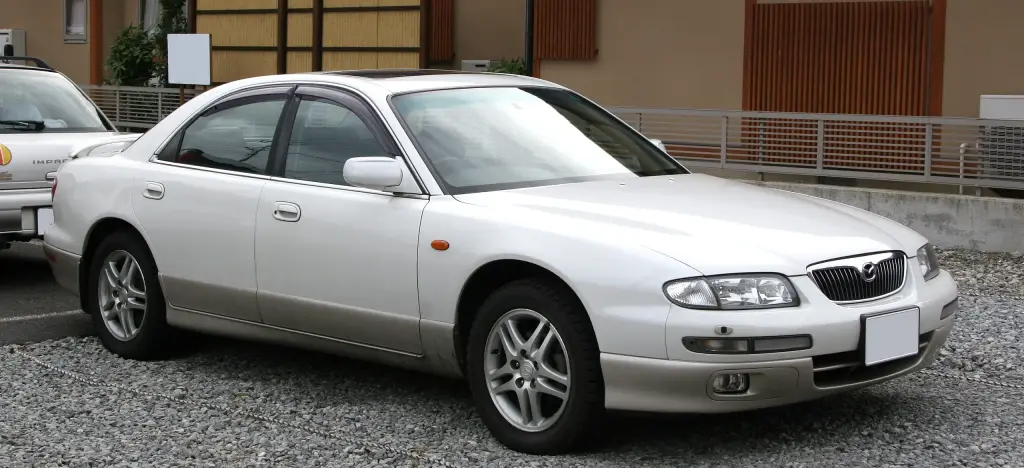
The Mazda Millenia was a front-wheel-drive luxury saloon built from 1993 to 2002 and sold as the Mazda Xedos 9 in Europe and as the Eunos 800 in Japan and Australia. It was originally meant to launch Mazda’s Amati luxury brand as the Amati 500, and when that plan collapsed it became Mazda’s flagship in North America instead.
Mazda Millenia at a glance
| Built | 1993–2002 |
|---|---|
| Planned as | Amati 500, for Mazda’s proposed luxury brand |
| Europe | Mazda Xedos 9, 1993–2002 |
| Japan and Australia | Eunos 800, 1993–1998 |
| North America | Mazda Millenia, from 1994 as a 1995 model |
| Engine landmark | first production car with a Miller-cycle engine |
| Layout | front-wheel drive |
| Flagship role | replaced the Mazda 929 in North America |
| Four-wheel steering | optional in Japan, yaw-sensitive |
The Xedos 9 record is merged here; it is the European name of the Millenia.
History of the Mazda Millenia
The Millenia was engineered for a more upscale market than Mazda’s usual customers, with better interior plastics, smaller panel gaps and a thicker, more even paint coating applied while the body rotated on a massive spindle. Mazda said this attention to detail was meant to set standards for at least ten years. The car was originally intended to launch Mazda’s new luxury brand Amati in 1994 as the Amati 500. In June 1992 Amati produced a logo and announced plans for a $75 million marketing campaign with a Los Angeles agency, and Mazda expected to sell 20,000 cars a year in 1994 and double that by 1995.
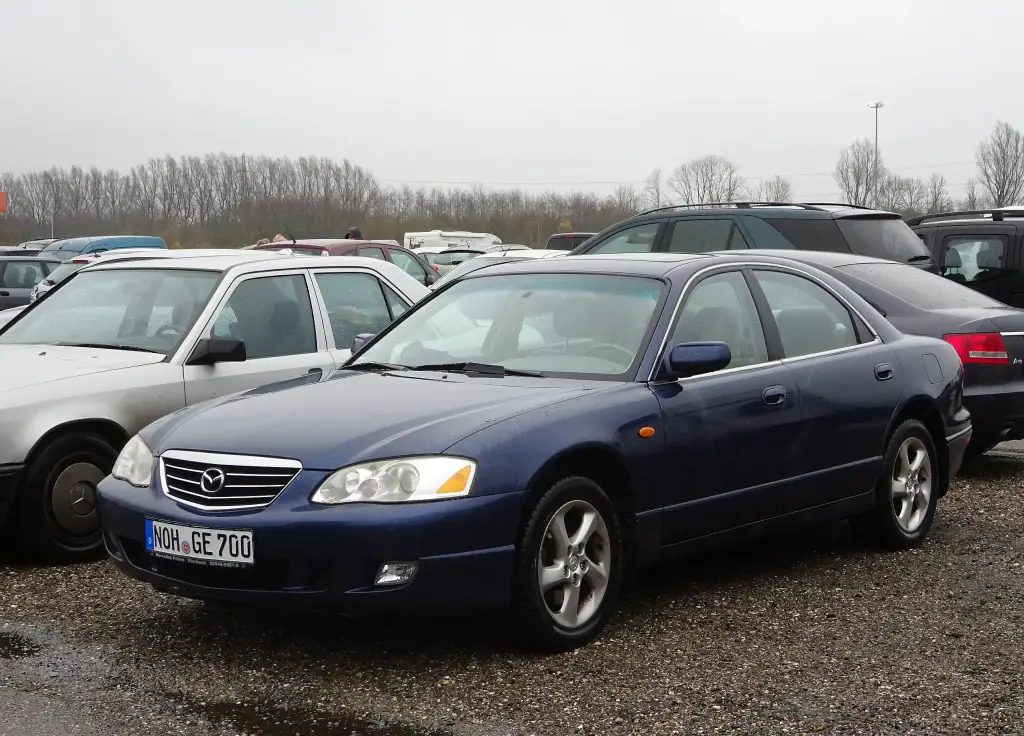
The recession that followed the collapse of the Japanese asset price bubble led to Amati being cancelled by October 1992, and in November 1993 it was decided to sell the car as a Mazda instead. As Mazda’s finances dwindled it rebadged the Millenia for its various sales channels under different names in different markets, with no equivalent from the Efini or Autozam channels. In Europe it was the Mazda Xedos 9 from 1993 to 2002, sold alongside the smaller Xedos 6. In right-hand-drive Japan and Australia it was the Eunos 800 from 1993 to 1998, with the Miller-cycle version sold as the Eunos 800M; yaw-sensitive four-wheel steering was optional in Japan, and Mazda claimed that with it the car could pass the elk test at speeds comparable to a BMW 850i and a Nissan 300ZX. In July 1997 Mazda discontinued the Eunos brand and the Eunos 800 became the Mazda Millenia.
In North America the Millenia was launched in 1994 as a 1995 model and replaced the Mazda 929 as the brand’s flagship saloon. Where the 929 had been the last non-luxury rear-wheel-drive Japanese import saloon in the United States, the Millenia was front-wheel drive. There was no North American equivalent of the Xedos 6 / Eunos 500, and the range came in three models, among them the base Millenia and the Millenia L with leather upholstery and a power moonroof. At its release it was the first and only production car in the world to use a Miller cycle engine, a design Mazda did not use again until the second-generation Mazda 2 in 2008. The name Millenia is a misspelling of millennia.
Design and features
- Miller cycle: the first production car in the world with a Miller-cycle engine.
- Amati origins: designed as the Amati 500 before that brand was cancelled.
- Build quality: tighter panel gaps and a rotational painting process for a smoother finish.
- Four-wheel steering: a yaw-sensitive system optional in Japan.
Mazda Millenia versions
- Mazda Xedos 9 (1993–2002): European name.
- Eunos 800 and 800M (1993–1998): Japanese and Australian names, the 800M with the Miller-cycle engine.
- Mazda Millenia (from 1994): North American flagship in base and L forms.
The Millenia replaced the Mazda 929 in North America and was sold next to the smaller Mazda Xedos 6. More Mazdas are in the Mazda collection.
Sources
- Mazda Millenia, English Wikipedia: Amati plans, Miller engine, market names
- Mazda Xedos 9, German Wikipedia: European market
- マツダ・ミレーニア, Japanese Wikipedia: Japanese market