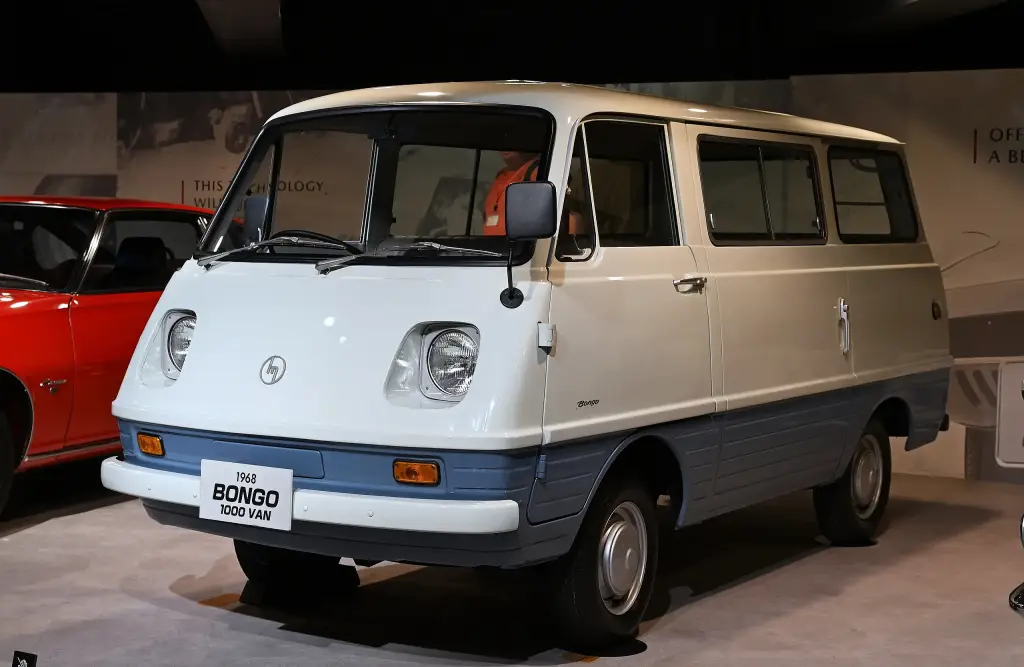
The Mazda Bongo is a cabover van and pickup truck that Mazda has built since 1966. In export markets it was sold as the E-series, with numbers from E1300 to E2500 depending on the engine, and Ford sold it as the Econovan while Kia built its own long-running Bongo. The name comes from the African bongo antelope.
Mazda Bongo/E-series at a glance
| Made since | May 1966 |
|---|---|
| Layouts over time | rear-, mid- and front-mounted engines |
| First generation | 1966–1975, rear-engined, F800 and F1000 |
| Second generation | September 1977, mid-engined |
| Export names | E1300, E1400, E1600, E1800, E2000, E2200, E2500 |
| Ford versions | Ford Econovan, Econowagon and Spectron |
| Other versions | Eunos Cargo, Nissan Vanette, Kia Bongo and Ceres, Kia Wide Bongo |
| Electrics | a prototype electric van reached 75 km/h with a 60 km range |
| Replaced by | Mazda Bongo Friendee, then the Biante |
One page covers the Bongo and its export E-series names; the E1600 to E2500 records are merged into it.
History of the Mazda Bongo/E-series
Mazda introduced the Bongo in May 1966 with a rear-mounted 782 cc water-cooled four driving the rear wheels. From 1968 it was built in two versions, the F800 and the larger-engined F1000 with a 987 cc overhead-valve engine and 48 PS. The 1-litre model, chassis code FPA, was 3,770 mm long, 1,500 mm wide and 1,700 mm tall on a 2,000 mm wheelbase, and weighed 885 kg as a delivery van. Mazda also showed an electric version that could reach 75 km/h with a 60 km range, but it stayed a prototype. The rear-engined Bongo had a full chassis with the engine bolted to a four-speed transaxle at the rear, which gave it a half-tonne payload. Production ended in 1975, partly because of Mazda’s financial troubles and the stricter 1976 emissions rules.
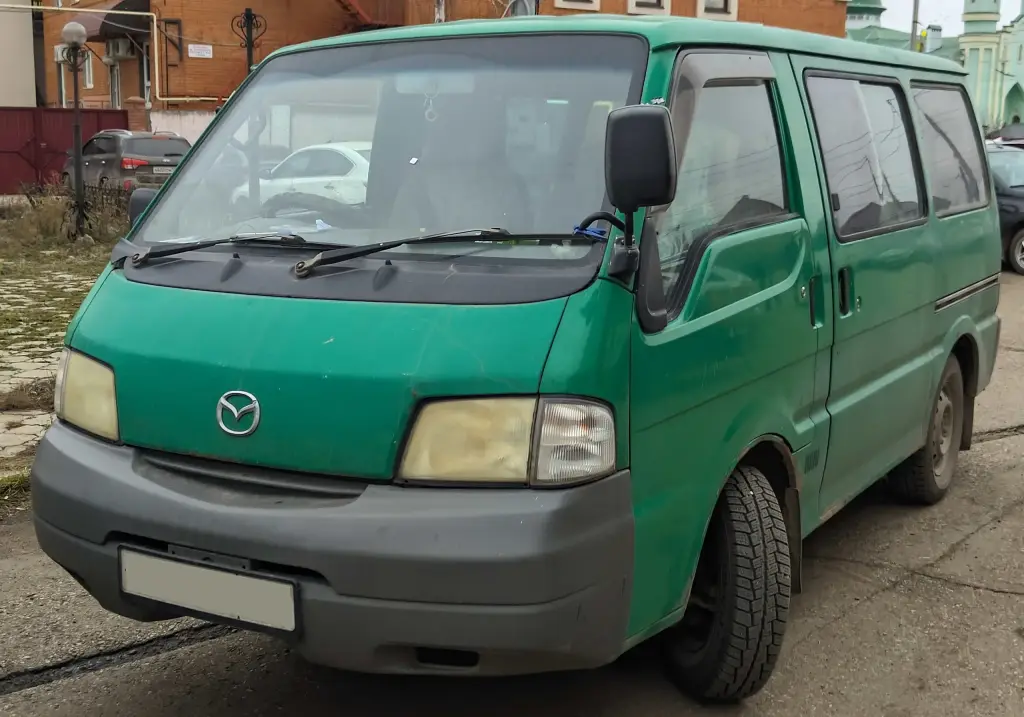
After a two-year gap the second Bongo appeared in September 1977 with a mid-mounted engine and rear-wheel drive. Ford sold it as the Econovan, and Mazda exported it as the E1300, E1400 and E1600 depending on engine size. From October 1979 a 2.2-litre diesel was available in commercial versions and sold abroad as the E2200, and in February 1980 it reached the passenger Bongo Multi Wagon. Britain received only the long-wheelbase one-tonne panel van with twin rear wheels and a five-speed manual with a column shifter, in 1982, a year before the next generation. Kia built this generation in Korea as the Bongo and Ceres, and it was still available there as late as 1999. The original had round headlights and no grille; a facelift in January 1981 brought rectangular headlights and a conventional grille.
The third generation arrived in September 1983 and ran until 1999, with a facelift in November 1986 that brought a lower, wider front. Four-wheel drive with the 1.8-litre petrol engine was offered from November 1984, when front disc brakes became standard, and a 2.0-litre petrol engine arrived in 1986. The Bongo was sold by Ford in Asia as the Spectron passenger version and the J80 cargo model, in Australia through Mazda as the E-series, and from 1994 by Nissan as the Vanette. Longer, larger versions were called the Bongo Brawny and were sold in Europe between 1978 and 2001 as the Mazda E-series.
Design and features
- Three engine layouts: rear-mounted, mid-mounted and front-mounted across the generations.
- E-series names: export model numbers followed engine size, from E1300 to E2500.
- Many badges: Ford Econovan and Spectron, Eunos Cargo, Nissan Vanette and Kia Bongo.
- Bongo Brawny: the longer version sold in Europe as the E-series from 1978 to 2001.
Mazda Bongo/E-series versions
- F800 and F1000 (1966–1975): rear-engined vans and pickups.
- Bongo II / E1300–E2200 (1977–1983): mid-engined generation.
- Bongo III (1983–1999): third generation with four-wheel drive from 1984.
- Bongo Brawny: longer and larger version sold as the Mazda E-series in Europe.
- Ford Econovan, Spectron and J80: Ford-badged versions.
The Bongo was replaced in the passenger role by the Mazda Biante, and its larger relatives are the Mazda T-series trucks. More Mazdas are in the Mazda collection.
Sources
- Mazda Bongo, English Wikipedia: generations, engines, badges
- Mazda Bongo, German Wikipedia: E-series, Brawny, German market
- マツダ・ボンゴ, Japanese Wikipedia: Japanese model history