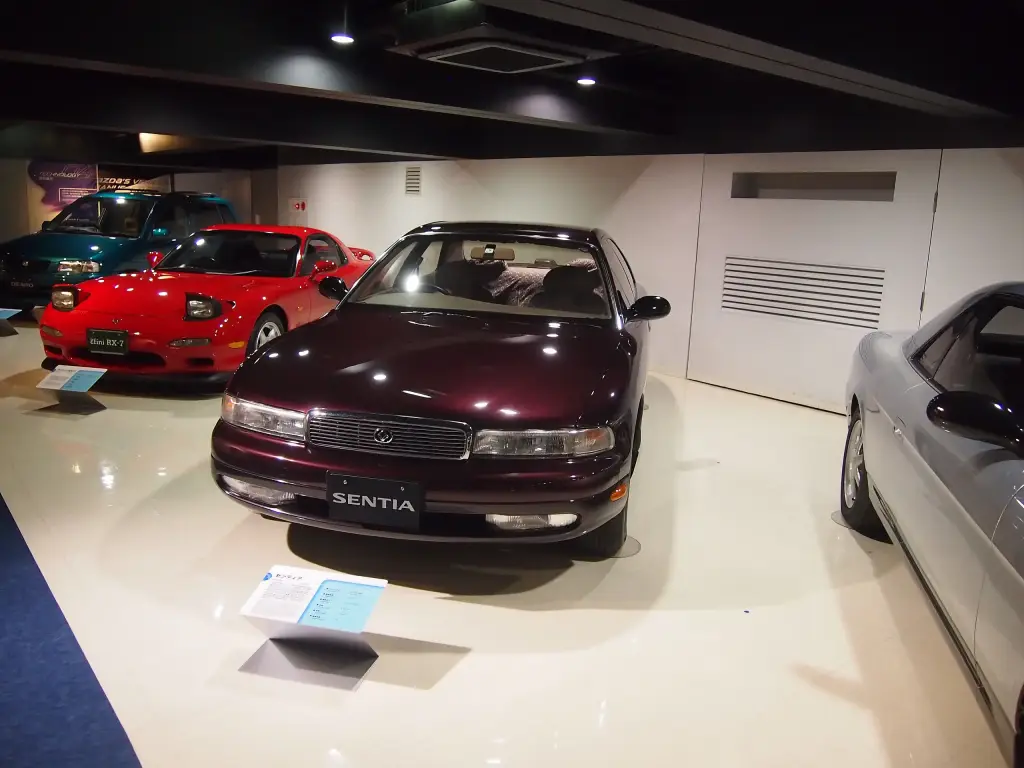
The Mazda Sentia is a mid-size rear-wheel-drive luxury car that Mazda sold in Japan from 1991 to 1999 over two generations. It replaced the Luce as Mazda’s largest flagship saloon, a role the company had filled since the late 1960s, and it was also built under licence in South Korea as the Kia Enterprise until October 2002.
Mazda Sentia at a glance
| Sold in Japan | 1991–1999, two generations |
|---|---|
| Replaced | Mazda Luce |
| Layout | front engine (front-midship), rear-wheel drive |
| Engine | 3.0-litre V6 |
| Luxury twin | Efini MS-9, with more standard equipment |
| Four-wheel steering | Mazda’s first speed-sensitive system |
| Solar ventilation | sunroof solar cells driving fans in the boot |
| Korean version | Kia Enterprise, built until October 2002 |
| Name origin | Latin sentio, to sense, feel or hear |
The Efini MS-8 record is merged here: it was the Sentia’s sister car on the same platform.
History of the Mazda Sentia
Development of a successor to the fourth-generation Luce began shortly after that car’s release in 1986, under chief designer Shunji Tanaka, who from early 1988 considered a more unconventional approach. The team struggled with a theme called Prince’s Coach, after the Japanese Crown Prince who later became Emperor Akihito, and rejected an unusually large number of full-size models. A young American designer, Peter Montero, was asked to develop the theme in a 1/5 scale model, and argued that as a non-luxury brand building a luxury car Mazda should emphasise proper rear-wheel-drive proportions. After the model was reviewed with management, an earlier full-size model was modified by pulling the front wheels forward, lengthening the dash-to-axle distance and shortening the front overhang. Another young designer, Dori Regev, developed the final design, which was approved later that year and frozen on 24 December 1988 for 1991 production, with prototype testing starting in 1989.
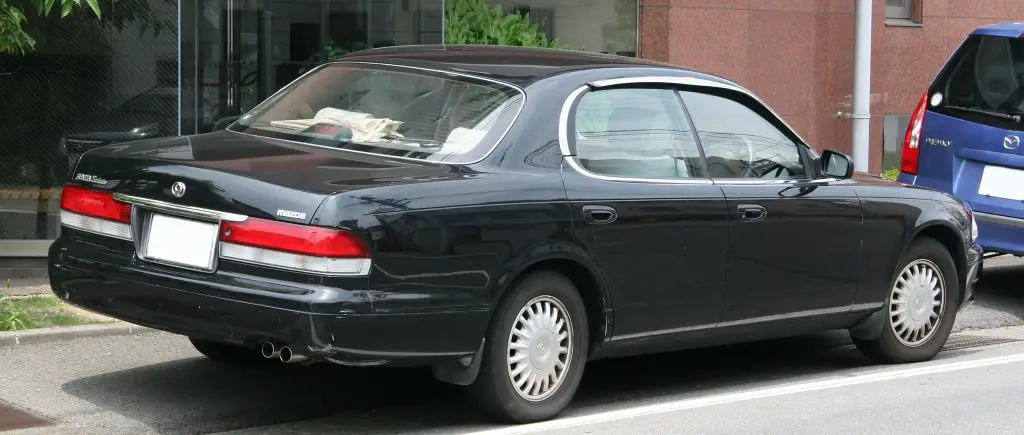
When the Sentia was introduced in Japan it was also sold through Mazda’s short-lived exclusive luxury channel as the Efini MS-9, a higher-content luxury sedan with items that were optional on the Sentia as standard. It was the largest Mazda of its era and came with a 3.0-litre V6, making it the top of the range. Its width mattered in Japan because of dimension regulations, under which buyers pay extra annual tax for larger vehicles.
Mazda marketed the Sentia as having a front-midship layout: the V6 sat behind the front axle while the fuel tank rested above the rear axle, an engine position Mazda had already used in its rotary cars, mainly the RX-7 and the Cosmo. The car also debuted Mazda’s speed-sensitive four-wheel steering: below 35 km/h the rear wheels steered in the opposite direction to the front to reduce the turning circle, and at higher speeds they steered in the same direction to improve stability. A solar ventilation system used amorphous solar cells in the sunroof panel to power small fans in the boot area, cooling the cabin while the car was parked in the sun. The Sentia was replaced in 1999, and Kia continued to build it as the Kia Enterprise at its Hwaseong plant until October 2002.
Design and features
- Front-midship layout: the V6 sat behind the front axle with the fuel tank over the rear axle.
- Four-wheel steering: Mazda’s first speed-sensitive system, working below and above 35 km/h.
- Solar ventilation: sunroof solar cells powered fans to cool the parked car.
- Efini MS-9: a more luxurious twin sold through Mazda’s Efini channel.
Mazda Sentia versions
- Sentia HD (1991–1996): first generation, 3.0 V6, four-wheel steering and solar ventilation.
- Efini MS-9: luxury version with more standard equipment.
- Kia Enterprise: Korean licence-built version, until October 2002.
The Sentia replaced the Mazda Luce and was exported as the 929, and its Efini relative was the MS-6. More Mazdas are in the Mazda collection.
Sources
- Mazda Sentia, English Wikipedia: development, layout, four-wheel steering, Kia
- Mazda Sentia, German Wikipedia: European data
- マツダ・センティア, Japanese Wikipedia: Japanese market and grades