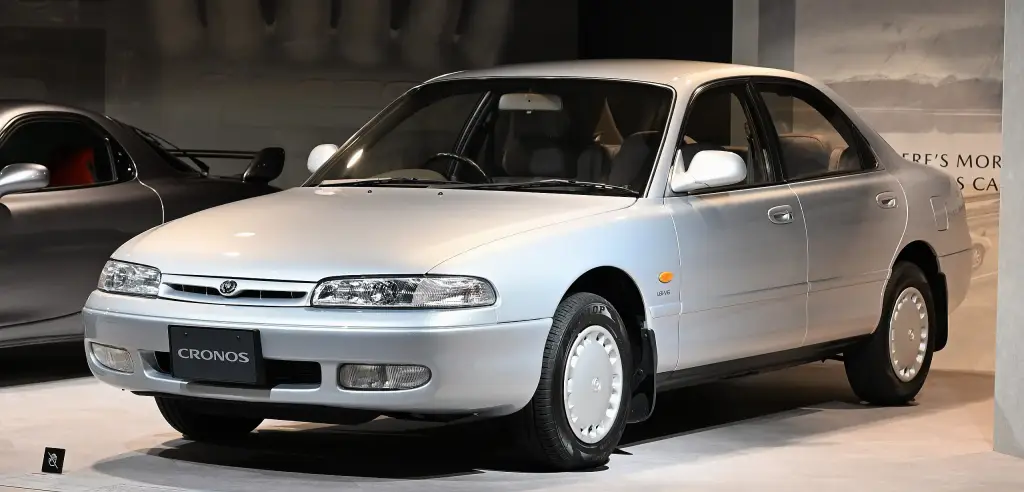
The Mazda Cronos was introduced in October 1991 as the replacement for the Capella in Mazda’s mid-size class. It was a front-wheel-drive saloon on the new GE platform with V6 engines, sold abroad as the Mazda 626, and it gave rise to a family of sister cars including the Efini MS-6. Production ended in 1997.
Mazda Cronos at a glance
| Introduced | 21 October 1991, as the Capella’s successor |
|---|---|
| Sold in Japan | 1991–1995 |
| Export production | until 1997, as the Mazda 626 |
| Platform | GE |
| Bodies | four-door saloon; the MS-6 was a five-door hatchback |
| Engines at launch | 1.8 and 2.0-litre K-series V6 |
| Added in 1992 | 2.0 diesel with PWS, all-wheel drive and a 2.5 V6 |
| 1994 update | 1.8 dropped, ABS standard, new grille |
| Built | about 34,096 |
| Sister cars | Efini MS-6, Eunos 500, Autozam Clef, Ford Telstar TX5 |
The Cronos is covered together with the Efini MS-6, its five-door sister car.
History of the Mazda Cronos
The Cronos arrived on 21 October 1991, sold only through Mazda’s Mazda dealership channel. At first it came with the new K-series V6 engines of 1.8 and 2.0 litres and front-wheel drive. In 1992 Mazda added a diesel with power steering, a viscous-coupling full-time four-wheel-drive version and a 2.5-litre V6 Gran Turismo series, and began production for export. An update in October 1994 dropped the 1.8, made ABS standard on every grade and changed the grille, and Japanese sales ended in December 1995. Export production, sold locally as the Mazda 626, continued until 1997, when the seventh-generation Capella arrived. Total production was about 34,096 cars.
The Cronos was part of a strategy that went badly wrong. Mazda was pursuing many low-volume models, and its Hofu plant was set up to build the whole family of sister cars on one mixed line: the Efini MS-6, the Efini MS-8, the Eunos 500 and the Autozam Clef, plus the Ford Probe and Telstar for other channels. The plan was to drop the well-known Capella name because the car had grown into the larger Japanese three-number tax class, and to give each sales channel its own model. Instead the Cronos and its sisters were barely recognised, and combined monthly sales stayed below 10,000. With the collapse of the Japanese bubble economy, the cost of the strategy brought Mazda close to bankruptcy – what became known as the Cronos tragedy.
The Efini MS-6 was the five-door hatchback version, sold in Japan from November 1991 to 1994 and in Europe as the Mazda 626 from 1992 to 1997. It differed from the Cronos in its rear bodywork and a body-integrated rear spoiler, and it was well regarded in Europe, especially in Germany, although its low roofline limited rear headroom in Japan. It was launched with the same 1.8 and 2.0 V6 engines, gained a 2.0 four with four-wheel drive in 1992 and a 2.0 diesel in 1993, and was built until June 1994 in Japan when the Capella name returned.
Design and features
- GE platform: the basis for a whole family of Mazda saloons and hatchbacks.
- K-series V6: 1.8 and 2.0 V6 engines at launch, a 2.5 V6 added in 1992.
- MS-6 hatchback: the Efini version, praised in Europe and sold there as the 626.
- Five channels: sister cars for Mazda, Efini, Eunos and Autozam dealers.
Mazda Cronos versions
- Cronos (1991–1997): four-door saloon, 1.8 and 2.0 V6, later 2.5 V6 and diesel.
- Efini MS-6 (1991–1994): five-door hatchback, Mazda 626 in Europe until 1997.
The Cronos replaced the Mazda Capella, which returned in 1994, and its place in the range was later taken by the Mazda 6. More Mazdas are in the Mazda collection.
Sources
- マツダ・クロノス, Japanese Wikipedia: development, engines, sales strategy, production
- マツダ・アンフィニMS-6, Japanese Wikipedia: MS-6 versions and European sales
- Mazda Capella, English Wikipedia: place in the Capella line