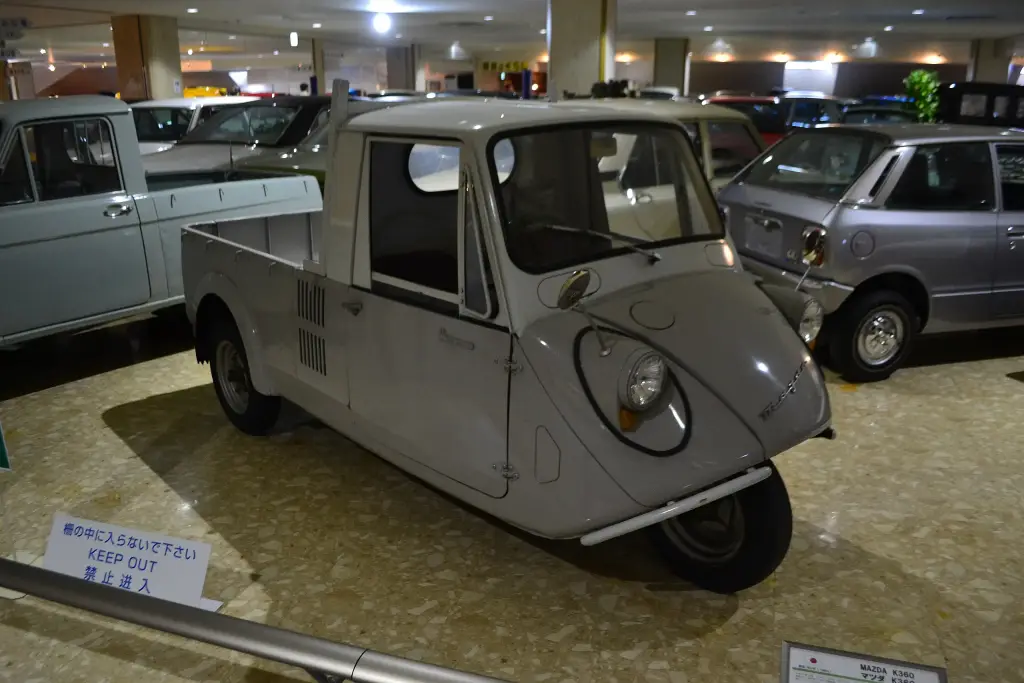
The Mazda K360 is a three-wheeled light truck that Mazda sold from 1959 to 1969. It replaced the Mazda-Go, was the company’s first light three-wheeler, and became famous in Japan under the nickname Kesaburō for its styling by Jiro Kosugi and bright two-tone paintwork.
Mazda K360 at a glance
| On sale | 1959–1969 |
|---|---|
| Type | three-wheeled light truck (auto rickshaw) |
| Replaced | Mazda-Go |
| Sister model | Mazda T600, with which it shared its design |
| Styling | Jiro Kosugi |
| Length | 2.975 m |
| Width | 1.28 m |
| Height | 1.43 m |
| Weight | 485 kg |
| Top speed | 65 km/h |
| Engine | air-cooled OHV V-twin, 11 hp at 4,300 rpm |
| Built | 280,000 |
History of the Mazda K360
The K360 went on sale in Japan in 1959 and stayed in production until 1969, with a total of 280,000 built. It replaced the Mazda-Go and was Toyo Kogyo’s first light three-wheeled truck, sharing its design with the larger Mazda T600. Its styling by Jiro Kosugi and bright two-tone colour scheme made it look smarter than a commercial vehicle, and it arrived at almost the same time as the round-steering-wheel Daihatsu Midget MP series, with which it was directly compared.
Sharing parts with the larger T600 helped: the K360 was quieter than the Midget, and its 12-inch tyres, against the Midget’s 9-inch, gave better steering stability and road holding, so it felt a size larger than its dimensions suggested. The engine was an air-cooled four-stroke OHV V-twin of the BA type with a 76-degree bank angle and dry-sump lubrication, producing 11 hp at 4,300 rpm and 2.2 kg·m at 3,000 rpm. It was mounted longitudinally between the cabin and the load bed and drove the rear wheels through a three-speed manual gearbox and a propeller shaft. That mid-engined layout cost some load-bed length but isolated the two-cylinder engine from the cabin, giving better refinement, a lower centre of gravity and easier servicing than its rivals, and the use of aluminium with help from Hiroshima Aluminium Industry, which had entered car parts in 1957, saved weight.
The frame was a triangular ladder, with a rigid fork, bottom links and coil springs at the front and semi-elliptic leaf springs with a rigid axle at the rear. Shock absorbers were fitted only at the front, and hydraulic leading-and-trailing-shoe drum brakes only at the rear. The steering was rack and pinion with a round wheel. In the 1960s the K360 and the Mazda B360 were exported to Burma, among other markets.
Design and features
- Mid-mounted V-twin: the engine sat behind the cabin, isolating noise and lowering the centre of gravity.
- Air-cooled engine: a 76-degree OHV V-twin with dry-sump lubrication.
- Kosugi styling: a two-tone paint scheme that made a commercial truck look cheerful.
- Larger wheels: 12-inch tyres gave better stability than the 9-inch wheels of the Daihatsu Midget.
Mazda K360 versions
- K360 (1959–1969): the standard three-wheeled light truck.
- Mazda T600: the larger sister model with the same design.
The K360’s four-wheeled relatives include the Mazda Porter and the Mazda T-series trucks. More Mazdas are in the Mazda collection.
Sources
- Mazda K360, English Wikipedia: dates, dimensions, production total
- マツダ・K360, Japanese Wikipedia: engine, chassis, styling, nickname