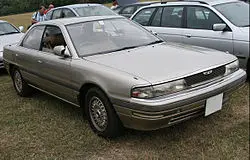
The Mazda Persona is a mid-sized, front-wheel-drive, four-door hardtop saloon that Mazda built in Japan from November 1988 to December 1991. A rebodied Capella/626 with more luxurious equipment, it was sold only in Japan, both in Mazda’s main range and as the Eunos 300.
Mazda Persona at a glance
| Built | November 1988 – December 1991 |
|---|---|
| Market | Japan only |
| Type | front-wheel-drive four-door hardtop saloon |
| Based on | Mazda Capella / 626 |
| Other name | Eunos 300, from November 1989 |
| 1.8 engine | single overhead camshaft, three valves per cylinder, 97 PS |
| 2.0 engine | twin camshafts, four valves, 140 PS |
| Trim levels | Type A and Type B |
| Award | Best Car Interior, 1988 |
| Replaced by | Efini MS-8, in March 1992 |
There are no free photographs of the Persona on Commons; the previous record image stays.
History of the Mazda Persona
The Persona was Mazda’s answer to the Toyota Carina ED, Nissan Presea and Mitsubishi Emeraude, Japanese saloons that tried to capture the pillarless hardtop look and proportions of large American cars. Transposed to a smaller Japanese saloon, that proportion often produced a small, low cabin between long front and rear ends. It was a rebodied Capella/626 with more luxurious equipment and was offered new only in the domestic Japanese market.
The 1.8-litre engine had a single camshaft and three valves per cylinder and produced 97 PS, while the two-litre had twin camshafts and four valves and produced 140 PS. Both were fuel injected and could also be found in the Capella/626 range and other MA-platform cars, although the two-litre was tuned for more torque here. A limited-edition Persona Couture arrived in February 1990, available only in Silver Stone Metallic, fully equipped with air conditioning and ABS over the Type B and only with the larger engine and automatic transmission; it cost ten percent more than a 2000 Type B. A minor change in March 1990 brought new colours and more equipment, including a power seat and optional ABS, and replaced the 12-valve 1.8 with a twin-cam 16-valve unit already seen in the Eunos 300, producing 115 PS. The two-litre FE DOHC stayed unchanged. Production stopped in December 1991 and the car remained on sale for another three months, replaced by the Efini MS-8 in March 1992.
Mazda put much emphasis on the interior and marketed the car under the tagline Interiorism. It had lounge-style door trims that appeared to merge into the rear seats when the doors were closed, and the front seat belts were mounted in the rear doors to be as discreet as possible. It won a prize for Best Car Interior in 1988. Other unusual details were the absence of ashtrays and a cigarette lighter, both available as a cost option, and a pull-out drawer under the passenger seat instead of a traditional glovebox. There were two equipment levels, Type A and Type B, both well equipped, with the Type B adding items such as a leather interior.
When Mazda launched the Eunos dealership channel in Japan for 1990, with sales from 1 November 1989, the Persona became available as the Eunos 300. The ostensibly sportier Eunos version came with an ashtray and lighter and a different V-pattern grille rather than the Persona’s fine mesh, and it received the more powerful 1.8 from the start, a few months earlier than the Persona. Its two-litre option was the 150 PS FE-ZE DOHC engine.
Design and features
- Interiorism: door trims designed to look continuous with the rear seats.
- Door-mounted belts: front seat belts fitted in the rear doors to keep the cabin clean.
- No ashtrays: ashtrays and a lighter were cost options, and a drawer replaced the glovebox.
- Eunos 300 twin: a sportier version for Mazda’s new Eunos channel.
Mazda Persona versions
- Persona Type A and Type B (1988–1991): the two equipment levels, the B with leather.
- Persona Couture (1990): limited edition in Silver Stone Metallic.
- Eunos 300 (1989–1991): Eunos-badged version with a V-pattern grille.
The Persona was a more luxurious Mazda Capella and was replaced by the Efini MS-8, a sister of the Mazda Sentia. More Mazdas are in the Mazda collection.
Sources
- Mazda Persona, English Wikipedia: engines, interior, Eunos 300, end of production
- Mazda Persona, German Wikipedia: model data
- マツダ・ペルソナ, Japanese Wikipedia: Japanese market