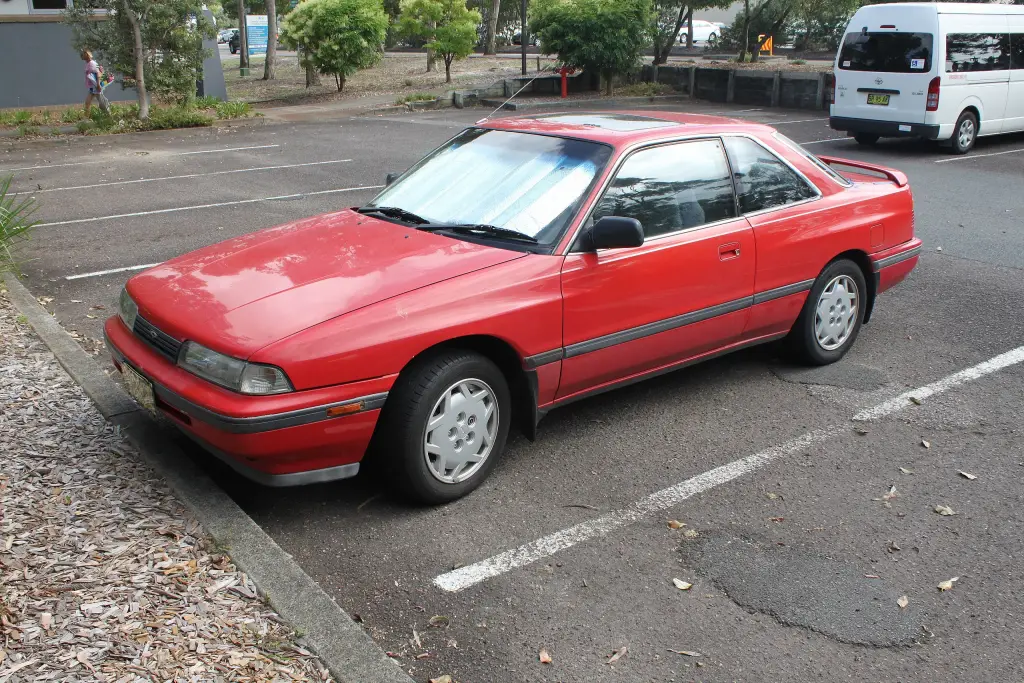
The Mazda MX-6 is a front-engine, front-wheel-drive sport compact coupé that Mazda built from 1987 to 1997 over two generations. It was mechanically identical to the Ford Probe and to the Capella/626 and replaced the 626 Coupé, sharing the GD and GE platforms with those cars.
Mazda MX-6 at a glance
| Built | 1987–1997, two generations |
|---|---|
| Layout | front engine, front-wheel drive |
| Platforms | GD (1988–1992) and GE (1993–1997) |
| Sister cars | Ford Probe, Mazda 626 and Ford Telstar |
| Built at | Flat Rock, Michigan, or in Japan |
| US engines | 2.2 F2 with 110 hp, 2.2 turbo with 145 hp |
| European engines | 1.8 F8 and 2.0 FE or FE-DOHC |
| Gearboxes | five-speed manual or four-speed automatic |
| Four-wheel steering | offered on the first-generation GT |
| Turbo torque | 258 N·m in the US GT |
History of the Mazda MX-6
The first-generation MX-6 appeared in 1987 and lasted until 1992 in the United States, with model years from 1987 to 1991 in some markets. It was based on a series of futuristic sports compact concept cars of the early 1980s, was a large coupé on the Mazda GD platform and used the inline-four Mazda F engines with a G4A-EL four-speed electronic-shift automatic. The US market used the F2 2.2-litre engine with 110 hp, or a turbocharged version with 145 hp, while European and Japanese cars came with either a 1.8-litre F8 or a 2.0-litre FE or FE-DOHC. There were two gearboxes, a five-speed manual or a four-speed automatic with overdrive.
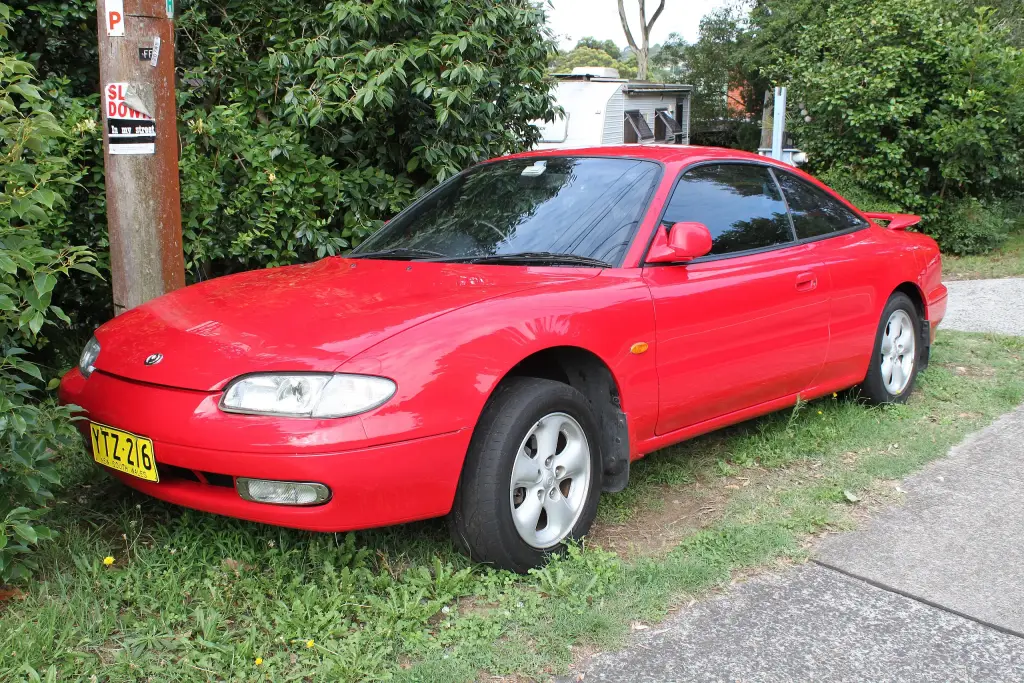
In the United States the first generation came in DX, LX, LE and GT trim levels. The DX was the basic model with the 110 hp 2.2 and few options; the LX added power windows, locks and mirrors and an optional electric moonroof; the LE was the rare Luxury or Leather Edition with leather seats and a leather gear knob; and the GT had all the LX equipment plus the F2T 2.2 turbocharged and intercooled engine with 145 hp and 258 N·m, four-wheel disc brakes with optional ABS and a three-way electronically adjustable suspension called AAS. In 1989 Mazda offered a four-wheel-steering option on US-market MX-6 GTs: an electronically controlled rear steering rack turned the rear wheels opposite the fronts at low speed to improve cornering and with the fronts at high speed for lane changes. In other markets the option was available on GT models through all years.
In Europe the car was sold as the 626 Coupé, usually with the 1.8 SOHC F8 or 2.0 SOHC FE in GLX form or the 2.0 FE-DOHC in GT form, and four-wheel steering was a common option. Australian cars almost always had the 2.2 turbocharged F2T and four-wheel steering, and carried the MX-6 name. Japanese cars were sold as the Capella C2 in GT-R, GT-X and GT-S forms. The cars were built either by AutoAlliance in Flat Rock, Michigan, for North America or in Japan for Asian and European markets. A second generation followed on the GE platform from 1993 to 1997.
Design and features
- Four-wheel steering: an electronically controlled rear rack, standard on many GT models.
- 2.2 turbo: the F2T with 145 hp and 258 N·m in the US GT.
- AAS suspension: three-way electronically adjustable damping on the GT.
- Ford Probe twin: mechanically identical to the Probe and the 626.
Mazda MX-6 versions
- GD (1987–1992): first generation, 2.2 and 2.2 turbo in the US, 1.8 and 2.0 in Europe.
- US trims: DX, LX, LE and GT.
- 626 Coupé: the European name for the first generation.
- Capella C2: the Japanese name, in GT-R, GT-X and GT-S forms.
- GE (1993–1997): second generation.
The MX-6 shared its platform with the Mazda 626 and was the coupé companion of the MX-3. More Mazdas are in the Mazda collection.
Sources
- Mazda MX-6, English Wikipedia: platforms, engines, trims, four-wheel steering
- Mazda MX-6, German Wikipedia: European versions
- マツダ・MX-6, Japanese Wikipedia: Japanese market