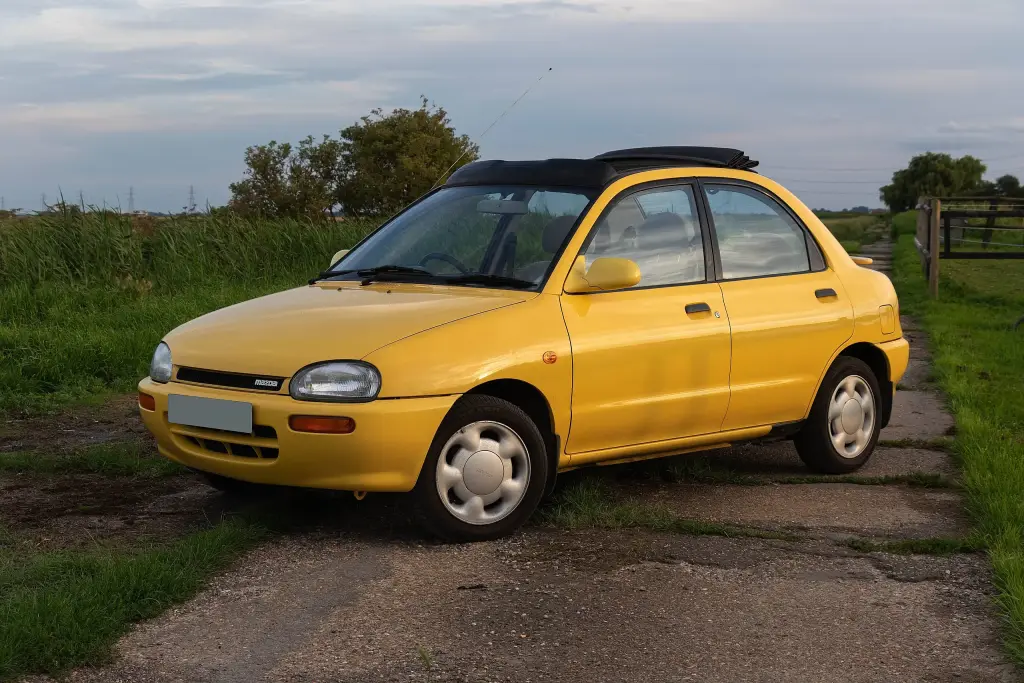
The Mazda 121 was Mazda’s European small car from early 1987 until spring 2003, when the Mazda2 replaced it. It went through three generations, two of them developed with Ford, and it also appeared in Japan as the Autozam Revue and in Australia as the 121 Metro.
Mazda 121 at a glance
| Built | early 1987 – spring 2003 |
|---|---|
| Generations | three: DA, DB and JASM/JBSM |
| First generation | DA, 1987–1991, shared with Ford Festiva and Kia Pride |
| Second generation | DB, September 1990 – June 1998; Autozam Revue in Japan |
| Third generation | JASM/JBSM, March 1996 – 2003, Ford Fiesta based |
| Earlier use of the name | 1975–1981, piston-engined versions of the Mazda Cosmo/RX-5 |
| DA engines | 1.1 (42 kW), 1.3 (40 and 44 kW) |
| DB engines | 1.1 (40 kW), 1.3 (39 and 53 kW), 1.5 (65 kW, Japan only) |
| Roof | canvas folding top offered on DA and DB |
| Successor | Mazda2 |
The name was used for several different cars; this page follows the European 121 of 1987–2003.
History of the Mazda 121
The 121 name was first used between 1975 and 1981 for piston-engined versions of the Cosmo sports coupé, but the car usually meant by the name arrived in early 1987. The DA-generation 121 was a joint project with Ford and Kia and closely resembled the Ford Festiva and Kia Pride; the European version was presented at the 1988 Geneva Motor Show. Equipment was sparse – no central locking, no electric windows, no power steering – but the interior was cleverly packaged, with a rear bench that slid forwards and backwards and could be folded to make a bed. A canvas folding roof was sold as the 121 CT, or Fun Top in Australia. A facelift in 1989 brought a new grille, instruments and seats.
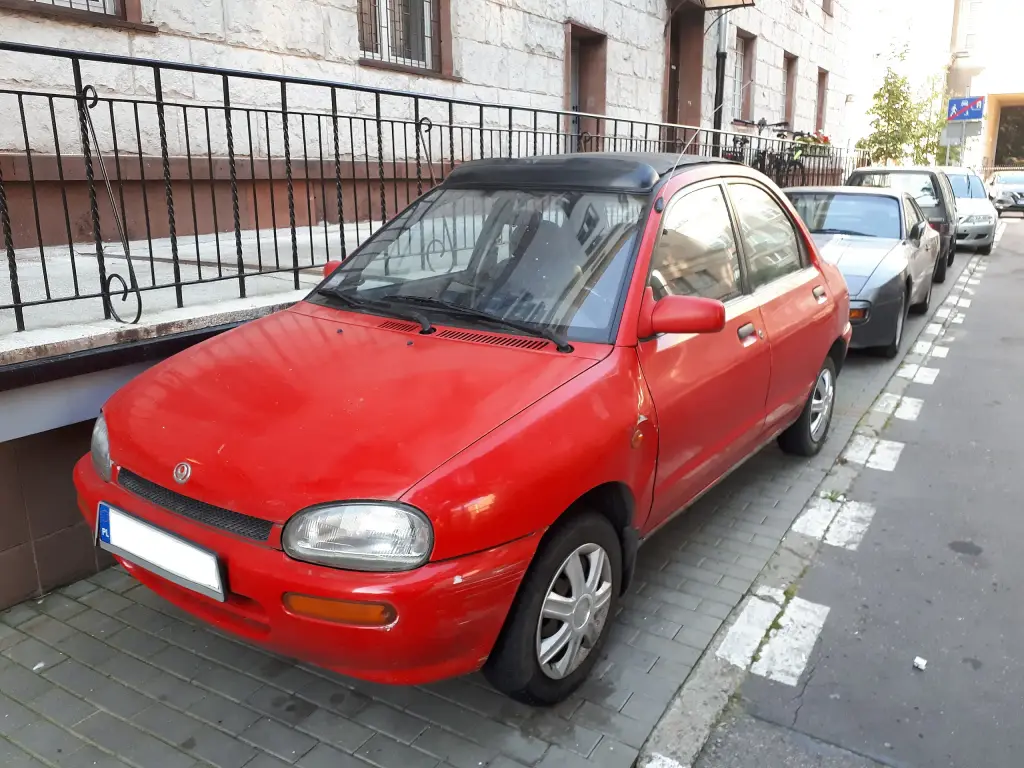
The second generation, the DB, was built from September 1990 to June 1998 and was Mazda’s own design, with a notchback rather than a hatchback; outside Europe it was the Autozam Revue, and from 1994 simply the Mazda Revue. Its rounded shape earned nicknames such as the Egg or the Bubble Car, and the idea behind it was a car without corners or edges. The interior was better finished than the DA’s, with options such as an illuminated ignition lock, central locking, front electric windows and air conditioning. The canvas top returned, now opening from either end. A 1.1-litre engine was offered in some export markets, a 1.3 in two states of tune, and a 1.5-litre 88 PS unit only in Japan.
The third generation arrived in March 1996 as the JASM five-door and JBSM three-door. It was again a joint development with Ford and shared its platform with the Fiesta, and it stayed in production until 2003. In markets where the Fiesta-based car was not sold, the first-generation Demio carried the 121 name until 2002.
Design and features
- Clever packaging: the DA’s sliding rear bench added about 20 cm of load length.
- Canvas roof: a large folding fabric top on both the DA and the DB.
- Two-way canvas top: on the DB it could be opened from the front or the rear.
- Joint development: the DA was shared with Ford and Kia, the third generation with Ford.
Mazda 121 versions
- 121 DA (1987–1991): three- and five-door hatchback, Ford Festiva twin.
- 121 CT / Fun Top: canvas-roof version of the DA.
- 121 DB (1990–1998): rounded notchback; Autozam Revue in Japan.
- 121 JASM/JBSM (1996–2003): Ford Fiesta-based three- and five-door.
The 121 was replaced by the Mazda 2 and sat below the Mazda 323 in the range. More Mazdas are in the Mazda collection.
Sources
- Mazda 121, English Wikipedia: uses of the name, 1975–2002
- Mazda 121, German Wikipedia: generations, engines, equipment